
A Viking-Age grave did not always contain only the person for whom it was apparently built.
Across Scandinavia and Scandinavian communities in Britain, Ireland and Iceland, archaeologists have repeatedly found extra fragments of human bone mixed into later burials. Some were cremated. Others were unburned. Many belonged to individuals different from the main deceased.
For decades, such fragments could be explained as accidental contamination from older graves, disturbed cemetery soil or careless excavation.
A major 2026 study argues that explanation cannot account for the wider pattern.
Archaeologist Frida Espolin Norstein of Stockholm University examined evidence from more than 85 graves at 23 archaeological sites. Her research concludes that additional human remains were often deliberately selected, moved and incorporated into new Viking-Age funerary contexts.
The implications reach far beyond unusual burial customs.
These bones suggest that Viking-Age communities did not always treat a dead body as an indivisible individual. A fragment could shift between being part of a particular person and becoming a powerful material used to transform a new grave.
More Than 85 Graves Contained Additional Human Remains
Norstein’s study, “The (De)Parted: Fragmentation and Redeposition of Human Bone in Viking Age Graves,” was published in Current Swedish Archaeology, Volume 34, in 2026.
The peer-reviewed study of Viking bone redeposition draws together evidence from more than 85 graves across 23 sites.
Its geographical range is important.
Examples occur in Scandinavia as well as places settled by Scandinavians in Britain, Ireland and Iceland.
These were therefore not isolated mistakes made at one cemetery.
Norstein identified a recurring funerary practice.
Additional remains could appear as single bones, fragments or cremated material belonging to people other than the grave’s primary deceased.
Once those cases are considered together, accidental disturbance becomes increasingly difficult to use as a universal explanation.
Archaeologists Once Treated Many Extra Bones As Contamination
Finding an older bone inside a newer grave creates an immediate archaeological problem.
Cemeteries were reused.
Grave digging could cut through older burials.
Bones might move through soil disturbance, animal activity or later excavation.
For those reasons, an apparently misplaced human fragment could easily be classified as accidental.
Norstein argues that archaeologists need to examine placement and treatment more carefully.
Repeated patterns indicate that people sometimes handled earlier remains intentionally before placing them into new funerary deposits.
That distinction changes the question.
Instead of asking how an unwanted bone entered a grave, archaeologists can ask why someone wanted it there.
Human Bone Could Become Part Of The Funeral
Modern assumptions tend to treat a corpse as belonging exclusively to one deceased individual.
Viking-Age mortuary practice could operate differently.
A body might be cremated, fragmented, moved, revisited or partially redeposited.
Fragments from an earlier person could then participate in the funeral of somebody else.
Norstein’s evidence suggests that bone could therefore acquire a role comparable to other materials placed in graves.
It might contribute to the transformation taking place during burial rather than functioning simply as the physical residue of another dead individual.
That interpretation does not mean Viking communities forgot whose bones they were handling.
Some remains may have retained strong personal associations.
Others seem to have operated differently.
The distinction between person and material could change according to context.
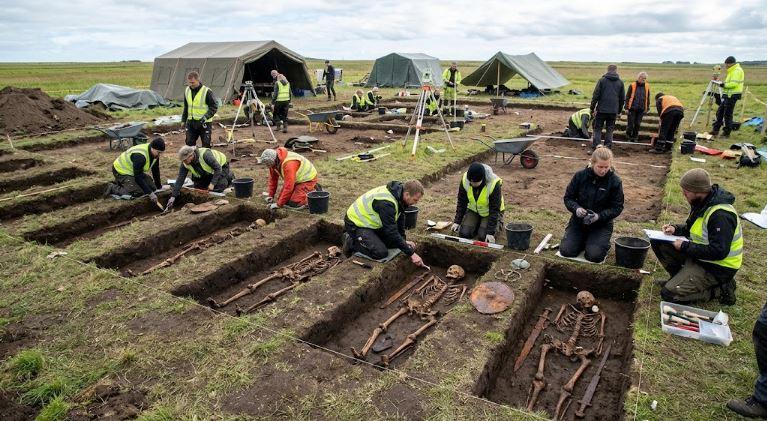
Cremated And Uncremated Bone Were Both Reused
The practice cannot be explained only through cremation.
Norstein’s dataset includes both burned and unburned human remains.
That is significant because cremation physically transforms a corpse.
Fire breaks the body into fragments and changes the appearance, texture and sometimes color of bone.
One might therefore expect cremated remains to be treated more easily as divisible material.
Yet uncremated bones could also be redeposited.
The broader pattern suggests that fragmentation itself formed part of Viking-Age relationships with the dead.
A whole body was not always required for human remains to retain ritual importance.
One fragment could be enough.
Human And Animal Bones Could Receive Similar Treatment
One of the study’s most provocative findings concerns animals.
Viking graves commonly contain animal remains.
Horses, dogs and other animals could accompany human burials, while cremated funerals sometimes mixed human and animal bones so thoroughly that separating them archaeologically becomes difficult.
Norstein notes comparable treatment of human and animal bone, including both cremated and uncremated examples.
That similarity questions a strict modern hierarchy in which every piece of human bone must represent an individual person while animal bone functions only as an offering.
Viking-Age funerals may have understood bone partly through its material properties.
Human and animal remains could participate together in creating the grave.
Bone May Have Been A Transformative Material
Norstein describes the funerary role of bone through ideas of personhood, materiality and transformation.
The key argument is not simply that Vikings respected ancestors.
Something more flexible may have been happening.
A bone could operate differently depending on where people placed it and what they did with it.
Inside one context, it remained part of a remembered individual.
After fragmentation, burning or redeposition, the same material could assume another role within a new burial.
In other words, its meaning was not fixed permanently at death.
Funerary actions could help produce that meaning.
This makes Viking graves dynamic rather than static.
They were not merely containers filled once and then forgotten.
Some Bones May Still Have Represented Known People
The material interpretation should not be pushed too far.
Norstein explicitly allows for cases in which redeposited fragments retained connections with particular individuals.
A community might know whose remains were being moved.
Relatives could potentially recover bone from an earlier grave.
A fragment might preserve an ancestral connection even after entering somebody else’s burial.
Unfortunately, archaeology rarely supplies names.
Without inscriptions or genetic evidence linking remains, identifying such relationships can be extremely difficult.
Researchers therefore need to distinguish what the archaeology demonstrates from what remains possible.
Intentional redeposition is often detectable.
The identity remembered by the mourners usually is not.
Reopening Graves Was Already Part Of Viking Mortuary Life
The new study fits a growing archaeological recognition that Viking graves could have long biographies.
Some burial monuments were reopened.
Objects could be removed or rearranged.
New burials appeared beside or inside older monuments.
Human remains could also move.
Such actions need not represent grave robbery in the modern sense.
Returning to an earlier grave might renew relationships with ancestors, transform the monument or connect a new death with an older past.
That broader context makes redeposited bone easier to understand.
A grave could remain socially active long after its first funeral.
Old Bones Could Connect A New Burial With The Past
Placing older human remains into a newer grave could create a direct physical relationship between different deaths.
Whether that relationship represented ancestry cannot always be demonstrated.
Still, older material gave a new burial a past.
The mechanism resembles a wider Viking-Age fascination with objects that already possessed biographies.
Weapons could be inherited.
Ancient objects were reused.
Old monuments attracted new graves.
Earlier materials gained new meanings when incorporated into contemporary ritual.
Human bone may have participated in the same process, although its treatment was obviously more intimate than the reuse of an ordinary object.
The practice turns memory into something physical.
The Pattern Extends Beyond Scandinavia
Finding similar practices in Britain, Ireland and Iceland adds another layer.
Scandinavian communities abroad adapted to different environments and interacted with local populations.
Their funerary customs varied considerably.
There was never one standardized “Viking funeral.”
Some people were cremated.
Others received inhumation graves.
Ships, boats, weapons, animals, jewelry and ordinary objects appeared in different combinations.
Human bone redeposition joins that diversity.
Its presence across several regions suggests that manipulating older remains belonged to a broader repertoire of possible Viking-Age funerary actions rather than one narrowly local custom.
Viking Graves Were More Complicated Than Single-Person Tombs
Archaeological language can encourage a simple formula.
One grave equals one dead person.
Many Viking burials refuse to cooperate with that model.
Multiple people can share graves.
Animal remains can intermingle with humans.
Cremated fragments may represent more than one person.
Older bones can enter newer burials.
Objects can move in and out of monuments.
That complexity is important when archaeologists reconstruct identity from grave goods.
A sword beside a body does not automatically provide a complete biography of the deceased.
Likewise, an extra skull fragment or burned bone cannot automatically be dismissed as contamination.
The grave itself was something communities constructed through relationships among bodies, objects, animals and materials.
This Changes How We Read Unusual Viking Burials
The findings also matter for sites where cultural boundaries are already difficult to interpret.
Old Norse News recently examined the Chodlik boat burial and its complicated Viking-Slavic funerary context.
Sites like Chodlik show why burial practices should not be reduced to a checklist identifying one ethnicity or belief system.
Norstein’s research makes a similar argument from another direction.
Even something as apparently straightforward as human bone could perform several roles.
Context determined meaning.
The Research Is Part Of A Larger Study Of Viking Personhood
Norstein’s work connects with her broader Stockholm University project, “Bodies of Objects: The Role of Grave Goods in the Construction of Viking Age Persons.”
The project received SEK 2,361,610 from Riksbankens Jubileumsfond.
According to the Bodies of Objects research project, the wider goal is to question simple connections between particular grave goods and fixed identities such as gender, status or profession.
The bone study extends that approach to human remains themselves.
If objects could help construct a person during burial, fragments of another body might participate in that process too.
That makes the funeral an active creation of relationships rather than a passive display of someone’s identity.
Why Vikings Put Other People’s Bones Into New Graves
No single explanation will fit every one of the more than 85 graves Norstein studied.
Some bones may have represented remembered people.
Others may have functioned primarily as potent funerary material.
Certain deposits could establish connections with earlier graves or ancestors.
Different communities undoubtedly understood them in different ways.
What the 2026 research challenges is the assumption that additional human bones were simply archaeological noise.
Across 23 sites, fragmented and redeposited remains repeatedly entered new graves in deliberate ways.
Human and animal bones sometimes received comparable treatment.
Both cremated and uncremated remains could move between contexts.
A fragment could retain personal identity in one situation while becoming transformative material in another.
That makes Viking concepts of the body considerably more flexible than modern cemetery expectations.
Death did not necessarily produce one complete individual who entered one grave and remained there permanently.
Bodies could be burned, divided, revisited and reused.
Older remains could become part of newer funerals.
The grave was therefore not always the end of a body’s story.
Sometimes it was the beginning of another one.
