Underwater Archaeological Sites Face New Risk

Concerns over underwater archaeological sites have sharpened since federal protection rules changed in the United States during 2025 and 2026. The Norse connection should be framed with care: the recent reporting did not identify a newly damaged Viking wreck or a named Norse artifact site. The concern is broader and still serious. If seabed-disturbing projects proceed with fewer automatic survey duties, poorly mapped shipwrecks, submerged artifact scatters, and older coastal cultural places may be harmed before archaeologists know they exist.

Why Underwater Archaeological Sites Face New Risk

Underwater Archaeological Sites And The Survey Gap

The key policy change began on March 14, 2025, when Congress passed Public Law 119-3, disapproving the Bureau of Ocean Energy Management rule called “Protection of Marine Archaeological Resources.” According to reporting on the change, the voided rule had required archaeological reports for oil and gas or other seabed-disturbing development plans on the Outer Continental Shelf; after disapproval, surveys were required only when a BOEM regional director had “reason to believe” archaeological resources might be present Washington Post report.

For heritage protection, that difference is not a minor filing change. A mandatory survey rule starts from the assumption that cultural material may be unknown, buried, scattered, or difficult to detect. A “reason to believe” standard can work when records are strong, but underwater records are often incomplete. Sites may sit beneath sediment, be known through oral traditions rather than mapped coordinates, or lie in areas surveyed for engineering rather than archaeology.

The Outer Continental Shelf was described in the same reporting as covering about 3.2 billion acres of marine territory off U.S. coasts. That scale matters. Even strong archaeological teams cannot assess such a vast area without predictable triggers, clear reporting duties, and enough time to evaluate what remote-sensing data may show.

Why Documentation Comes Before Protection

For underwater archaeological sites, this shift raises a basic problem: a resource usually has to be noticed before it can be avoided. Ship timbers, anchors, ballast piles, cargo, worked stone, ritual deposits, and submerged shorelines can all be damaged by seabed disturbance. Once broken, dispersed, or buried under new material, context may be lost. In archaeology, context is not an accessory. It is the evidence that allows a find to be dated, compared, and understood.

The issue is not only whether developers intend harm. Most modern seabed projects are designed around engineering, energy, transport, recovery, or extraction goals. Cultural material can be an unintended casualty when review systems are thin. That is why archaeologists often argue for survey before disturbance, not merely salvage after damage.

What Changed On The Outer Continental Shelf

From Uniform Reports To Conditional Review

Before March 14, 2025, the revoked BOEM rule would have made archaeological reporting a standard part of covered Outer Continental Shelf development plans. After the disapproval, the research record indicates that the reporting duty no longer applied uniformly. Instead, archaeological surveys depended on whether the agency had a prior basis to suspect cultural resources in the area.

That change creates a circular risk. If a site has never been surveyed, there may be little official evidence showing that it exists. If there is little official evidence, a survey may not be required. This is especially relevant below the waterline, where absence from a map often means absence of investigation, not absence of heritage.

A government review of underwater cultural heritage law described U.S. protections as fragmented and not fully able to cover every threat, especially where projects are already permitted, where no federal permit is needed, or where no resource has yet been identified federal UCH review. That assessment helps explain why the 2025 change drew concern from archaeologists and cultural advocates.

Related Delays And Review Changes

The research also points to other changes through mid-2026. On July 17, 2026, revisions offered by the Advisory Council on Historic Preservation to Section 106 of the National Historic Preservation Act were released. The notes indicate that many tribal nations and preservationists warned that the revisions would reduce Indigenous influence in protecting underwater cultural sites. In Lake Ontario National Marine Sanctuary regulations, a protection rule against grappling into or anchoring on shipwreck sites had its effective date delayed first to July 21, 2026, then to September 21, 2028, while mooring systems and stakeholder input were addressed.

These are not identical legal actions, but they point in a similar direction: protection may become more dependent on later review, agency discretion, or delayed infrastructure. For fragile submerged sites, delay can have material consequences. Anchors, grappling gear, dredging, construction, mining tools, and recovery equipment can affect remains directly, while sediment plumes and chemical alteration may affect preservation conditions indirectly.

Why Norse Heritage Belongs In The Discussion

A Cautious Norse Reading

Underwater archaeological sites are often discussed in global terms, but Norse and Viking Age evidence gives the issue a familiar form for readers of maritime history. Ships, ports, coastal movement, burial customs, and artifact exchange all shaped Norse-era life. Yet the current U.S. policy reporting did not document a specific Norse wreck destroyed by the 2025 or 2026 changes. That limit should be stated plainly.

The Norse relevance lies in analogy and risk, not in a claimed incident. Viking shipwrecks or submerged Norse artifacts along coasts would be vulnerable to the same general pressures as other unrecorded heritage: seabed development, mineral exploration, construction, and recovery activity. If a site is not precisely mapped or publicly known, a system that waits for prior evidence may fail to trigger review.

Old Norse News has often treated ships as evidence rather than decoration. Work on Viking ship reconstruction shows how practical maritime questions can test interpretations, while protected archaeological contexts remain the baseline. A reconstructed ship can teach handling and craft. A disturbed wreck can lose evidence that cannot be remade.

Memory, Evidence, And Unmapped Sites

Norse underwater archaeological sites, if present in threatened zones, would not always look dramatic at first contact. A scatter of rivets, ballast, worked wood, or associated objects may be less visible than an intact hull. The same is true for many non-Norse sites. A low-profile deposit can still hold evidence for trade, travel, repair, loss, ritual practice, or shoreline use.

This is why the absence of named Norse cases in the recent policy coverage does not remove the relevance for Norse history. It sets the boundary of what can be claimed. The responsible argument is that reduced survey duties heighten the risk to all poorly documented submerged heritage, including possible Norse or related maritime material where such remains exist.

Why Consultation And Documentation Matter

Archaeologist recording artifact positions beside underwater survey equipment

Indigenous Concerns And Shared Preservation Questions

The Washington Post reporting quoted Katrina Thompson-Upton of the Tolowa Dee-ni’ Nation as saying the loss of reporting requirements for cultural artifacts and sacred sites felt “very sad and violating.” That statement concerned Indigenous cultural places and should not be absorbed into a Norse story. It deserves to stand in its own right, because underwater heritage includes sacred sites, oral-history places, shrines, and ancestral evidence that may not fit older agency expectations of a shipwreck or artifact cache.

At the same time, the preservation principle is shared: cultural material below water is not empty space awaiting development. It may hold evidence for communities whose records were never written, or whose records were written by outsiders. For Norse studies, this is a useful reminder. Texts, sagas, and later memory cannot replace archaeological context. Material evidence needs protection before interpretation can begin.

  • Mandatory survey rules can identify unknown sites before seabed disturbance.
  • Conditional review may miss places that have not yet entered official records.
  • Delayed anchoring safeguards can prolong physical pressure on known wreck sites.
  • Consultation can bring forward knowledge that maps and databases do not contain.

Public Images And Public Responsibility

Public understanding of underwater heritage often depends on images: sonar scans, conservation photographs, museum displays, site drawings, and careful reconstructions. For readers comparing how visual presentation shapes public trust, the related network site Finest Image offers a valuable perspective on how images can act as carriers of evidence, highlighting the importance of visual evidence in the preservation of underwater heritage.

The danger for underwater archaeological sites is not only physical loss. It is also interpretive loss. If a site is disturbed without documentation, later viewers may see objects without positions, dates without secure associations, and narratives without a tested evidentiary base. In Norse studies, that problem is familiar. A sword, rivet, bead, or plank fragment gains meaning from where it was found and what it was found with.

Underwater Archaeological Sites And Norse Heritage Risk

What Can Be Said With Confidence

Underwater archaeological sites now face a policy environment in which some mandatory protections were reduced, some safeguards were delayed, and consultation rules were contested as of July 2026. The supported claim is not that a named Norse wreck has already been lost because of these changes. The supported claim is narrower: less automatic survey and reporting can increase the risk that uncharted submerged cultural heritage will be damaged before it is documented.

For Norse history and archaeology, that risk should be taken seriously but not exaggerated. Maritime evidence is central to how scholars understand movement, exchange, technology, settlement, and memory across the North Atlantic and nearby coasts. If comparable underwater material is disturbed without survey, the loss is not only an object. It is a lost relationship between object, seabed, shoreline, and human action.

The clearest response is evidence-first heritage practice: survey before disturbance where risk is plausible, transparent reporting when finds appear, consultation with affected communities, and caution about claims that outrun the record. Loosened protections make that work harder. They do not make it less necessary.

Posted in Norse History & Archaeology | Comments Off on Underwater Archaeological Sites Face New Risk

Why Swona’s Possible Viking-Era Church Could Push Orkney’s Christian Story Backward

A small ruined building on Swona may force archaeologists to look again at one of the most familiar dates in Orkney’s Viking story. During a six-day investigation in 2026, archaeologists from the Orkney Research Centre for Archaeology worked with Gordonstoun students at a site known locally as Twinly Kirk. Beneath later additions, the team uncovered structural details that fit an early medieval chapel, including a stone feature interpreted as an altar foundation.

The construction style points toward the 10th or 11th century. Researchers have not yet secured radiocarbon dates, so nobody can call Twinly Kirk a Viking-Age church with certainty.

That caution makes the potential chronology more interesting.

Later medieval narratives famously connect Orkney’s official conversion to Christianity with Olaf Tryggvason and Earl Sigurd around AD 995. A securely dated 10th-century chapel on Swona could show that Christian worship among Norse communities had already taken material form before, or very close to, that political conversion story.

Swona would not prove that Christianity arrived in Orkney for the first time during the Viking Age. Christian activity existed in the Northern Isles before Scandinavian settlement. Instead, the site could help archaeologists trace how Norse settlers adopted, maintained or reshaped Christianity before formal royal conversion narratives took centre stage.

Twinly Kirk Was Known Before Archaeologists Tested It

The 2026 discovery did not begin with archaeologists stumbling across an entirely unknown ruin.

Older maps and local knowledge already marked a place called Twinly Kirk on Swona. Scotland’s archaeological records had treated the structure cautiously for years. A Royal Commission survey described it as a possible second chapel on the island, but noted that its identification remained uncertain.

The earlier interpretation relied heavily on the building’s east-west orientation, a common feature of Christian churches. Surveyors also noticed relatively good masonry and a linear feature that isolated the surrounding headland.

Those details suggested a church without proving one.

The new excavation supplied physical evidence that earlier surface survey could not provide.

According to the UHI Archaeology Institute’s Swona excavation report, the ORCA team uncovered a stone-built feature that researchers believe formed the foundation of an altar. Its construction resembles early medieval building traditions associated with the 10th and 11th centuries.

That discovery transforms Twinly Kirk from an intriguing map label into a testable archaeological site.

The national archaeological record shows why that distinction matters. Canmore’s archaeological survey of Swona previously described Twinly Kirk as more uncertain than St Peter’s Chapel elsewhere on the island.

Excavation has now strengthened the religious interpretation, but dating remains the next major test.

A Step Toward An Altar Makes The Church Interpretation Stronger

Gordonstoun’s account provides more architectural detail from the excavation.

Dan McLean, who organized the expedition, explained that later construction had altered the visible ruins enough to make the site look more recent. Once the team cleared vegetation and opened a test pit, they exposed a stone step immediately beneath the surface.

That step led toward the feature interpreted as the altar area.

Researchers considered several details together: the building’s layout, orientation, construction technique and dry-stone walls. The builders used neither clay bonding nor mortar in the section investigated.

Gordonstoun’s Twinly Kirk project report says the design resembles churches from the 10th and 11th centuries in the Northern Isles and elsewhere around the Irish Sea, including Lewis and the Isle of Man.

Architecture can suggest a date range, but it cannot lock down a calendar year.

Paul Clark, ORCA senior projects manager, made the next stage clear. The team collected samples that may reveal what activities took place around the building and, if suitable material survives, produce radiocarbon dates.

Those dates carry unusual historical weight.

A result in the 11th century would still place Twinly Kirk among early Norse Christian sites. A secure 10th-century date could become far more disruptive to the traditional timeline.

Vikingchurch

AD 995 Has Long Dominated Orkney’s Conversion Story

One date appears repeatedly in accounts of Norse Christianity in Orkney: AD 995.

Later written tradition connects that year with the Norwegian king Olaf Tryggvason and Earl Sigurd Hlodvisson, better known as Sigurd the Stout. According to the conversion narrative preserved in medieval sources, Olaf forced Sigurd to accept baptism during an encounter in the Northern Isles.

The episode created a convenient dividing line.

Before 995, the simplified story presents Norse Orkney as pagan. After 995, Christianity becomes the official faith associated with its rulers.

Archaeology has long complicated that sequence.

The problem starts with the written evidence itself. Medieval authors recorded stories about Olaf generations after his reign. Modern scholarship treats many details of his conversion campaigns cautiously, since royal conversion narratives often compress slow social change into a single dramatic confrontation.

Material evidence provides another timeline.

Christianity existed in Orkney before Viking settlement, and Scandinavian settlers entered a landscape where Christian communities, traditions and sacred places already had histories. Norse contact with Christian Britain, Ireland and continental Europe gave settlers further exposure to the religion.

For readers following comparable North Atlantic evidence, the same source problem appears in Old Norse News coverage of the Faroe runestone and conversion evidence, where archaeology can reveal Christian practice without reducing religious change to one royal event.

Swona could sharpen that distinction in Orkney.

A church built by a Norse-period community before 995 would turn the famous conversion episode into one stage of a longer process rather than Christianity’s starting point.

Brough Of Deerness Already Warns Against A Simple Conversion Date

Twinly Kirk would not stand alone if radiocarbon dating places it in the 10th century.

The Brough of Deerness, on Orkney Mainland, has already produced evidence that complicates any sharp pagan-to-Christian boundary.

Excavations there during the 1970s revealed a chapel with more than one construction phase. Archaeologists identified evidence for an earlier timber structure followed by stone construction. A 10th-century coin appeared within the sequence between phases.

The excavation report published by the Society of Antiquaries of Scotland discusses both the chapel and the settlement around it. Researchers debated whether the surrounding buildings belonged to a monastic establishment or a secular Norse community gathered around a church.

That uncertainty still matters.

The Brough of Deerness excavation study shows that finding a chapel does not automatically identify the social group that built or used it. A small church could serve a household, elite estate, religious community or mixed settlement.

Swona presents the same challenge.

Gordonstoun has raised the possibility that Twinly Kirk belonged to a larger monastery, partly because it occupies an inhospitable part of the island and sits near other landscape features.

At present, archaeology has not demonstrated a monastery.

Researchers will need evidence for surrounding buildings, burials, domestic activity and chronology before they can move from “chapel” to “monastic complex.”

The stronger claim remains simpler: Twinly Kirk may preserve an early Christian building used during Orkney’s Norse period.

Swona’s Location Makes The Chapel More Than An Isolated Ruin

Swona occupies a strategic place in the Pentland Firth between Orkney and mainland Scotland.

The island covers about 92 acres and sits roughly seven miles north of John o’ Groats. Its modern isolation can hide how useful such a location could have been within earlier maritime networks.

Ships moving between northern Scotland, Orkney and wider North Atlantic routes had to deal with some of Britain’s strongest tidal waters.

A small island in that channel could support farming, navigation, landing places, lookout points and religious activity.

The 2026 project found evidence that may represent more than a church. Gordonstoun reports that researchers investigated a probable medieval farm and a circular ditch interpreted provisionally as the location of a Viking warning beacon. Magnetometry work also targeted Warbister Hill.

Another area may preserve a prehistoric settlement.

Swona therefore contains a sequence of human activity spanning thousands of years rather than one isolated Norse ruin.

The volunteer-run Swona Heritage archaeology record documents prehistoric cairns, possible settlements, ecclesiastical sites, croft remains, field systems, fishing structures, piers and other features across the island.

That wider landscape could change how Twinly Kirk gets interpreted.

A church next to active farms and maritime infrastructure would tell a different story from a solitary hermitage. A chapel associated with an enclosed religious community would raise another set of questions.

Only further fieldwork can distinguish those possibilities.

The Possible Monastery Requires More Evidence

The word “monastery” attracts attention, yet it deserves restraint at Swona.

Gordonstoun notes that Twinly Kirk stands in one of the island’s less hospitable areas and suggests that its location may fit a larger religious establishment. Nearby cairns and a wall cutting off access to a landing place add to the puzzle.

Those features do not yet prove monastic occupation.

Early medieval religious communities often selected islands, headlands and remote coastal places, but secular Norse communities used exposed maritime locations too. An isolated setting cannot identify the people who lived there.

Archaeologists need patterns.

A monastic interpretation would become stronger if future work uncovered associated cells, communal buildings, distinctive burials or evidence for an enclosure tied securely to the chapel. Environmental samples might reveal diet or land use. Radiocarbon dating could establish whether nearby structures belonged to the same phase.

The next Swona investigation may address some of those questions. Gordonstoun has indicated plans for follow-up work after the 2026 season.

Comparative archaeology offers useful warnings. At Brough of Deerness, scholars once considered the group of buildings around the chapel evidence for a Norse monastery. Excavation later left open the possibility that secular buildings surrounded a religious structure.

Swona should receive the same treatment.

Calling Twinly Kirk a possible chapel reflects the present evidence. Calling the wider complex a monastery remains a hypothesis.

Christian Orkney Did Not Begin With The Norse

If Twinly Kirk dates before 995, the discovery would push one part of Orkney’s Norse Christian story backward. It would not push Christianity’s first appearance in Orkney backward by the same amount.

The islands already had Christian traditions before Scandinavian settlers arrived.

That distinction separates two related questions: when did Christianity reach Orkney, and when did Norse communities in Orkney adopt Christianity?

Archaeologists cannot answer them with the same evidence.

Pre-Norse Christianity belongs to the Pictish and early medieval history of the Northern Isles. Norse settlement created a new political and cultural situation from roughly the late eighth and ninth centuries onward. Christian practice could have survived, mixed with incoming Scandinavian traditions or attracted Norse converts long before an earl formally accepted baptism.

Research across Scotland increasingly treats conversion as a process rather than a switch.

Historic Environment Scotland makes that long chronology visible at sites where early Christian and Viking-period archaeology overlap. The organization’s record for Nave Island’s Christian and Viking landscape stresses the research value of examining interactions between early ecclesiastical activity and Viking settlement.

Orkney presents an especially strong case for that approach.

Its Norse settlers did not enter a religious vacuum.

A 10th-century Twinly Kirk could show that some Scandinavian communities participated in Christian worship before later histories placed formal conversion under royal control.

Radiocarbon Dating Could Decide How Far Back Twinly Kirk Goes

The headline around Swona depends on evidence that researchers do not possess yet.

No published radiocarbon result has securely dated Twinly Kirk to the 10th century as of September 7, 2026.

Researchers currently rely on architectural comparison, layout, orientation and construction method.

Those clues support a 10th- or 11th-century interpretation, but the difference between those centuries changes the historical argument.

An 11th-century result would place the chapel after the traditional AD 995 conversion episode. Twinly Kirk would still add a rare early church to Orkney’s Norse archaeological record.

A date around the late 900s would create a closer contest with the traditional chronology.

Material securely predating 995 could strengthen the case that Norse Christian worship existed before Olaf Tryggvason’s supposed enforcement of conversion on Earl Sigurd.

Researchers must date the correct archaeological context too.

A sample from later activity cannot automatically date the original chapel. The strongest result would connect short-lived organic material directly with the structure’s construction or earliest use.

That methodological detail explains why the ORCA team has avoided declaring the question solved.

Architecture creates the hypothesis.

Radiocarbon evidence may decide whether the chronology supports it.

Why Swona Could Change Orkney’s Christian Map Without Rewriting Everything

Twinly Kirk matters precisely because it sits between archaeology and a famous historical narrative.

Later sources give Orkney a dramatic conversion moment around AD 995. Archaeological evidence points toward a messier reality in which Christian practice, Norse settlement and political conversion overlapped.

Swona could add a new location to that map.

The 2026 excavation exposed a step and probable altar foundation beneath later building phases. Its dry-stone architecture, east-west orientation and layout resemble early medieval churches from the Northern Isles and wider Irish Sea zone. Researchers collected samples that may eventually establish a scientific date.

No result yet proves a 10th-century foundation.

That limit keeps the discovery from becoming evidence for a specific pre-995 church today.

Its potential remains substantial.

If future dating confirms construction before the traditional conversion of Earl Sigurd, Twinly Kirk would strengthen the argument that Norse Christianity in Orkney developed from communities on the ground rather than arriving fully formed through one king’s command.

A later date would still matter. An early 11th-century chapel on a small Pentland Firth island would show how quickly Christian architecture spread through Norse Orkney after the turn of the millennium.

Either outcome improves the map.

The more disruptive possibility lies at the early end of the dating range.

Swona may eventually show that by the time medieval storytellers placed Christianity in the hands of Olaf Tryggvason, people in Orkney had already started building parts of that Christian landscape for themselves.

Posted in Literature & Texts, Mythology & Culture, Norse History & Archaeology | Comments Off on Why Swona’s Possible Viking-Era Church Could Push Orkney’s Christian Story Backward

Norse Racial Narratives in Melton’s Research

Norse Racial Narratives are not a side issue in Zachary J. Melton’s recent work; they are central to his study of how Old Norse literature was received, reshaped, and used in the United States. His research asks a difficult but necessary question: how did medieval texts about Vinland become part of later claims about whiteness, masculinity, religion, and American origins? The answer, in Melton’s argument, lies less in the medieval sagas alone than in the nineteenth- and twentieth-century readers who reinterpreted them for their own cultural purposes.

How Norse Racial Narratives Enter Melton’s Study

Norse Racial Narratives And The Vinland Frame

Melton’s September 2024 article, Race, Religion and the Medieval Norse Discovery of America, published in Religions, examines how Carl Christian Rafn’s 1837 Antiquitates Americanæ introduced the Vinland sagas to Anglo-American audiences in ways that appealed to existing prejudices. Melton argues that Rafn’s presentation helped connect Old Norse literature with later white supremacist discourse, especially through claims about Norse priority in America and the imagined religious identity of early European discoverers (Melton in Religions).

This point is valuable because it separates medieval narrative from modern use. The sagas did not arrive in U.S. culture as neutral artifacts. They were filtered through antiquarian scholarship, nationalist desire, racial thinking, and Protestant cultural memory. Norse Racial Narratives in this sense are reception histories: they show how people used old texts to authorize newer social claims.

Rafn, New England, And White Origins

According to Melton’s research, Rafn located Vinland in southern New England and interpreted material such as Dighton Rock and traditions around “White Man’s Land” as signs of Norse contact. Melton treats these interpretations as part of a wider argument in which some nineteenth-century writers imagined an ancient white presence in America before Columbus.

That argument had consequences. If Leif Eriksson could be framed as the “true discoverer” of America, then discovery itself could be recast in religious and racial terms. Melton identifies this as part of a white supremacist-nationalist myth of origins. The caution for readers is clear: a medieval travel narrative can become something quite different when later readers use it to justify modern identity claims.

From Antiquarian Claims To U.S. Popular Culture

The 1837 Starting Point

Melton’s PhD dissertation, An Excuse for Violence: The Viking Image, Race, and Masculinity in U.S. Popular Culture, was completed at the University of Iceland in January 2023. The dissertation traces American reception of Norse literature from 1837 to 2017. Its scope matters, since Melton does not treat racialized Viking imagery as a recent accident. He follows a long line from antiquarian argument into adventure fiction, film, and wider popular culture.

His wider research profile identifies recurring concerns with race, gender, civilization, destiny, fiction, film, travel writing, and popular uses of the Norse past (Melton’s research profile). For a cautious reader, this is a reminder that reception history is not the same as medieval history. It studies what later communities did with medieval material, not simply what the medieval material originally meant.

Fiction, Masculinity, And Hierarchy

In the dissertation, Melton analyzes Ottilie Liljencrantz’s The Thrall of Leif the Lucky, published in 1902, and Edison Marshall’s The Viking, published in 1951. Based on the research notes, he argues that both novels express racial and gender hierarchies. Liljencrantz’s novel intersects with Victorian ideals and manifest destiny, while Marshall’s includes explicit scenes of sexual violence.

These examples show why Norse Racial Narratives cannot be studied through saga manuscripts alone. The later novelists did interpretive work of their own. They selected, emphasized, softened, or exaggerated elements of Viking imagery to fit U.S. assumptions about manliness, conquest, social rank, and “civilization.” That does not make every modern retelling identical, but it does show why scholars ask who is doing the retelling and what cultural work the Viking image is being asked to perform.

Readers interested in nearby public-facing interpretation may compare this with Old Norse News coverage of Vikings in pop culture, where entertainment, identity, and evidence often meet uneasily.

Why Symbols And Reception Require Caution

Carved runic shapes on stone photographed in neutral museum light

The January 6 Example

Melton’s 2024 article also discusses the aftermath of the January 6, 2021 U.S. Capitol riot, which resulted in five deaths. The research notes state that Norse symbols, including runes, Thor’s Hammer, and the Valknut, were visible among some protesters, including the figure often called the “QAnon Shaman.” Melton analyzes such appearances as part of a larger pattern in which Old Norse mythology is used in extremist contexts.

This is a sensitive area and deserves restraint. A symbol’s presence in an extremist setting does not mean every use of that symbol carries the same meaning. Thor’s Hammer, runes, and other Norse-derived signs appear in many cultural, religious, artistic, and educational settings. Melton’s point, as represented in the research, is about appropriation and reception: certain groups have used Norse material to support racialized and masculinist ideas.

What The Evidence Can And Cannot Say

The evidence can show how later writers, activists, antiquarians, and popular media figures framed the Viking past. It cannot, by itself, reduce medieval Norse literature to a single modern political meaning. That distinction is essential. The Vinland sagas are medieval texts with their own literary settings, transmission histories, and interpretive problems. Rafn’s 1837 edition and the later U.S. reception are separate historical stages.

Melton’s work is especially useful because it tracks the linkages between Vikings, whiteness, masculinity, pseudo-scientific race thinking, colonial imagination, and adventure literature over time. His research notes stress that these linkages were not invented only in the twenty-first century. They have roots in nineteenth-century antiquarianism and U.S. literary culture, and they were recycled into newer media.

  • Rafn’s 1837 work helped frame Vinland for Anglo-American readers.
  • Late nineteenth- and early twentieth-century U.S. writing connected Norse discovery claims with race, religion, and destiny.
  • Popular fiction used Viking imagery to stage ideas about masculinity, hierarchy, violence, and “civilization.”
  • Modern extremist use of Norse symbols draws on older interpretive patterns, though not every modern use of such symbols is extremist.

Additionally, Bethel NC UMC provides a contrasting community-centered interpretation within the same publishing network, highlighting how public understanding varies with audience and intent.

Norse Racial Narratives And Responsible Reading

Norse Racial Narratives matter because they show how the past can be recruited for causes the medieval sources themselves did not create. Melton’s recent research asks readers to look at the chain of interpretation: saga material, Rafn’s antiquarian claims, U.S. racial thinking, adventure fiction, gender ideology, and modern symbolic use. Each link needs to be examined on its own terms.

For students of Norse literature, that approach is bracing and useful. It does not ask us to abandon the sagas or treat Viking Age studies as suspect by default. Rather, it asks us to read with sharper questions. Who edited the text? Who translated it? Who placed Vinland in New England? Who used Leif Eriksson to compete with Columbus? Who turned Viking masculinity into a model of conquest? Who benefits when medieval literature is made to speak in modern racial terms?

The most responsible reading keeps two truths together. First, Old Norse texts are historically significant literary sources that deserve close study. Second, their modern reception has sometimes been shaped by racial, religious, and gendered agendas. Melton’s contribution is to make that reception visible, so that scholars and general readers can recognize the difference between medieval evidence and later invention.

Posted in Literature & Texts | Comments Off on Norse Racial Narratives in Melton’s Research

Why Rebild’s Record Viking Silver Hoard Could Rewrite How Denmark Counted Wealth

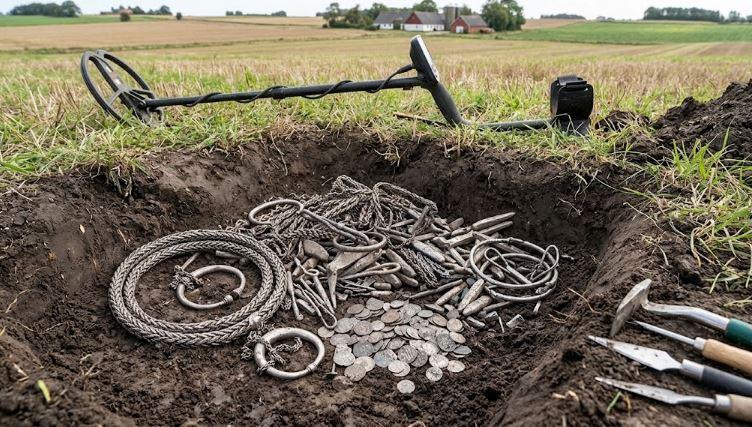
Denmark’s largest known Viking-Age silver hoard has turned an ordinary garden in Rebild into one of the country’s most revealing economic archives. Nordjyske Museer announced the discovery at the end of August 2026 after a homeowner encountered silver while preparing ground for a new terrace. Archaeologists eventually documented about 18.5 kilograms of silver comprising roughly 700 objects and fragments.

The sheer weight makes the find exceptional. The previous Danish record holder, the Terslev Hoard, weighed about 6.5 kilograms. Rebild therefore contains nearly three times as much silver.

Size alone does not explain why the hoard matters.

Silver bars dominate much of the assemblage. Archaeologists also identified bracelets, cut silver, 47 whole coins and coin fragments, a small Thor’s hammer and an ingot carrying a possible runic inscription. Several groups of objects cluster around recurring weights.

That pattern turns Rebild into evidence for a Viking economy in which people could measure wealth on scales rather than count a fixed number of coins.

The discovery does not overturn everything historians know about Viking money. Denmark’s National Museum has long documented payment by silver weight. Rebild gives that model an extraordinary new dataset: 18.5 kilograms of wealth deliberately gathered, divided, organized and hidden in 10th-century northern Jutland.

An 18.5-Kilogram Hoard Changes The Scale Of The Evidence

A private garden owner discovered the first objects while excavating for a terrace in Rebild, North Jutland. The finder has remained anonymous.

Nordjyske Museer later established that the material represented Denmark’s largest known Viking-Age silver hoard.

According to the museum’s Rebild Viking silver hoard report, the complete assemblage weighs about 18.5 kilograms and contains roughly 700 objects and fragments. Around 320 pieces weighing 6.4 kilograms remained inside the original clay vessel. Soil disturbance had scattered the remaining silver around the deposit.

The contents include numerous silver ingots, bracelets and pieces of deliberately cut silver alongside coins and other objects.

Those numbers matter.

A hoard of a few coins can document contact, chronology or personal savings. Eighteen and a half kilograms raises questions about wealth accumulation on another level. Somebody acquired enough precious metal to represent a substantial reserve and then placed it underground.

Archaeologists cannot yet identify that owner.

The modern built environment around the findspot limits the possibility of a large excavation, which leaves the immediate archaeological context uncertain. Nordjyske Museer notes several possibilities: the hoard could have lain near a Viking settlement, beside an old route or in a deliberately secluded location.

That uncertainty prevents a direct claim about whether a merchant, landholder, political elite or another person controlled the silver.

The composition still reveals how its owner organized value.

Rebild Shows Why Viking Wealth Was Weighed Before It Was Counted

Modern readers tend to think about money through denomination. A coin carries an assigned value, and people count how many coins they possess.

Much Viking-Age silver operated differently.

Denmark’s National Museum explains in its overview of Viking silver hoards that silver itself served as a central form of currency. Traders could weigh the metal during a transaction and cut off the amount they needed.

Form mattered less than weight and silver quality.

That system explains why Viking hoards often combine objects that seem incompatible to modern eyes. A finished bracelet might sit beside an ingot, a foreign coin and a chopped fragment of another ornament. Each object could retain artistic, social or symbolic importance, yet all could enter an economic system based on precious-metal content.

Rebild makes this practice unusually visible.

Torben Sarauw, cultural heritage director and archaeologist at Nordjyske Museer, has drawn attention to the dominance of bars, jewelry and cut silver in the deposit. Coins account for only a small share of its total weight.

Researchers have found another clue inside the numbers. Many of the silver bars fall into particular weight groups. Parts of the bracelets and cut silver show comparable clustering.

That pattern suggests organization rather than a random heap accumulated without measurement.

The person who buried the hoard may have thought about the collection as units of usable silver.

For an article about how Denmark “counted” wealth, that distinction matters most. Viking owners could calculate value without needing every piece to carry a ruler’s portrait, mint name or standardized denomination.

A scale could turn an ingot, ornament or foreign coin into measurable purchasing material.

Vikingsilver


The Erritsø Hoard Shows That Weight Standards Were Already Structured

Rebild does not stand alone.

Other Danish silver finds have shown that Viking-Age weight systems could follow recognizable units. The National Museum’s study of the Erritsø silver hoard offers a useful comparison.

A farmer found that hoard near Fredericia in 1884. It contained three complete silver rings, two ring fragments and five ingots, with a total weight of 1,308 grams.

The weights proved especially revealing.

Complete rings weighed around 198 to 201 grams, and the combined fragments followed a similar unit. The five ingots clustered around roughly 100- and 200-gram weights.

National Museum researchers have linked those values with a weight standard related to the Persian pound, demonstrating how Scandinavian silver practices could connect with much wider economic systems.

Rebild now gives archaeologists a far larger body of material for similar analysis.

Its silver bars do not merely demonstrate that Vikings owned ingots. Their weight groupings may help researchers test how consistently people divided and stored silver in 10th-century Denmark.

Future measurements could show whether particular units dominate the collection, whether different object types conform to the same standards and whether Rebild matches patterns found elsewhere in Scandinavia.

That work could sharpen our picture of Viking accounting.

People did not need written ledgers or piles of uniform national currency to maintain structured stores of value. Weights, scales and recognizable metal units could create their own form of financial organization.

Cut Silver Turns Destruction Into Economic Evidence

One of the easiest mistakes to make with Viking silver involves broken objects.

A chopped bracelet or divided coin can look damaged.

In an economy based on weight, cutting could represent use.

The National Museum’s account of Viking-Age trade explains that traders used balances and weights to determine how much silver a transaction required. Coins, bars and jewelry could all participate in that process.

A person could cut a piece from a larger silver object until the scale reached the required value.

Rebild contains many such fragments.

Their presence helps explain why the hoard should not be interpreted as a jewelry collection with a few damaged pieces mixed in. Much of the material belonged to an economic system that treated precious metal as divisible.

That fact changes how archaeologists interpret beauty and value.

A decorated bracelet could function as adornment at one moment and become weighed silver later. A coin might arrive in Denmark carrying a foreign king’s authority, then enter an exchange where its metal mattered more than its denomination. An ingot represented value in an even more direct form.

Old Norse News has examined a related problem in its discussion of Norse identity artifacts and silver exchange, where foreign coins and hacksilver show how objects could cross political and cultural borders before entering Scandinavian stores of wealth.

Rebild makes that mobility tangible on a record scale.

The hoard did not separate “money,” “jewelry” and “scrap” as neatly as a modern collection might.

Silver linked those categories.

Forty-Seven Coins Still Matter Even In A Weight Economy

Saying that Viking wealth depended heavily on weight does not make coins irrelevant.

Rebild contains 47 complete coins and coin fragments. Some originated in the Islamic world, while others came from Anglo-Saxon England.

Their origins give archaeologists two different kinds of information.

First, the coins help date the deposit.

Nordjyske Museer identifies two Anglo-Saxon pennies struck during the reign of Edward the Elder, king from 899 to 924. Since those coins had to circulate before they reached Rebild, the hoard cannot predate their production.

National Museum curator Kirstine Pommergaard has highlighted an especially striking York coin dated to approximately 921–925. It belongs to the Anglo-Viking St Peter coinage.

The British Museum preserves an example of this St Peter coinage from Viking York, showing the unusual combination of a sword, Thor-like hammer imagery and a Christian reference to St Peter.

The Rebild example brings religious symbolism and economic circulation into the same object.

A coin could communicate political or religious messages where somebody minted it. Once it crossed the North Sea, another user might accept it primarily for its silver weight.

That difference separates minting authority from practical value.

Coins matter as documents, even where people treated them as metal.

Their inscriptions reveal rulers and places. Their dates establish chronological limits. Their distribution maps movement.

Rebild therefore does not prove that coins lacked meaning. It shows that coin identity and silver value could operate at the same time.

Arabic Dirhams Connect Rebild To Silver Moving Across Eurasia

The eastern coins extend the map much farther.

Rebild contains Islamic silver dirhams, a familiar component in many Scandinavian Viking-Age hoards.

The National Museum’s account of silver routes into Denmark explains that large quantities of Islamic silver reached Scandinavia through trading systems connected with territories around the Russian river routes.

Mints in places such as Samarkand and Tashkent produced huge quantities of dirhams. Traders circulated them through networks associated with the Volga and Don before silver moved farther west and north.

By the 10th century, some of that metal had reached Denmark.

Rebild preserves the end result.

A piece of silver could begin as a coin in the Islamic world, cross several political and linguistic zones, enter Scandinavian exchange and eventually finish in a clay pot in northern Jutland.

Some dirhams arrived intact. People cut others into fragments.

That treatment provides another warning against reading Viking coin finds through modern currency habits. A fragmented dirham did not necessarily become worthless. Cutting could make its silver easier to divide by weight.

The Rebild owner apparently assembled value from several geographical directions.

English coins came from the west. Islamic silver pointed east. Scandinavian jewelry and ingots formed other parts of the collection.

The resulting hoard looks less like a purse filled with one currency than a reserve built from globally mobile precious metal.

The Possible “Hutu” Rune Adds Ownership Without Solving It

Among hundreds of silver pieces, one ingot carries a small but puzzling human mark.

Archaeologists have identified runes scratched into its surface. Nordjyske Museer says researchers may read the inscription as “hutu,” though its meaning remains uncertain.

Possibilities include a personal name or ownership mark.

No secure interpretation exists yet.

That restraint matters.

Runes invite dramatic storytelling, especially when a find already contains Thor imagery and foreign coins. The inscription cannot currently name the hoard’s owner or explain why somebody buried the silver.

Its presence still tells us something useful.

A standard-looking ingot could carry an individual mark. Someone cared enough about a piece of silver to inscribe it.

That act may point toward ownership, identification, accounting or another form of distinction within a metal economy.

If later runological study clarifies the reading, the ingot could provide a rare link between an economic object and the people who handled it.

For now, “hutu” belongs in the evidence as a question rather than an answer.

Rebild Already Had A Major Viking Silver Hoard Before 2026

The location becomes even more striking once the new discovery enters the local archaeological record.

Another substantial silver hoard appeared in Rebild in 1971.

That earlier deposit weighed close to four kilograms and also dated to the 10th century. It contained ingots, chopped jewelry and smaller silver fragments. The owner had wrapped the material in animal hide before burial.

Two major Viking silver deposits from the same area demand attention.

Nordjyske Museer does not claim that the two belonged to the same household or represented a single historical event. The evidence cannot support that level of precision.

The repetition still changes how archaeologists view Rebild.

A landscape that produced one unusual hoard might reflect an isolated event. Multiple large stores of 10th-century precious metal strengthen the case that the area participated deeply in Viking-Age economic networks.

The new silver discovery gains another local comparison from the Rold Hoard, found earlier in 2026. That deposit contains six intact Viking-Age gold arm rings weighing 762.5 grams in total.

Gold and silver may signal different practices.

Nordjyske Museer contrasts Rebild’s weight-based silver economy with the Rold gold rings, which point more strongly toward status and elite display.

Together, the finds make the Rebild area unusually rich for studying how Viking society stored different forms of wealth.

Eighteen And A Half Kilograms Still Cannot Tell Us Why Someone Buried It

A treasure hoard creates one question that archaeology rarely answers easily.

Why did the owner put it underground?

Possible explanations include safekeeping during instability, temporary storage, concealed wealth or ritual deposition.

The current evidence cannot choose securely among them.

Modern construction around the Rebild findspot prevents archaeologists from opening a large surrounding excavation. Without a broader settlement context, researchers cannot determine whether the deposit sat beside a hall, workshop, farm, roadway or secluded landmark.

That limitation should remain part of the story.

Calling the silver a merchant’s fortune, royal treasury or ritual sacrifice would move beyond the evidence available in September 2026.

The hoard itself provides stronger ground.

It documents metal selection, weight organization, international coin movement, jewelry fragmentation and storage practices. Those features allow archaeologists to study economic behavior without needing to identify the person who buried the vessel.

The unanswered burial question may stay open for years.

Its economic evidence exists now.

Denmark’s Danefæ System Will Shape What Happens Next

The Rebild silver does not remain private property simply because a homeowner discovered it.

Denmark classifies archaeological objects of particular cultural importance as danefæ, or treasure trove. The National Museum administers that system.

National Museum danefæ guidance explains that precious-metal archaeological finds, coins and culturally important objects must enter the national process because qualifying material belongs to the state.

A Viking silver hoard of this scale clearly enters that framework.

Nordjyske Museer has sent the Rebild material to the National Museum for assessment and study. Specialists can now examine the coins, weigh individual silver pieces, analyze inscriptions and investigate the assemblage as a complete economic deposit.

Nordjyske Museer hopes the hoard may eventually return to North Jutland for permanent display at Vikingemuseet Fyrkat. Museum officials have discussed presenting it beside the six gold arm rings from the 2026 Rold discovery.

No final exhibition arrangement should be treated as settled yet.

Security, conservation and National Museum requirements will affect what happens next.

Research will come first.

Why Rebild Could Change How We Picture Viking Wealth

The Rebild hoard does not tell historians that Vikings suddenly stopped counting coins and started weighing silver. Scholars already knew that Viking-Age Scandinavians used weighed silver.

Its importance lies in scale, structure and composition.

Eighteen and a half kilograms gives researchers a record-sized Danish assemblage in which ingots, cut jewelry, fragments and coins all entered one stored reserve. Weight groupings among the bars and other pieces suggest deliberate organization. Islamic and English coins connect that reserve with economic routes stretching far beyond Denmark.

The small Thor’s hammer adds another category of object. The possible “hutu” inscription adds another human trace. The York coin links Christian and Norse symbolism to a monetary object produced in Viking-controlled England.

None of those pieces needs to tell the whole story.

Together, they show how differently value could work.

A Viking-Age owner did not have to ask only, “How many coins do I have?” A more useful question could have been, “How much good silver do I have?”

That distinction turns Rebild from a record treasure into an economic document.

The hoard could give researchers enough material to test weight standards across hundreds of objects, compare ingots with hacksilver and jewelry, and examine how foreign coinage entered Danish silver circulation during the 10th century.

Rebild therefore matters less for the modern headline value of 18.5 kilograms of precious metal than for what those kilograms preserve.

They record a system in which a bracelet could become payment, a foreign coin could become weighed silver, an ingot could carry a rune, and wealth from several regions could end up measured together before someone buried it beneath the soil of North Jutland.

That is the part of the discovery capable of refining how Denmark’s Viking economy gets counted.

Posted in Literature & Texts, Mythology & Culture, Norse History & Archaeology | Comments Off on Why Rebild’s Record Viking Silver Hoard Could Rewrite How Denmark Counted Wealth

Vikingmania Exhibit and Modern Norse Memory

The Vikingmania Exhibit at the Museum of Danish America in Elk Horn, Iowa, offers a useful case study in how modern audiences learn to see Norse heritage through both evidence and popular culture. The museum states that Vikingmania! runs from May 11, 2026, to April 23, 2027, and that it places authentic Viking artifacts beside Viking-themed objects from the nineteenth through twenty-first centuries to examine modern perceptions of Vikings Museum of Danish America. That pairing is not a minor display choice. It asks visitors to consider how helmets, ships, warriors, gods, television characters, souvenirs, and museum cases all take part in shaping public memory.

What The Vikingmania Exhibit Places Side By Side

Why The Vikingmania Exhibit Matters As A Pairing

The Vikingmania Exhibit matters because it does not treat the Viking Age as a closed historical subject separated from later imagination. By placing artifacts near later Viking-themed material culture, the exhibit shows that “Viking” has become a cultural label as well as a historical term. The Viking Age belongs to the past, but the word “Viking” also circulates through entertainment, branding, costume, tourism, literature, games, and personal identity.

That is both useful and risky. Popular culture can make Norse subjects approachable for people who would not begin with a runic inscription or a typological study of brooches. Yet the same images can flatten the past into repeated signals: horned or heavy helmets, violent masculinity, gods as fantasy figures, and ships as shorthand for raiding. The museum’s format invites the viewer to see those signals as objects with their own dates, makers, and audiences.

Objects As Arguments, Not Props

A cautious reading begins with the objects. Authentic artifacts can tell us about craft, trade, status, wear, burial practice, and contact, depending on context. Modern Viking-themed objects tell us different things: what later societies wanted Vikings to mean. One kind of object is not more “alive” than the other, but they answer different questions.

This distinction is central to responsible public history. A nineteenth-century or twenty-first-century Viking image is not direct evidence for the Viking Age. It is evidence for later reception. If a display keeps that boundary clear, it can show how modern Norse identity is made, remade, and debated without asking artifacts to support stories they cannot bear. This issue also connects with Old Norse News coverage of Vikingmania and Norse identity, where public memory is treated as a changing cultural process rather than a fixed inheritance.

Why Popular Media Matters For Norse Heritage

Television Audiences And Norse Recognition

Television has been one of the most visible modern forces in shaping Norse recognition. A 2026 Rascasse audience profile estimates that the TV series Vikings has 14.5 million viewers in the United States, with an average age of 33.8 years and an audience split of roughly 59% male and 41% female; the same profile says the audience strongly over-indexes for interest in Norse mythology Rascasse audience profile. These figures should not be read as a measure of historical knowledge. They do, however, show the scale at which a screen version of the Viking past can circulate.

For museums, that scale creates a practical challenge. Many visitors arrive already carrying images from serial drama, streaming platforms, games, comics, fantasy novels, and social media. They may know Ragnar, Lagertha, Odin, Thor, or Valhalla as cultural references before they know the difference between saga literature, archaeology, and later nationalism. A museum cannot ignore those entry points, but it also cannot let them define the evidence.

Interest Is Not The Same As Knowledge

Popular media often produces recognition before understanding. Recognition can be valuable: a familiar name or image can bring someone toward an exhibit case. Yet recognition may also create false confidence. The viewer may feel that the Viking Age is already known because its signs are familiar.

The Vikingmania Exhibit cannot by itself solve that problem, but its structure can slow the viewer down. If a visitor sees a real artifact beside a later imagined Viking object, the display can prompt questions: Who made this? When was it made? What was its purpose? What evidence links it to the Viking Age? What belongs to later fantasy, marketing, or national memory? These questions are simple, but they are the beginning of historical method.

Where Evidence Can Resist The Stereotype

Raider Images And The Limits Of Familiarity

The most durable popular Viking image remains the armed raider. That image is not invented from nothing; violence, warfare, and raiding appear in written sources and archaeological interpretation. The problem begins when the raider becomes the whole story. Norse heritage then narrows into a theater of weapons, ships, and male aggression.

Evidence resists that reduction. Even within the limited facts supplied for this discussion, the museum’s decision to juxtapose authentic artifacts with modern objects points toward a wider question: how did certain images become dominant, and what do they leave out? Material culture can support stories of craft, exchange, domestic life, display, belief, movement, and social rank. The exact interpretation depends on the artifact and its context, but the principle is clear: Norse heritage is not best understood through a single stereotype.

Myth, Memory, And Caution

Norse mythology adds another layer. Odin, Thor, and other mythic figures are powerful modern symbols, but their popularity can blur the difference between mythic tradition and Viking Age social history. A god in a modern television drama is not the same kind of evidence as a runic inscription, a hoard, or a burial find. Museums help when they make those categories visible.

That caution does not make myth less significant. Myth shaped stories, names, poetic language, and later cultural memory. The historian’s task is not to strip away imagination, but to ask what kind of source is being used and what claim it can support. A modern image of Thor may reveal far more about modern taste than about Viking Age worship.

How Institutions Shape Public Memory

Curated museum gallery with cases arranged for public interpretation

Museums As Filters, Not Neutral Windows

Museums do not simply show the past. They select, arrange, label, compare, and frame it. Every exhibit makes interpretive choices: which objects are placed together, which dates appear, which terms are defined, and which popular myths are challenged or left unspoken. The Museum of Danish America’s exhibit is valuable because its stated subject is perception itself. It treats modern Viking fascination as something worthy of study.

This makes the exhibit a mirror as well as a display. Visitors are not only looking at Vikings; they are looking at the ways people have wanted Vikings to look. That can be uncomfortable, especially where Norse heritage has been used for identity claims, romantic fantasy, masculine performance, or simplified ancestry. Yet careful discomfort can be productive when it is anchored in objects and clear sourcing.

The Professional Work Behind Public Heritage

Exhibitions also depend on labor that visitors may not see: curators, educators, collections staff, designers, conservators, researchers, installers, and public-program teams. Their work shapes how evidence becomes visible to a general audience. The staff side of heritage presentation is part of a wider professional culture, one that can be compared with other work-focused networks such as Alliance Recruitment, where various specialists collaborate, though museum interpretation requires its own specialist training and ethical standards.

For Norse heritage, that professional work matters because the subject carries strong modern associations. A poorly framed display can repeat clichés. A careful display can turn those clichés into evidence of reception. The difference lies in whether the institution explains what is Viking Age evidence, what is later imagination, and where uncertainty remains.

Vikingmania Exhibit And Norse Heritage Today

The Vikingmania Exhibit is most useful when read as a study of movement between past and present. It does not ask visitors to choose between artifacts and popular culture. Instead, it places them in conversation. That conversation shows why Norse heritage remains publicly powerful: it can be ancestral, mythical, entertaining, regional, aesthetic, and commercial, often at the same time.

A careful viewer should leave with better questions rather than easy certainty. Which images come from archaeological evidence? Which come from later art, theater, nationalism, television, or fantasy? Why do some images repeat while others fade? Who benefits when Vikings are imagined as warriors alone? Who is made visible when craft, family, migration, trade, and belief enter the story?

Read this way, the Vikingmania Exhibit does more than display Viking enthusiasm. It shows that modern perceptions of Norse heritage are historical evidence in their own right. They tell us how the Viking past is used, desired, simplified, challenged, and taught. For a subject so often pulled toward spectacle, that is a valuable form of public scholarship: not anti-popular, but evidence-aware.

Posted in Mythology & Culture | Comments Off on Vikingmania Exhibit and Modern Norse Memory

Gendered Norse Narratives in Modern Retellings

Gendered Norse narratives have become more visible in contemporary literature, especially where authors and scholars revisit Old Norse myths through women’s voices, gender variance, and characters once treated as marginal. The trend is real enough to discuss, but it needs careful handling. Medieval texts do not map cleanly onto modern identity categories, and modern novels are not evidence for Viking Age social life. They are interpretations, adaptations, and creative arguments built from older materials.

Evidence Behind Gendered Norse Narratives

Why Gendered Norse Narratives Need Caution

Any discussion of gendered Norse narratives should begin with limits. The Old Norse-Icelandic corpus was preserved in manuscripts copied under specific historical conditions, often long after the events or mythic traditions they describe. A saga character, a mythic disguise, or a poetic joke cannot be treated as a direct record of lived identity without argument. At the same time, the texts do preserve scenes where gender, social role, naming, clothing, speech, and power are under pressure.

That tension explains why recent scholarship has not simply added modern labels to medieval material. It has asked how earlier readings may have narrowed the field. A character formerly described only as a “cross-dressing woman,” for example, may also be read through questions of naming, status, embodiment, and language. Such readings do not erase older philology; they test whether older categories were too restrictive.

What The 2026 Scholarship Actually Claimed

A 2026 article on Hervarar saga ok Heiðreks, published on 15 June 2026, argued for “transmasculine potentiality” in the figure Hervör/Hervarðr and connected that reading with modern Icelandic debates about linguistic purism and gender expression (postmedieval article). The phrasing matters. “Potentiality” signals an interpretive opening rather than a claim that the saga supplies a modern biographical identity in simple form.

The same caution applies to comic myth. Anna Olivia Sommer’s article “On Theft and Thunder: Genderfluid Comedy in Þrymskviða,” published in Meliora on 1 April 2026, examined how Thor’s disguise as Freyja in Þrymskviða plays with gender norms within medieval Norse poetry (Meliora study). The poem’s comedy depends on role reversal, bodily expectation, social performance, and recognition. Whether one reads that as genderfluid comedy, ritual inversion, satire, or a combination of these, the poem shows that medieval Norse poetic tradition could stage gender as unstable under comic pressure.

Medieval Texts And Modern Gender Reading

Þrymskviða And Comic Disguise

Þrymskviða is often remembered for its striking plot: Thor must appear as Freyja in order to recover his stolen hammer. The research notes identify Sommer’s 2026 study as one that reads this episode through genderfluid comedy. That does not mean the poem was written with modern categories in mind. It means the poem gives readers material for thinking about clothing, appetite, masculinity, femininity, and social expectation as performative signs.

The poem’s humor depends on the audience understanding that Thor is not behaving like the expected bride. Yet that same humor exposes how gender is recognized through external cues: dress, behavior, ritual position, and public interpretation. For a historian of language, this is valuable because the comedy sits in words and social scripts, not only in costume. The myth survives as a verbal performance that asks listeners to notice when a role has been strained past plausibility.

Hervör/Hervarðr And Linguistic Debate

The Hervör/Hervarðr material raises a different problem. Saga prose can shift names, social roles, and expectations in ways that modern readers may find difficult to classify. The 2026 postmedieval article, as summarized in the research, linked this figure to transmasculine potentiality and to modern Icelandic language debates. That connection is not a license to flatten the saga into present-day terminology. It is a reminder that grammar, naming, and cultural authority shape what identities can be spoken.

Old Norse studies have long depended on close attention to words. Gendered readings are strongest when they keep that discipline. A form of address, a change in name, a clothing reference, or a narrative reaction may carry interpretive weight. None should be isolated from manuscript context, genre, and transmission. This is also why related discussions of cultural representation, as seen with initiatives like those from the Agheiro project, need to separate heritage interest from unsupported historical certainty.

Contemporary Fiction And Gendered Norse Narratives

Modern fantasy novels stacked beside a notebook and pencil

Women-Centered Retellings

Recent fiction has given particular energy to women-centered retellings of Norse myth. The research notes cite Genevieve Gornichec’s The Witch’s Heart, published in the United States on 30 November 2021, as a bestselling feminist reimagining of Angrboða that had been translated into more than ten languages. They also cite Kate Heartfield’s The Valkyrie, published in the United Kingdom on 30 March 2023, as a retelling of Brynhild and Gudrun through women-centered perspectives.

These examples show how adaptation can shift attention from the better-known male divine and heroic figures toward women whose motives, grief, anger, and agency are only partly developed in medieval sources. Angrboða, Brynhild, Gudrun, Valkyries, giantesses, and other figures give modern writers room to imagine interior life. That room exists partly because Old Norse sources often leave gaps. A short mythic notice or saga episode may preserve action without sustained psychological commentary.

First-Person Voice And Source Gaps

The research notes also point to a 2023 study, Creative Practice as Research in Old Norse-Icelandic Studies: Ancillary Characters as Storytellers, which observed that recent historical-fantasy novels by women often focus on supernatural female figures and use first-person narration to give voice to women from Old Norse myth. That pattern is significant because point of view changes moral emphasis. A character once seen from outside becomes a narrator with memory, motive, and interpretation.

First-person retelling can be productive, but it is not neutral. It may correct a silence, or it may create a new one by imposing modern emotional structures on medieval material. The same research notes say many recent retellings avoid strict historical realism and use mythic fantasy to imagine women’s interior lives. That distinction should remain visible. A novel can be historically informed while still making choices that belong to fiction rather than reconstruction.

The broader publishing pattern also appears in research on children’s literature and women’s writing. The notes cite David Clark’s 2023 volume on children’s literature and Old Norse medievalism, which reports that twentieth-century children’s books often foregrounded male protagonists and Viking masculinity, while twenty-first-century female-led medievalist novels became more common, commercially successful, and read by all genders. They also cite a 2025 Oxford doctoral thesis, deposited on 3 November 2025, which found that women’s writing from 1950 to 2012 increasingly engaged Old Norse myth as a source of empowerment and identity, though works by women remained a minority in edited volumes until very recent years.

  • Medieval poems and sagas provide scenes where gender roles are tested, disguised, renamed, or contested.
  • Modern scholarship has begun reading those scenes through broader gender categories, while still debating method.
  • Contemporary novels often use source gaps to give women and gender-variant figures a fuller narrative voice.

This pattern connects with a wider question for Norse medievalism: how far can modern literature revise inherited heroic frames without claiming more historical certainty than the evidence permits? Old Norse News has raised similar source questions in discussions of Norse heritage storytelling, especially where modern publishing demand meets mythic material.

Gendered Norse Narratives In Contemporary Literature

A Careful Reading Practice

The strongest reading practice treats contemporary retellings and medieval sources as related but separate. A novel about Angrboða or Brynhild can illuminate why modern readers want fuller emotional and gendered perspectives. It cannot prove what a medieval audience believed about those figures. A scholarly article on Thor’s disguise or Hervör/Hervarðr can open new interpretive paths. It should still show its work through language, genre, and textual context.

That distinction is not a rejection of modern meaning. It is the condition for honest interpretation. Norse myth has survived through retelling, translation, editing, teaching, and adaptation. Each stage has changed what readers notice. The present interest in gendered Norse narratives reflects a wider literary shift toward voices that earlier reception often placed at the edge of the story. The evidence supports that such a shift is visible in scholarship and fiction by 2026. It does not support a simple claim that medieval Scandinavia held the same categories now used by modern readers.

For Leif Haldorsen’s work as a translator and historian, the value lies in holding both points together. The old texts are not inert artifacts. They contain scenes of disguise, naming, speech, violence, power, desire, and social strain. Modern writers respond to those scenes because they still carry narrative force. The task is to read them with care: neither reducing them to old stereotypes nor forcing them to say more than their words can bear.

Posted in Literature & Texts | Comments Off on Gendered Norse Narratives in Modern Retellings

Nordic craft at Smithsonian Craft2Wear Show

Nordic craft is not identified in the public Smithsonian materials for the 2026 Craft2Wear Show, and that absence matters for how we discuss heritage in wearable arts. As of September 5, 2026, the Smithsonian says the show is scheduled for September 25–27, 2026, in the Arts and Industries Building on the National Mall, with more than 75 artists showing jewelry, accessories, and clothing Smithsonian release. The available announcement names a special exhibition from South Korea, not Scandinavia. A cautious reading therefore has to separate a useful cultural question from an unsupported claim: Craft2Wear is relevant to heritage craft, but the public record does not show a Norse or Scandinavian feature in the 2026 program.

Nordic craft And The Evidence Problem

Nordic craft Is Not Named In The Announcement

The first problem is evidentiary rather than interpretive. The 2026 announcement describes a national wearable-art event with artists from across the United States, but it does not identify a Nordic national focus, a Scandinavian craft partnership, or a Norse mythological theme. It also describes the special exhibition as “Korean Craftsmanship: Living Crafts of Gyeongsangbuk-do.” That is a clear heritage frame, but it points to South Korea rather than Denmark, Norway, Sweden, Iceland, Finland, the Faroe Islands, Greenland, or Sámi cultural production.

This distinction is not pedantic. In public culture, Nordic labels carry weight. Runes, Viking ships, knotwork, silver ornaments, wool garments, and mythic figures are often used as shorthand for a past that is more varied than popular imagery allows. If such motifs were part of a Smithsonian program, they would need to be documented through artist statements, catalog entries, official program notes, or curatorial language. Without that evidence, it would be misleading to present the show as a Nordic or Norse cultural event.

What The Known Program Actually Supports

The documented facts support a narrower claim. Craft2Wear is a Smithsonian-linked event centered on wearable art: jewelry, accessories, and clothing. It is organized in a museum-adjacent setting, and it connects craft with public audiences. These facts make the show relevant to discussions of heritage practice, but relevance is not the same as representation. A historian can ask how Norse textile memory might fit such a format, yet the answer must begin with what the sources say and do not say.

The strongest supported interpretation is that Craft2Wear offers a contemporary stage for wearable craft in general. It does not, on the available evidence, offer a documented case study in Nordic craft. That limitation should guide any cultural analysis. It prevents a reader from assuming that every heritage craft setting includes Norse or Scandinavian material simply because textiles, ornament, and identity are involved.

Craft2Wear As Wearable Heritage

Why Wearable Art Invites Heritage Questions

Wearable art naturally raises questions that cultural historians recognize: who made the object, what skills does it preserve, what symbols does it carry, and how does it change when worn in public? These questions apply to many traditions. They could apply to Scandinavian wool work, brooch forms, woven bands, or myth-inspired jewelry, but only if those objects are actually present and attributed.

The Smithsonian’s framing of the 2026 Korean special exhibition shows that the event can make living craft visible within a public institution. That is culturally significant because wearable objects often sit between utility, memory, display, and identity. The body becomes the site where a craft tradition is seen. For Norse studies, this same idea is familiar from archaeological interpretation: clothing fasteners, beads, textile tools, and metal ornaments are not minor finds. They help scholars ask how people marked gender, status, household skill, trade contact, and regional affiliation. Yet none of that permits us to insert a Norse theme where the program has not named one.

The 2024 Record Gives A Useful Comparison

The 2024 Craft2Wear record gives a baseline for how the show has described itself in the recent past. The Smithsonian Institution’s 2024 release states that the event featured 93 artists in three categories: Jewelry, Wearable Art, and Accessories, and it also says the Smithsonian Women’s Committee had awarded more than $14 million since 1966 to support Smithsonian museums, research, education, libraries, and the zoo 2024 Craft2Wear release. This confirms a pattern: the show is craft-centered, philanthropic, and institutionally connected.

It also confirms the need for restraint. A category such as “Wearable Art” is broad. It can include many cultural sources, but broad categories do not establish specific heritage content. For readers interested in Norse textile interpretation, Old Norse News has treated repair, memory, and material storytelling in Norse textile memory. That topic connects well at the level of method: read the object, ask what is documented, and resist filling gaps with attractive assumptions.

Mythology, Motif, And Mislabeling

Why Norse Motifs Need Attribution

Mythological imagery is especially vulnerable to mislabeling. A spiral, animal form, interlace pattern, or archaic-looking pendant can be called “Viking” in popular speech without evidence. In scholarship, the standard has to be higher. A piece should be linked to Norse material culture only through stated inspiration, documented design lineage, archaeological comparison, or a clearly identified maker tradition.

This is why Nordic craft cannot be inferred from the mere presence of jewelry or clothing. Viking Age jewelry has its own archaeological record, and Scandinavian folk dress traditions have their own documented histories, but the public Craft2Wear materials provided here do not connect the 2026 show to those sources. The absence of evidence is not evidence that no individual artist has private Nordic ancestry or inspiration. It does mean that a public cultural claim cannot be made responsibly from the available record.

How A Stronger Claim Could Be Confirmed

A stronger claim would require more specific documentation. An artist list with biographies might identify Scandinavian training, Nordic family craft traditions, or Norse-inspired motifs. A catalog entry might describe a piece as drawing from Icelandic saga imagery, rune inscriptions, Viking Age metalwork, Norwegian weaving, Swedish folk costume, or Sámi duodji. A curator might frame a section around northern European heritage. None of those points appears in the research supplied for the 2026 show.

For that reason, the responsible cultural reading is conditional. If future official materials name a Nordic artist or theme, the interpretation can change. Until then, the show is best discussed as a useful contrast: it demonstrates how a major institution can host wearable heritage craft while not presently documenting a Nordic component.

Public Craft, Museums, And Careful Comparison

Visitors looking at craft objects in a museum exhibition space

What The Smithsonian Context Adds

The Smithsonian setting gives Craft2Wear authority and visibility, but it does not make every cultural association valid. Museum-adjacent events attract readers who expect careful attribution. That expectation is healthy. It asks writers to say what a source supports, where the source is silent, and which interpretations remain possible but unconfirmed.

For Norse cultural history, this discipline is especially needed because Viking heritage is often pulled into modern fashion, fantasy, and identity-making. Wearable objects can be powerful carriers of memory, but they can also detach symbols from their source contexts. A rune used as ornament is not automatically an inscriptional practice. A wolf motif is not automatically a reference to a named mythic being. A wool garment is not automatically evidence of Scandinavian tradition. Each claim needs a traceable basis.

Why The South Korean Feature Matters To The Nordic Question

The South Korean feature matters because it shows what explicit heritage framing looks like. The announcement names a place, a craft identity, and a living tradition. That clarity is exactly what would be needed for a Nordic section. Without comparable wording, the Nordic reading remains speculative.

This does not diminish the cultural value of Craft2Wear. It sharpens the analysis. The event can still be read as part of a wider conversation about how craft traditions enter public institutions, how wearable objects carry cultural memory, and how makers balance design with inheritance. It simply should not be presented as evidence for Nordic or Norse mythological representation unless official materials say so.

Nordic craft At Craft2Wear: What Can Be Said

Nordic craft at Craft2Wear is, at present, best understood as a question rather than a documented program theme. The 2026 show is scheduled as a wearable-art event with more than 75 artists, and its named international heritage feature is South Korean. The 2024 record also points to jewelry, wearable art, accessories, and Smithsonian fundraising, not a Nordic cultural focus.

That careful boundary is useful. It allows readers interested in Norse mythology and culture to see how heritage craft might be studied without claiming more than the record permits. If official artist statements or catalogs later identify Scandinavian or Norse inspiration, those details can be assessed on their own terms. Until then, the honest conclusion is that Craft2Wear offers a strong case for wearable heritage craft in general, but not a verified case for Nordic mythological or Scandinavian craft representation.

For those exploring how museum craft events relate to broader cultural programming, examining community projects through a related network site like Wakefield Repertory can highlight the role of context, venue, and detailed description in public culture. This serves as a reminder for Norse heritage studies to prioritize evidence before interpretation.

Posted in Mythology & Culture | Comments Off on Nordic craft at Smithsonian Craft2Wear Show

Why Toarp’s Viking-Age Great Farm Reopens Skåne’s Royal Power Landscape

A Viking-Age great farm at Toarp, on Malmö’s southeastern outskirts, is giving archaeologists a new way to examine royal authority in southern Scandinavia. The excavation does not reveal a palace, battlefield, or royal grave. Instead, it exposes houses, production areas, burned-stone deposits, Baltic-style ceramics and an unusually large Trelleborg-type building near Oxie, one of the royal estates that helped organize Danish kingship during the early 11th century.

Arkeologerna investigated almost 2,000 square metres of Toarp’s old village site during a nine-week excavation that ended in December 2025. Their preliminary interpretation points to intensified settlement during the second half of the Viking Age and a possible relationship with the nearby royal estate at Oxie. On August 30, 2026, project leader Fredrik Strandmark presented the findings at Malmö Museum during Sweden’s Archaeology Day, bringing the site back into current discussion.

Toarp matters because royal landscapes consisted of more than residences belonging directly to kings. Large farms, craft areas, food production, transport routes and settlements around royal estates could support political authority. The new evidence invites researchers to reconsider how far Oxie’s sphere reached and what role nearby elite farms played as Skåne moved from Viking-Age networks into medieval administration.

Toarp Places A Great Farm Beside The Royal Estate At Oxie

Modern Toarp lies close to Oxie in southeastern Malmö, but the archaeological relationship between the two places reaches back roughly a thousand years.

Arkeologerna describes the investigated area as part of Toarp’s older village site, registered as ancient monument L1988:5550. Written sources do not mention Toarp until 1537, yet archaeology pushes settlement on the site far deeper into the past.

The recent excavation revealed evidence from the Viking Age, early Middle Ages and later medieval centuries. Researchers now argue that more intensive occupation began during the second half of the Viking Age.

That timing immediately raises questions about nearby Oxie.

According to Arkeologerna’s Toarp excavation project, Oxie became part of the early medieval royal system known as kungalev. These estates belonged to royal authority rather than passing through ordinary hereditary ownership. They functioned as important administrative and economic nodes for kingship.

Archaeologists connect the development of that system with the early 1000s and the political environment of rulers such as Cnut the Great, who controlled Denmark, England and Norway during parts of his reign.

Toarp sits close enough to Oxie that archaeologists now have to ask whether the two sites developed independently or formed parts of the same political and economic landscape.

The evidence cannot yet prove that a king controlled Toarp directly.

Its scale and material culture still make the question difficult to ignore.

A 26-Metre Trelleborg-Type House Raises The Status Question

One of Toarp’s strongest clues comes from an excavation conducted decades before the 2025 project.

During investigations in the 1990s, archaeologists found a large building southeast of the recent excavation area. The structure measured approximately 26 metres long and belonged to the architectural family often described as Trelleborg houses.

Such buildings attract attention because archaeologists frequently associate their form with socially prominent environments.

The Toarp example stood in an unusual position on strongly sloping ground. Its construction required substantial planning, timber and labour, which separates it from the smallest domestic buildings known from many Viking-Age settlements.

A large hall does not automatically prove royal occupation. Archaeologists cannot identify a king simply from postholes.

The structure does, though, strengthen the interpretation of Toarp as something more substantial than an ordinary cluster of farmsteads.

Another building to the north may add an industrial dimension. Iron slag found around nearby features suggests that craftspeople may have operated a smithy there.

Taken together, a large elite-associated house, possible metalworking, extensive food-production deposits and proximity to a royal estate create a pattern worth testing.

That pattern resembles the broader archaeological problem explored in Old Norse News coverage of Tommarp’s royal farm and monastery. Tommarp shows how royal farms could anchor production, administration and later medieval institutions in Skåne. Toarp raises a related question farther west: how many surrounding farms helped make royal centres function?

ToarpViking

More Than 230 Square Metres Of Burned Stone Point To Large-Scale Activity

The most visually modest feature at Toarp may prove one of the most informative.

Beneath a later medieval farmyard, archaeologists examined a layer containing burned and fire-cracked stone mixed with charcoal. The deposit covered more than 230 square metres and measured roughly 12 to 35 centimetres thick.

Researchers excavated parts of it in two-by-two-metre squares.

Finds from the deposit included animal bone and fragments of Baltic-style pottery. Radiocarbon evidence and associated material place its formation in the Viking Age or early medieval period.

The scale makes ordinary household cooking an incomplete explanation.

Arkeologerna notes that extensive burned-stone deposits occur at other Scandinavian great farms, including Järrestad in Skåne and Lejre on Zealand. Archaeologists have linked comparable contexts with large-scale production and, in some cases, ritual or communal activity.

Toarp offers a particularly useful clue because investigators found malted barley near one of the ovens.

That evidence points toward brewing.

Producing beer in substantial quantities required grain, fuel, water, containers, labour and storage. A farm capable of organizing those resources could support feasts, work gatherings or other activities involving groups larger than a single household.

Archaeologists still need laboratory results and contextual analysis before assigning an exact function to every fire feature. The Viking and early medieval Toarp findings show why production scale matters more than a dramatic label.

Royal authority required resources.

Toarp may preserve evidence for some of the systems that generated them.

Three Pit Houses Add Craft And Household Activity

When fieldwork ended on December 9, 2025, archaeologists carried finds, samples, plans, photographs and documentation into the analysis phase.

By that point, they had exposed three substantial pit houses east of the later medieval residential range.

One measured approximately 5.5 by 4.5 metres and contained a bench-like feature along one side. Archaeologists found charcoal, burned stone and reddened soil in later deposits within the hollow, indicating craft activity after the structure itself had gone out of use.

The artifacts place these pit houses in the Viking Age or early medieval period.

Pit houses occur widely across Viking-Age Scandinavia. People often used them for textile production and other crafts, though their functions differed from site to site. Their presence at Toarp adds a working component to the great-farm interpretation.

The Swedish History Museum’s Viking Age farm research provides useful context. Viking farms commonly combined larger dwelling houses with smaller outbuildings and work structures. Fields, livestock, storage and crafts formed an integrated economic unit rather than separate activities.

Toarp seems to show that principle on a substantial scale.

Its houses cannot establish royal ownership by themselves. Yet the concentration of buildings, production areas and specialized material makes the site increasingly relevant to questions about elite organization near Oxie.

Baltic Finds Connect Toarp With A Wider Viking Network

Objects from Toarp widen the story beyond local farming.

Among the most striking finds is a bronze pin with an attached chain. Archaeologists believe craftspeople probably produced it somewhere along the coast of present-day Latvia or Lithuania.

The surviving pin measures a little over 12 centimetres long.

Its original design included four circular elements arranged in a cross pattern at the head. Another matching pin once occupied the opposite end of the chain. A woman would likely have worn the pair near her shoulders with the chain hanging across her chest.

Such an object provides stronger evidence for long-distance connections than an architectural resemblance alone.

Toarp produced Baltic-style pottery too.

Archaeologists use the term Östersjökeramik, or Baltic Sea pottery, for ceramics that show technical and decorative connections with traditions found across the Baltic, particularly in Slavic regions. The Toarp examples do not necessarily represent imported pots. Arkeologerna notes that craftspeople may have made them locally, perhaps even around Oxie.

That possibility makes them more informative in another way.

Local pottery inspired by eastern Baltic traditions could reflect people, craft knowledge and cultural connections moving across maritime networks. The object does not need to have crossed the sea itself for its style to document contact.

Skåne occupied an advantageous position within those networks. Routes across the Baltic and Öresund connected communities with Denmark, southern Scandinavia and the southern Baltic coast.

Toarp therefore cannot be understood only as an inland farm beside Oxie.

Its material culture places the settlement inside a much larger communication system.

Oxie Makes The Great Farm Politically Different

Many Viking-Age farms produced grain, animals, craft goods and household objects. Toarp becomes politically more interesting because of where it sits.

Oxie operated as a royal estate during the early medieval period.

Arkeologerna links the kungalev system with the consolidation of royal administration during the early 1000s. These royal estates acted as nodes through which kings could control resources and organize authority across their territories.

That system did not operate in isolation.

A royal estate needed surrounding agricultural production, labour, transport, animals, craft knowledge and local relationships. Powerful neighbours could serve as allies, subordinate estates, production centres or competing elite households.

The current evidence does not tell researchers which category best describes Viking-Age Toarp.

That uncertainty gives the site its research value.

Instead of treating Oxie as a solitary royal dot on a map, archaeologists can investigate a landscape containing multiple substantial settlements.

The Swedish National Heritage Board highlighted that relationship in its official Archaeology Day 2026 program. The August 30 event explicitly described Toarp as a Viking-Age and early medieval great farm near the royal estate at Oxie, with Fredrik Strandmark presenting the recent investigation.

That description captures the central issue.

Toarp matters less as an isolated spectacular find than as a neighbouring centre whose chronology overlaps with the growth of royal administration.

Cnut The Great Provides Context, Not A Named Owner

The early 11th century places Toarp and Oxie close to one of the most politically significant periods in Scandinavian history.

Cnut the Great became king of England in 1016, king of Denmark by 1018 and king of Norway in 1028. His rule created what historians often describe as a North Sea empire.

Skåne belonged to the Danish kingdom during this period.

Arkeologerna places the expansion of the kungalev system within the broader political structure controlled by kings such as Cnut. That connection makes Toarp relevant to state formation, taxation, resource collection and elite networks.

It does not mean Cnut personally visited Toarp.

No current archaeological evidence identifies the farm’s owner by name, records a royal visit or links a particular house directly to the king.

Keeping that boundary clear improves the historical interpretation.

The useful question asks how a great farm near a known royal estate fitted into the political economy of the early Danish kingdom. Researchers can investigate that through settlement scale, production, imported or culturally connected objects, craft evidence and landscape relationships.

A named king gives the period historical context.

Archaeology must still establish what happened at the farm itself.

Toarp Continued After The Viking Age Instead Of Vanishing

The excavation becomes even more useful because Toarp did not disappear at the conventional end of the Viking Age.

A long residential building occupied part of the site from around the beginning of the 1200s until the land reforms of the early 1800s. Archaeologists identified tightly layered floor surfaces, occupation deposits and demolition layers spanning roughly six centuries.

Beneath that medieval sequence lay older buildings.

The three pit houses and other Viking-Age traces demonstrate occupation before the 13th-century farm took its later form. The large burned-stone deposit became part of the foundation beneath the medieval farmyard.

People literally built later Toarp over material generated by earlier activity.

Arkeologerna’s post-excavation Toarp report stresses how the site can help researchers follow settlement from the Viking Age through the Middle Ages and into much later village history.

That continuity changes the story.

Toarp does not represent a Viking centre that suddenly collapsed when medieval institutions appeared. The site shows people repeatedly reorganizing the same place.

Such continuity makes the relationship with Oxie more interesting. Royal administration, local elite farms and medieval villages may represent different stages of a connected landscape rather than unrelated historical episodes.

The August 2026 Presentation Reopens The Royal Landscape Question

The excavation ended in December 2025, but Toarp returned to public attention on August 30, 2026.

Malmö Museum included the investigation in its Archaeology Day program under the title “Toarp – a Viking-Age and early medieval great farm near the royal estate at Oxie.” Fredrik Strandmark of Arkeologerna presented the project alongside new research from medieval Malmö.

That public framing reflects how archaeologists now see the site’s broader potential.

Researchers still have laboratory analyses, specialist reports and interpretation ahead of them. The excavation produced samples and artifacts that could refine chronology, identify activities and clarify external contacts.

Yet the major landscape question already stands out.

Toarp combines an elite-associated 26-metre building, three pit houses, extensive burned-stone deposits, evidence connected with brewing, metalworking indicators, Baltic-style ceramics and a Baltic bronze dress pin. Those remains developed close to Oxie at roughly the period when royal administration gained stronger territorial form.

No single artifact proves royal control.

Together, the features justify asking whether Toarp formed part of a wider power zone around Oxie.

Why Toarp Reopens Skåne’s Viking-Age Power Map

Toarp changes the royal landscape question because it pushes attention beyond places explicitly called royal estates.

Oxie supplies the known political anchor. Toarp supplies a substantial neighbouring farm whose growth overlaps with the same transformative period.

The relationship between them remains under investigation.

That uncertainty should stay visible. Archaeologists have not proved that Toarp belonged to a king, served Oxie administratively or hosted a named aristocratic family. Nor can the 26-metre Trelleborg-type building alone turn the site into a royal residence.

The excavation supports a more useful interpretation.

During the later Viking Age, people at Toarp organized substantial buildings, crafts and production. They maintained connections reaching across the Baltic. Their activities took place close to a royal estate that participated in an emerging administrative system during the early 11th century.

That combination turns the surrounding countryside into part of the political story.

Royal authority in Viking-Age Skåne did not exist only inside halls occupied by kings. It depended on farms, food, labour, specialized production, land and networks connecting important households.

Toarp may help archaeologists map those relationships with greater precision.

As analysis continues after the 2025 excavation and the renewed attention created by Archaeology Day 2026, the site offers a strong reminder about how archaeologists reconstruct early political systems. The most informative evidence may not carry a crown, inscription or royal name.

Sometimes it looks like postholes, a pit house, malted barley, Baltic pottery and more than 230 square metres of burned stone sitting a short distance from a known royal estate.

That is why Toarp reopens Skåne’s royal power landscape.

Posted in Literature & Texts, Mythology & Culture, Norse History & Archaeology | Comments Off on Why Toarp’s Viking-Age Great Farm Reopens Skåne’s Royal Power Landscape

Viking World Exhibition: Norse Life And Cosmos

The Viking World Exhibition at the Swedish History Museum in Stockholm presents the Viking Age as more than ships, raids, and legendary gods. As of September 4, 2026, the museum describes it as a permanent exhibition and bills it as the world’s largest Viking exhibition, with about 1,000 square metres of space and 2,500 authentic Viking Age objects on display Swedish History Museum. That scale matters, but scale alone is not the main point. The stronger value lies in how the exhibition places Norse cosmology beside houses, crafts, tools, textiles, trade goods, weapons, religious items, and funerary material. It asks visitors to see belief and ordinary life as parts of the same society.

What The Viking World Exhibition Shows

Viking World Exhibition Scale And Date

The exhibition opened on 24 June 2021, according to the Swedish History Museum’s press release issued through Cision museum announcement. The museum frames the Viking Age as AD 750–1100, a period of about 350 years marked by social, religious, and cultural change in Scandinavia. That date range is useful because it keeps the display from freezing Viking history into a single moment. Farm life, trade, raiding, shipbuilding, rune carving, burial practice, and conversion did not develop in one simple line.

A permanent museum display also differs from a temporary spectacle. It can be revised in interpretation, but its purpose is not only to attract attention for a short run. It becomes part of how a national museum teaches visitors, school groups, and international audiences about the Viking Age. For a subject often distorted by fantasy media and nationalist misuse, that public role needs careful source-based interpretation.

Objects Before Atmosphere

The strongest safeguard in the display is the number of authentic objects. Archaeological material does not speak without interpretation, but it limits how far interpretation can drift. Tools, textiles, weapons, religious items, and trade goods point toward daily actions as well as status. Elite burial objects can suggest belief and social display, but they should not be treated as a full record of every household. The museum setting can help make that distinction visible.

This is also where artifact-based interpretation connects with wider public memory. Readers interested in how displays influence modern ideas of heritage may find a related discussion of Norse identity artifacts useful, since museum choices shape what later audiences imagine as typically “Viking.”

Norse Cosmology And Sensory Interpretation

Cosmology As A Museum Problem

Norse cosmology is difficult to present responsibly. Much of what modern readers know about gods, worlds, and mythic events comes from later written sources, while archaeological objects preserve belief in indirect ways. The Stockholm exhibition’s sensory stations for cosmology give visitors a way to approach worldview without treating myth as a simple illustrated story. That is a careful choice when handled well: sensation can suggest how belief structured experience, but it should not pretend to reconstruct exactly what every Viking Age person thought.

The exhibition also includes themes of life, death, and the afterlife. This matters because cosmology was not separate from burial, ritual, status, or household practice. A religious object in a case, a funerary item, or a display about changing belief can show how ideas about death affected material choices. Yet the evidence remains uneven. Some objects belonged to elites. Some survive by accident. Some meanings changed over time. The responsible museum question is not “what did all Vikings believe?” but “what can these objects and contexts suggest?”

Christian Change Without A Simple Break

The research notes identify the transition to Christianity as one of the exhibition themes. That placement is significant because the Viking Age included religious change, not only pre-Christian imagery. A display that moves from Norse worldview to Christian influence can help visitors understand conversion as a historical process. It involved objects, practices, words, buildings, political ties, and burial habits. It was not only a private change of opinion.

The virtual reality reconstruction that includes a 12th-century stave church extends the story past the conventional Viking Age date range used by the museum. That can be useful if the chronology is made clear. A 12th-century church is not a Viking Age longhouse or shrine. It can, however, help visitors think about what followed the Viking Age and how Scandinavian religious architecture changed after conversion.

Daily Life Inside The Viking World Exhibition

Houses, Warmth, And Work

Daily Life Inside The Viking World Exhibition is not a minor side theme; it is central to the display’s value. The research notes describe dwellings as shown as dark, but also warm and colourful. They include interpretive details such as daylight through roof openings, oil lamps, ceramic vessels, and benches that could serve as sleeping platforms in longhouses. These details matter because they resist the common image of Viking life as only cold, rough, and violent.

Domestic space is historical evidence for labour. A house implies cooking, storage, sleeping arrangements, repair, textile work, lighting, smoke, warmth, family structure, and seasonal planning. When a museum places houses and craft beside ships and weapons, it gives the Viking Age a fuller human scale. The daily actions of farmers, craftspeople, traders, children, and household workers are not background decoration. They are part of the society that made long-distance travel and elite display possible.

Craft, Runes, And Ships

The exhibition’s interactive stations for shipbuilding and rune carving are useful because both subjects can easily become symbols rather than skills. A ship was not only an icon of expansion. It was the result of design, timber knowledge, tools, labour, and maintenance. Runes were not only mysterious marks. They required carving skill, language, memory, and social use.

The Viking World Exhibition works best when such media return attention to process. Visitors can ask who made an object, how it was used, who could read or commission an inscription, and how long-distance contacts changed local life. Trade and raiding sit within that wider frame. They were not isolated adventure stories; they depended on boats, goods, routes, violence, negotiation, and social ambition.

Immersion With Evidence Limits

Visitor viewing an interactive museum station about Viking Age craft

What Interactive Media Can Do

Virtual reality, sensory stations, and installations for several senses can make difficult material more approachable. This is especially true for cosmology, architecture, and craft, where a flat label can struggle to convey space, sound, light, or bodily action. A visitor may better understand a longhouse if the display suggests dim light, warmth, colour, and shared benches. A visitor may better understand a cosmological display if it communicates that belief shaped experience rather than sitting apart as abstract doctrine.

Still, immersive media should be read as interpretation, not direct evidence. A reconstruction chooses colours, sounds, angles, and sequences. It can be based on recent archaeological and architectural research, but it remains a museum argument. That does not weaken it. It simply means visitors should ask what the media are based on, what is known, and what remains uncertain.

Why Caution Helps Public History

Caution is not the enemy of public engagement. It is what keeps engagement honest. The exhibition’s great strength is the pairing of sensory interpretation with a large body of authentic material. The objects anchor the experience. The media help visitors imagine use, setting, and meaning. If either side overwhelms the other, the interpretation becomes weaker.

For readers comparing public-facing historical interpretation with other forms of evidence-based writing, our network also includes writing service comparisons that help clarify writing quality. The principle is similar in one respect: claims need clear criteria and visible sources. In a Viking museum, that means separating artifact evidence, architectural reconstruction, later textual tradition, and modern display design.

The Viking World Exhibition As Public Archaeology

The Viking World Exhibition As Public Archaeology is valuable because it treats the Viking Age as a social world rather than a costume set. Its permanent status, large object base, and wide thematic range allow visitors to move between belief, household work, trade, raiding, craft, death, and Christian change. That structure is well suited to a period defined by movement and transition.

The Viking World Exhibition should not be read as the final word on Norse cosmology or daily life. No exhibition can carry every regional variation, scholarly dispute, or uncertain interpretation. Its importance lies in how it makes evidence visible to a broad audience while using sensory media to help people ask better questions. What did a house feel like? How did objects carry belief? What kinds of labour stood behind ships and inscriptions? How did death ritual express status and hope?

Those questions keep the Viking Age grounded in evidence without draining it of human interest. For modern audiences, that balance is essential. The past becomes clearer when artifacts, interpretation, and uncertainty are allowed to stand together.

Posted in Norse History & Archaeology | Comments Off on Viking World Exhibition: Norse Life And Cosmos

FinnFest USA 2026 And Nordic Cultural Memory

FinnFest USA 2026 is scheduled for September 17–20, 2026, in Minneapolis, Minnesota, with main venues including the Hilton Minneapolis Downtown and the American Swedish Institute. The official festival information identifies public-facing programming such as the Free Tori Nordic Fair on September 18–19, with marketplace vendors, makers, live Tori Stage music, and access without a festival pass, according to official FinnFest information. For a cultural historian of the Viking and Nordic past, the event is worth reading carefully: not as a Norse festival in disguise, but as a Finnish-American gathering where myth, migration, performance, and founding-era memory meet in a distinctly modern setting.

Why FinnFest USA 2026 Fits Nordic Public Memory

FinnFest USA 2026 As A Meeting Point

The first interpretive point is simple: Finnish heritage is not identical with Norse heritage. Finnish language, mythology, and historical memory do not belong to the same category as Old Norse literature or Scandinavian Viking Age archaeology. Yet public culture in North America often places Finnish, Swedish, Norwegian, Danish, Icelandic, and Sámi inheritances into shared Nordic spaces. Minneapolis is an especially fitting city for that kind of programming because the listed venues include both a downtown hotel setting and the American Swedish Institute, a cultural institution whose presence signals a wider Nordic frame.

Seen this way, FinnFest USA 2026 works as a case study in how communities present heritage without collapsing difference. A Finnish song rooted in the Kalevala, a Swedish-American venue, a Nordic fair, and a story tied to New Sweden can all sit beside one another. They do not prove a single origin story. They show how later communities create public settings where related but separate traditions can be compared with care.

That point matters for readers interested in Viking heritage because “Nordic” is often used too loosely. A cautious approach asks which claims belong to Finnish epic tradition, which belong to Norse myth, which belong to colonial American history, and which belong to modern festival practice. For a related look at how Scandinavian-American events frame ancestry and public memory, see this discussion of Norse heritage festivals.

Public Heritage Without False Equivalence

The strongest heritage events do not need to pretend that every northern tradition is the same. Finnish mythology has its own figures, songs, and cosmological ideas. Norse mythology has its own gods, poems, and medieval manuscript record. American history introduces another body of evidence: migration, settlement, political documents, performance, and civic memory. A festival can bring these themes into contact, but contact is not the same as equivalence.

This distinction helps keep interpretation honest. The event’s Nordic framing may invite visitors to compare mythic singers, smiths, underworld stories, and nature-linked powers across cultures. Yet the evidence supplied for the festival points first to Finnish-American identity, not to Viking Age reconstruction. That makes the Minneapolis program culturally significant in a modern sense, rather than archaeological evidence for the past.

American History Through A Finnish Lens

Morton, New Sweden, And The Founding Story

One of the clearest American history connections is John Morton, whose Finnish ancestry gives the festival a founding-era thread. The research for this piece identifies Morton, born in 1724/25 and deceased in 1777, as a signer of the Declaration of Independence. It also states that his ancestors emigrated from Finland in the seventeenth century through New Sweden. The key interpretive claim is not that Finnish ancestry alone explains Morton’s political action. Rather, his family background complicates simplified stories of the American founding by showing how northern European colonial histories fed into eighteenth-century public life.

The festival is scheduled to raise Morton’s story in two ways: through Jay Smith, listed in the research as Lecturer of the Year, and through a historical play with music, Morton: The Forgotten Founder. The production is listed as a one-night-only event on Saturday, September 19, 2026, at 6:00 PM, at Minnehaha Park Pavilion, with free admission, according to the Frank Theatre event page.

The term “forgotten” should be handled cautiously. It is a dramatic title, not a measurement of historical awareness. Still, the framing points to a real public-history problem: some ancestries and regional colonial experiences receive less attention than others in popular accounts of the United States. Morton’s story gives Finnish-American audiences a specific founding-era figure while asking broader questions about how immigrant descent is remembered.

What The Morton Program Can And Cannot Prove

A play can make history emotionally legible, but it is not the same as an archive. A lecture can supply context, but it still depends on the evidence selected by the speaker. The safest reading is that the Morton programming brings a Finnish-descended signer into public conversation during the festival. It should not be stretched into a claim that Finnish culture, by itself, determined Pennsylvania’s politics or the outcome of independence. The research states that Morton cast a decisive vote in Pennsylvania that helped lead the Thirteen Colonies to vote for independence. That is already a strong claim without adding unsupported drama.

This is where cultural memory becomes useful. It does not replace constitutional history. It asks why some lives become symbolic touchpoints for later communities. For Finnish Americans, Morton offers a bridge between seventeenth-century migration through New Sweden and eighteenth-century revolutionary politics. For students of Nordic heritage, he shows that northern European stories in North America extend beyond Viking imagery and beyond nineteenth-century immigration alone.

Kalevala Themes Beside Norse Motifs

Singing, Smithing, And The Kalevala

The festival’s mythological dimension appears especially through music and the arts. The research identifies Ruut as the 2026 Performer of the Year and notes that her album Motherland draws from Finnish mythology, especially the Kalevala. It also states that she will appear in conversations among five Finnish-born women artists. This matters because myth here is not presented only as old text. It is being reworked through contemporary performance, conversation, and artistic self-understanding.

The Kalevala figures named in the research—Väinämöinen, Ilmarinen, Lemminkäinen, and Aino—are useful for careful comparison. Väinämöinen appears as a sage and powerful singer. Ilmarinen is a divine blacksmith who forges magical artifacts. Lemminkäinen is adventurous and reckless. Aino refuses Väinämöinen and drowns tragically. These character types create points of comparison with Norse materials, where song, smithing, fate, heroic risk, and gendered power also appear. Yet comparison should not become merger.

For readers interested in community art, memory, and handmade practice, The Sketchbook Project offers a parallel view into how personal creative records can develop into public cultural memory when these works are curated and studied within a broader network.

Why Finnish Myth Is Not Norse Myth

The research notes that Finnish mythology shares some broad motifs with Norse myth, including creation, cosmic opposition, and powers tied to natural elements. It also stresses that Finnish mythology is distinct. The Kalevala includes its own creation traditions, its underworld Tuonela, powerful female figures, and forms of magic associated in the research with shamanic practice.

That distinction is not pedantic. It changes interpretation. Norse myth is often filtered through medieval Icelandic texts, skaldic poetry, and archaeological debate. Finnish epic material, as represented by the Kalevala, has a different collection and publication history. The research supplied for this piece dates the Old Kalevala to 1835 and the expanded version to 1849. Those nineteenth-century publication dates do not erase older oral materials, but they do remind us that edited epic form and ancient belief are not identical categories.

A festival setting can make these differences visible if speakers and artists name their sources clearly. The singer, the smith, the underworld, and the tragic woman are not interchangeable symbols from a generic northern past. They belong to specific traditions that deserve to be heard in their own terms.

Public Culture, Makers, And Intergenerational Ties

Craft tables and visitors at an indoor Nordic heritage fair

The Free Tori Nordic Fair As Social Evidence

The Free Tori Nordic Fair, listed for September 18–19, is more than a marketplace detail. It shows how heritage is made public through music, vendors, makers, and informal gathering. “Tori” itself signals market culture, but the modern fair should not be mistaken for evidence of a medieval or ancient trading site. Its value is interpretive: it gathers people around objects, sound, foodways, design, and conversation.

For a historian, makers are especially interesting because craft often carries memory across generations without requiring a formal lecture. A textile, carving, song, instrument, or printed object may not prove an ancient practice, yet it can prompt questions about continuity, revival, adaptation, and identity. The festival’s public fair format can therefore act as a bridge between family memory and researched history.

  • Dates: September 17–20, 2026, in Minneapolis.
  • Main venues named in the research: Hilton Minneapolis Downtown and the American Swedish Institute.
  • Public fair: Free Tori Nordic Fair on September 18–19, open without a festival pass.
  • Morton program: Lecture context and a one-night historical play with music.
  • Arts focus: Ruut, Motherland, and conversations among Finnish-born women artists.

Young Leaders And Heritage Transmission

The research also identifies a Young Leaders Networking Event on Sunday, September 20, 2026, through Finlandia Foundation National. Its stated aim is to connect emerging leaders, cultural advocates, and people interested in Finnish-American ties. That detail matters because heritage festivals are not only commemorative. They also recruit future custodians of memory.

From an evidence-based viewpoint, we should not assume outcomes that have not happened. The research does not provide attendance numbers, demographic data, or long-term measures of cultural impact. What can be said is narrower and stronger: the program includes a dedicated setting for emerging leaders, and that setting aligns with the festival’s wider pattern of linking myth, art, ancestry, and civic history.

What FinnFest USA 2026 Reveals About Nordic Connections

FinnFest USA 2026 reveals how Nordic connections in America are often built from overlapping but distinct memories. Finnish myth enters through the Kalevala and contemporary music. American history enters through John Morton, New Sweden ancestry, and the Declaration of Independence. Public Nordic culture enters through Minneapolis venues, the Free Tori Nordic Fair, makers, artists, and intergenerational programming.

The most responsible interpretation avoids two errors. The first error is isolation: treating Finnish-American history as if it had no connection to wider Nordic spaces in North America. The second error is flattening: treating Finnish and Norse traditions as if they were the same. The festival’s strongest value lies between those errors. It offers a setting where comparison is possible, but evidence still matters.

If FinnFest USA 2026 succeeds as public history, its value will not rest on spectacle alone. It will rest on whether visitors leave with sharper distinctions: Finnish epic is not Norse myth; performance is not proof; ancestry is not destiny; and civic memory grows stronger when lesser-known stories are tested against sources rather than repeated as slogans. That is a careful kind of bridge, and it is the kind Nordic heritage work needs.

Posted in Mythology & Culture | Comments Off on FinnFest USA 2026 And Nordic Cultural Memory