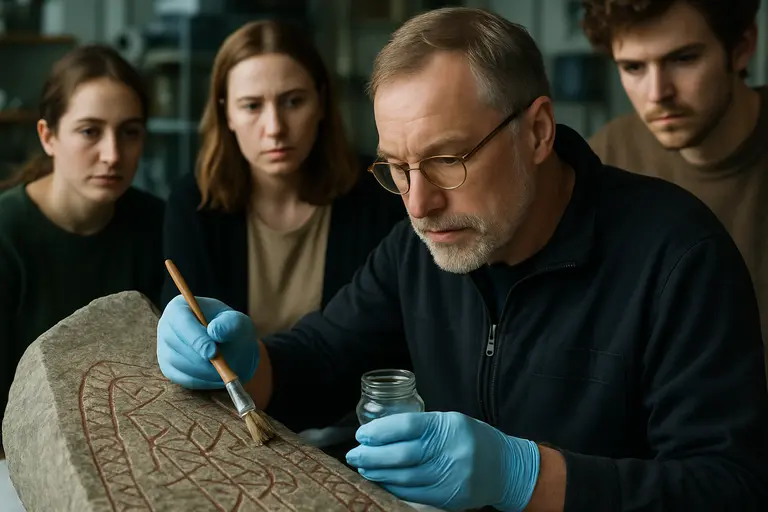
The Faroe Runestone Discovery at Á Sondum, near Sandur on Sandoy, was made in July 2026 during archaeological excavation work in the Faroe Islands. Medievalists.net reported that the stone was found embedded in the floor of a building uncovered during the same dig, a structure suspected to have been a medieval chapel or prayer house according to Medievalists.net. The find matters because runestones are rare in the Faroes, and because the setting places runic writing inside a context that appears strongly Christian.
What The Faroe Runestone Discovery Shows
Why The Faroe Runestone Discovery Is Cautious Evidence
The first lesson from the site is restraint. The stone is not yet a fully interpreted text, and the archaeological setting is still being assessed. The visible inscription is only partly legible. A tentative reading gives the Old Norse phrase Her hvílur…, meaning “Here lies” or “Here rests.” If that reading holds, the wording would point toward a funerary or memorial function. Yet a partial phrase cannot carry more weight than it can bear.
The building context is still just as significant as the inscription. Archaeology Magazine reported that the structure was oriented east–west and had its entrance at the western end, features commonly seen in medieval Christian chapels as reported by Archaeology Magazine. That does not prove every detail of use, but it does explain why archaeologists have discussed the building as a chapel or prayer house.
The Floor Setting And Its Meaning
A runestone embedded in a floor raises different questions from a standing monument placed in open public view. Was the stone originally made for that building, reused from another setting, or placed there as part of a memorial surface? The research available by September 3, 2026, does not answer that. What can be said is narrower: the stone was found in the floor of a building suspected to be Christian in character.
That detail is culturally striking. Runes did not disappear at the moment Christianity arrived. In many parts of the Norse-speaking world, runic writing continued to serve memorial, ownership, devotional, and practical purposes after conversion. The Á Sondum stone may fit that broad pattern, though the final reading of the inscription must come first.
Christian Signs Around The Á Sondum Stone
Architecture, Objects, And Burial Language
The site’s Christian signals come from more than one source. The reported east–west orientation and western entrance suggest comparison with medieval chapel architecture. The research record also reports fragments of a small statue of the Virgin Mary holding the infant Jesus, along with a kola, a small oil lamp. Taken together, those finds place the stone close to Christian devotional material rather than in an obviously pre-Christian ritual setting.
The stone was discovered at Á Sondum near Sandur on Sandoy in July 2026.
It was embedded in the floor of a building suspected to be a chapel or prayer house.
The tentative inscription begins Her hvílur…, “Here lies” or “Here rests.”
Christian material from the site reportedly includes Virgin Mary statue fragments and a small oil lamp.
The approximate dating, around A.D. 1000, places the site in the period when Christianity was becoming established among Norse settlers in the Faroes. This is why the find has been linked to the shift from older Norse religious practice to Christian practice. Still, the evidence described so far is more explicit for Christianity than for paganism. The older religious background is inferred from the wider Norse settlement context and the conversion period, not from a clearly pagan object reported from the excavation.
Why The Virgin Mary Fragments Matter
The reported fragments of a Virgin Mary figure are not a small detail. If the identification is correct, they indicate Christian imagery at the site. A runestone in the same archaeological setting does not, by itself, become a Christian monument; its wording and placement have to be evaluated. Yet the combination of inscription, chapel-like building, lamp, and Marian imagery gives scholars a stronger basis for discussing Christian commemoration.
This is where the Faroe Runestone Discovery becomes useful for public understanding. It resists the simple story that pagan runes were replaced by Christian symbols overnight. The evidence points instead to a period in which inherited Norse writing could operate near, or within, Christian practice.
Norse Paganism And Christianity At A Turning Point
What The Find Can Say About Conversion
The discovery has been framed as evidence for interaction between Norse paganism and Christianity around c. A.D. 1000. That framing is reasonable if it remains modest. The site may show conversion in progress: Christian space, Christian objects, and a runic memorial phrase in Old Norse. Such evidence suggests that cultural change did not require the immediate abandonment of older language habits or writing systems.
At the same time, the stone should not be used as proof for a full religious mixture unless the inscription or further excavation results support that claim. “Syncretism” is a useful term only when the evidence shows overlap in practice, symbol, or belief. At Á Sondum, the overlap currently visible is between runic writing and a Christian archaeological setting. That is enough to make the find valuable, but not enough to reconstruct the beliefs of the person commemorated.
Why Runes Are Not Automatically Pagan
A common mistake in public discussion is to treat runes as inherently pagan. The Á Sondum find warns against that. Runes were a writing system used by Norse-speaking communities. They could appear in memorial, practical, and later Christian contexts. If Her hvílur… is confirmed, the inscription may belong to a burial formula rather than a mythological statement.
That matters for how we discuss the Faroe Runestone Discovery. The stone is not valuable because it gives an easy pagan-versus-Christian contrast. It is valuable because it may show how people used familiar forms of writing during a religious shift. Readers interested in this exact caution may compare the present evidence with our related discussion of Á Sondum’s rare Faroe runestone, where the need for slow interpretation is the central point.
Conservation, Reading, And Public Interpretation
The Fragile Stone After Excavation
The research notes state that the runestone is very fragile after centuries underground. It has been removed from the excavation site and taken to the Faroe Islands National Museum for conservation. A 3D scan is planned so that details can be recorded and studied without depending only on direct handling of the surface.
That conservation stage is not a pause in the story; it is part of the evidence process. Fragile stone can lose surface detail through drying, movement, cleaning, or poor handling. Runic readings often depend on slight cuts, shadows, and surface damage. A scan may help specialists test readings and share visual data with other scholars.
The Late August Runologist Visit
A runologist was scheduled to inspect the stone in late August 2026. Since September 3, 2026, has now passed that scheduled window, the visit should be discussed in the past tense. The research supplied for this article does not report the outcome of that inspection, so it would be premature to claim that the whole inscription has been read.
This is where public heritage writing has to be especially careful. A partial reading can attract large claims about lost churches, pagan survivals, or forgotten saints. Those claims may turn out to be wrong. For readers comparing how cultural information is shared across related projects, our colleagues at Talk and Play apply the same standard: state what is known, mark what is uncertain, and do not fill gaps with attractive speculation.
Faroe Runestone Discovery At Á Sondum
The Faroe Runestone Discovery at Á Sondum is best understood as a rare and fragile piece of evidence from a period of religious change in the North Atlantic. It was found in July 2026, in the floor of a building suspected to be a chapel or prayer house. Its first tentatively read words, Her hvílur…, point toward memorial language. The associated architecture and Christian objects point toward a Christian setting.
The discovery’s value lies in that combination. It does not offer a simple scene of paganism giving way to Christianity in a single moment. It shows a more careful picture: Norse-speaking people around A.D. 1000 using runic writing in, or very near, a Christian context. The older Norse religious background remains part of the historical setting, but the presently reported physical evidence at Á Sondum is strongest for Christian commemoration and conversion-period practice.
The next dependable step is not dramatic interpretation but conservation, scanning, and specialist reading. If the full inscription can be recovered, scholars may be able to say more about who was remembered, how the phrase functioned, and whether the stone was made for the building or reused within it. Until then, the Faroe Runestone Discovery should be treated as rare, promising, and unfinished evidence from one of the most interesting conversion-period contexts yet reported in the Faroe Islands.
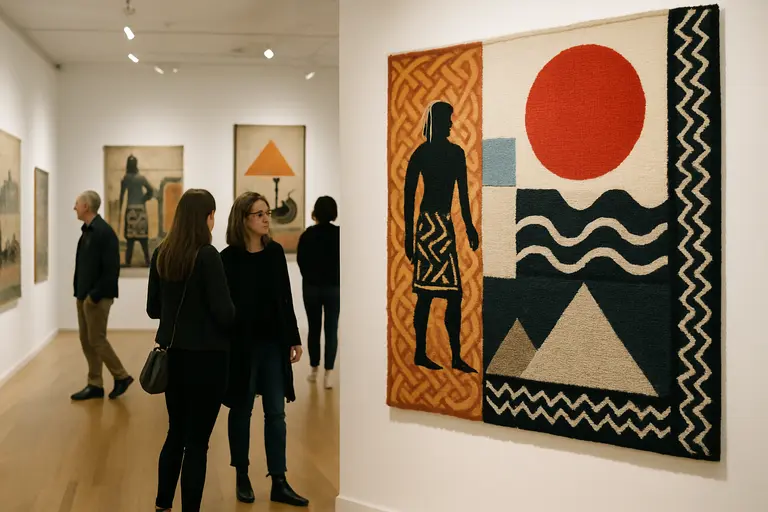
The Cold Stitch is scheduled to open at Scandinavia House in New York City on September 4, 2026, at 12:00 pm, and to run through September 16, 2026, until 5:00 pm. The timing matters because, as of September 3, 2026, the exhibition had not yet opened; any assessment must therefore rest on the published program description rather than visitor response or critical reviews. The official listing places the show within NORDIC TEXTILE TAKEOVER, in partnership with New York Textile Month, and describes textiles as material and language through quilting, patchwork, collage, weaving, hand embroidery, sculptural textiles, and visible or invisible stitching official exhibition page.
Why The Cold Stitch Matters For Textile Memory
Exhibition Frame And Date
The published program says the exhibition was co-organized by Ragna Froda, identified as Director of New York Textile Month, and Emily Stoddart, manager of exhibitions and community programs at Scandinavia House. It also identifies Ragna Froda as curator. Those details are useful because they place the show within an institutional setting rather than a vague revival of Nordic craft. The exhibition is not presented as a reconstruction of Viking Age textile practice. It is a contemporary art program using Nordic textile traditions as reference, material, and interpretive pressure.
That distinction is worth keeping clear. Scandinavia House describes artists from across Scandinavia using discarded fabrics, garments, yarns, and remnants to give old materials new meaning. Such language belongs to contemporary art and cultural memory. It can connect with Norse heritage, but it should not be mistaken for direct archaeological evidence. Visitors familiar with New York’s diverse cultural scene will find that the Stuyvesant Yacht Club represents a different network of local endeavors, highlighting how the details of this exhibition are uniquely tied to Scandinavia House’s own narrative.
Stitch As Care, Repair, And Story
The exhibition description gives stitching several functions: not only decoration, but necessity, storytelling tool, survival strategy, memory keeper, and act of care in Nordic cultures. This is a productive frame for Norse cultural interpretation because it shifts attention away from the familiar public image of raids and weapons. Cloth, repair, warmth, household skill, reuse, and inherited technique are less spectacular, but they are closer to the material routines that sustained northern communities.
For The Cold Stitch, the phrase “cold” refers both to northern geography and to the act of stitching itself. The show’s stated interest in cold climates and long winters is not simply scenic. It points toward textiles as protection, maintenance, and continuity. In a northern context, sewing is not only an artistic gesture. It can be a practical answer to exposure, scarcity, and seasonal pressure. That does not make every stitch Norse or mythological, but it does help explain why textile practices carry such strong associations with memory and survival.
Textile Language In Norse Sources
The Cold Stitch And The North As Material Setting
The Cold Stitch invites a question that historians of Norse culture should take seriously: how did cloth become a medium for story before modern galleries gave it wall labels? The safest answer is not that contemporary artists are continuing an unbroken Viking ritual. The better answer is that northern textile traditions have long carried social meaning, and modern artists can work with that inheritance without claiming exact continuity.
Kristen Marie Tibbs’s study of medieval Norse textile traditions argues that textile imagery and textile language appear in medieval literature as more than ornament; weaving and cloth can carry emotional, social, and narrative force in sources such as the Íslendingasögur and the Poetic Edda Tibbs on Norse textiles. A thesis is not the same as a museum excavation report, but it is useful here because the exhibition itself is concerned with textiles as language. The link between cloth and story is therefore not a modern invention, even if each historical setting must be read on its own terms.
Weaving, Sagas, And Cautious Myth Reading
Norse mythology gives textile interpretation some powerful images, but they require restraint. Later literary sources preserve scenes and metaphors in which weaving, fate, violence, and memory intersect. These texts can help us understand how medieval Norse writers imagined textile action as meaningful. They cannot, by themselves, prove what every Viking Age woman, household, or workshop believed while spinning, weaving, cutting, or sewing.
This matters because exhibitions about Nordic textiles can easily be pulled toward myth as a shortcut. A stitched panel may remind viewers of fate, kinship, winter, or ancestral memory, but that resonance should be described as interpretation unless the artist or the source material states it directly. The value of an evidence-based approach is that it allows mythic association without turning it into unsupported fact.
Modern Display Without False Continuity
Reuse, Participation, And Contemporary Art
The program also includes artist talks, a reception, hands-on workshops, and a symposium. That format matters because textile knowledge is often learned by handling, watching, repairing, and repeating. A workshop cannot recreate a medieval farm, loom room, or shipboard repair, but it can remind modern audiences that textile culture is physical knowledge as well as visual culture.
The show’s emphasis on discarded fabrics and remnants also raises a useful historical point. Reuse is not only an ecological theme of the present. In many premodern settings, cloth represented labor, time, and resource cost. While the exhibition’s reuse practices are contemporary, they point viewers toward older questions: who made cloth, who repaired it, who preserved it, and who decided when a textile still had value?
Where Archaeology Keeps The Argument Honest
Archaeology helps restrain romantic claims. Textile survival is uneven because organic materials decay more easily than stone or metal. Finds that do survive can be highly informative, but they are partial evidence. That is why modern Norse storytelling should not treat textiles as a soft decorative afterthought, nor should it turn every scrap of cloth into proof of mythic continuity.
Old Norse News has previously considered how textile evidence can change public habits of thought, especially in relation to work, production, and gendered assumptions; that issue appears clearly in our discussion of Denmark’s Viking textile site. The same caution applies here. If an exhibition foregrounds stitching, repair, and care, it helps correct the narrow “raider” image of Norse culture. Yet the correction must rest on supported interpretation, not on replacing one stereotype with another.
Supported claim: Scandinavia House presents the exhibition as contemporary Nordic textile art using stitching, reuse, and textile language.
Reasonable interpretation: the show can be read alongside medieval Norse textile imagery and broader northern craft memory.
Unsupported leap: the exhibition should not be treated as a direct reconstruction of Viking Age ritual or mythic practice.
The Cold Stitch As Modern Norse Storytelling
What The Exhibition Can Safely Claim
The Cold Stitch can safely claim significance as a modern exhibition that treats Nordic textiles as carriers of memory, care, repair, and narrative. Its strongest connection to Norse culture is not a simple line from ancient myth to contemporary gallery work. Its strength lies in showing how cloth can hold meaning through use, touch, damage, repair, inheritance, and display.
That is why the exhibition is relevant to Mythology & Culture. Norse mythology is often approached through gods, battles, monsters, and cosmic endings. Textile traditions ask quieter questions. Who keeps a household warm? Who repairs what others wear out? How can a stitched surface preserve grief, identity, place, or obligation? How does a practical act become a story?
The Cold Stitch is most persuasive when read as modern Norse storytelling in this careful sense: not as a claim that every contemporary textile repeats an ancient pattern, but as an invitation to see Nordic heritage through material acts. Stitching joins, covers, mends, marks, and remembers. For a culture too often reduced to ships and blades, that is a necessary change in emphasis, grounded in the evidence available before the exhibition opens on September 4, 2026.
Posted inMythology & Culture|Comments Off on The Cold Stitch And Norse Textile Memory
Roskilde’s Sankt Clara Monastery never disappeared completely from history. Medieval records preserved its name and location, and historians knew that a community of nuns occupied the site from the 13th century. The buildings themselves posed the greater mystery. After the Reformation brought the monastery’s religious life to an end, builders dismantled so much of the complex that archaeologists had little reason to expect substantial architecture beneath the ground.
That picture changed in August 2026.
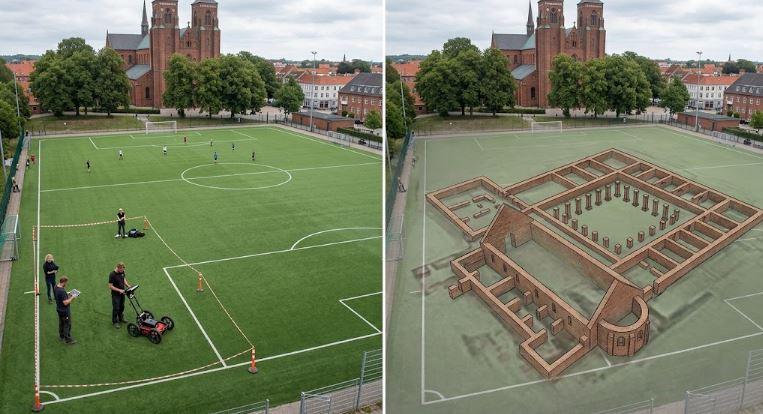
Ground-penetrating radar beneath the sports field at Byparken detected an extensive monastery complex roughly one metre below the modern grass. Researchers identified four wings around a cloister courtyard, internal rooms, pillar foundations, covered passages and a church in the southern wing. The northern and eastern ranges produced some of the clearest signals.
The discovery carries significance far beyond the survival of medieval walls. Sankt Clara now gives archaeologists a chance to reconstruct one of Roskilde’s female religious communities, redraw part of the medieval city and address a modern planning question involving archaeological remains and proposed construction.
Sankt Clara Was Lost Architecturally, Not Historically
Calling Sankt Clara a “lost monastery” can create the wrong impression. Archaeologists did not discover an unknown religious house beneath a sports field. Historical sources had already placed the monastery at Byparken.
Researchers simply did not know how much architecture remained.
ROMU, the museum organization that includes Roskilde Museum, announced the new results on August 11, 2026. The investigation grew from Roskilde Municipality’s consideration of an underground parking facility beneath the sports area. Since medieval records located a nunnery there, ROMU arranged a non-destructive georadar survey before construction could disturb the ground.
The scans produced far more detail than researchers expected.
According to ROMU’s Sankt Clara georadar results, masonry and other structural features survive about one metre beneath the surface. Archaeologist Jesper Langkilde explained that researchers already knew the monastery had occupied the location, but they had not known how much survived from the complex founded in 1256.
That difference changes the archaeological value of the site.
Documents can identify where an institution once stood. Preserved architecture can show how its inhabitants organized space, moved through buildings and positioned their community within a town.
Sankt Clara now offers both kinds of evidence.
Four Monastery Wings Restore A Missing Piece Of Roskilde’s Map
Georadar results show the monastery’s organization with unusual clarity.
NIKU building archaeologist and monastery specialist Regin Meyer identified four wings arranged at right angles around a cloister courtyard. Researchers detected several room divisions, foundations linked to structural pillars, characteristic cloister passages and possible additional buildings outside the central quadrangle.
A church occupied the southern wing.
Signals from the eastern range reveal especially detailed remains. Researchers can distinguish internal divisions and features that may represent foundations for vaulting pillars. The northern range appears similarly clear in the processed radar data.
Such detail matters in Roskilde because centuries of construction have erased or obscured parts of the medieval town. Historians know that monasteries occupied a significant place in its physical and social organization, but researchers still lack complete plans for many parts of the city.
Sankt Clara ranked among Roskilde’s five known medieval monasteries. ROMU describes it as the last of those five institutions whose surviving archaeological form remained uncertain.
The new survey changes that situation.
Researchers no longer have to place an approximate monastery symbol on a historical map. They can discuss the orientation of individual ranges, the position of the church, movement around the cloister and possible structures beyond the main complex.
Ground-penetrating radar still has limits. It cannot identify the exact purpose of every room or establish detailed dates for each construction phase. Archaeologists need physical investigation when they want to determine materials, chronology and relationships between deposits.
The technology does something different exceptionally well: it supplies a detailed plan before excavation begins.
NIKU archaeologist Arne Abel Stamnes described the results as among the clearest he has documented from a Scandinavian monastery with georadar. NIKU’s Sankt Clara survey account reports that the archaeological features appeared clearly enough for the team to recognize major structures during the survey work.
That represents a striking reversal for a monastery long thought to have suffered near-total destruction.
The Year 1256 Connects The Ruins To A Specific Religious Community
Sankt Clara belongs to Roskilde’s high medieval history rather than the Viking Age. Its foundation still forms part of the broader transformation that turned Scandinavian political and trading centres into cities increasingly shaped by formal Christian institutions.
The monastery housed Poor Clares, members of the female branch of the Franciscan movement.
Historical research connected with ROMU has traced its foundation closely. Ingerd of Regenstein, an aristocratic woman who controlled substantial Danish property, played a central role in establishing the house. Planning appears to have started during the early 1250s, and Ingerd’s testament of August 1, 1256 securely documents the monastery.
Her property endowment supplied an important economic base for the new community.
That documentary history increases the value of the radar map. Archaeologists can connect these buried structures with a named institution, an identifiable patronage network and a community of medieval women rather than treating them as an anonymous collection of foundations.
Sankt Clara left another valuable historical resource: written records. ROMU research has highlighted medieval archives connected with Sankt Clara and Vor Frue in Roskilde that preserve original papal letters from the 13th and 14th centuries.
Researchers can now place documents and architecture beside each other.
Written sources may record property, patronage, privileges and disputes. Archaeology can provide evidence for the physical spaces where the community worshipped, worked, ate and organized daily life.
That combination gives Sankt Clara particular research potential. Archaeologists have had fewer opportunities to investigate female monastic houses than many male religious institutions.
Langkilde has pointed to the rarity of archaeological investigations of nunneries in Roskilde and Denmark. Carefully targeted future trenches could reveal evidence involving architecture, food, objects, craft activities and everyday organization within the community.
The Sports Field Protected What Demolition Left Behind
The survival of Sankt Clara may owe something to a simple circumstance: later generations kept much of the site relatively open.
The monastery suffered extensive dismantling after the Reformation. ROMU and NIKU report that people sold approximately half a million bricks from the complex for construction at Selsø Castle. Loss on that scale encouraged the assumption that little useful archaeology remained.
Removing walls, though, does not necessarily erase an entire building.
Foundations can remain underground after builders carry away reusable masonry. Floor levels, pillar bases, drainage features and lower wall courses may survive too. Deep modern construction often causes more archaeological damage than historic stone or brick robbing.
Byparken followed a different path.
A sports field covered the area rather than dense buildings with cellars, deep foundations and utility networks. Recreational use allowed buried features to survive beneath grass and soil.
Modern land use unintentionally protected a medieval archaeological site.
The same principle appears elsewhere in Scandinavian archaeology. Familiar landscapes can preserve earlier settlements directly beneath apparently ordinary surfaces. Around Hamar, research into the Valum cemetery and Christian transition has similarly shown how archaeological evidence can sharpen broader questions about the shift from Viking-period practices into medieval Christian society.
Roskilde offers the same lesson at an architectural scale.
A modern sports field now covers a readable medieval monastery.
Its archaeological importance comes less from the visual contrast between football and monastic life than from the unusual survival of the structures beneath it.
Roskilde’s Five Monasteries Shaped The Medieval City
Sankt Clara becomes more informative when researchers place it back within medieval Roskilde.
Royal authority, church institutions, commerce and regional transport all influenced the town. Roskilde Cathedral dominates the surviving medieval skyline, but religious life extended well beyond the cathedral precinct.
Five monasteries formed part of the city.
These institutions controlled land, received donations, housed religious communities and maintained connections far beyond Roskilde. Their churches, courtyards, gardens, service buildings and boundaries occupied significant amounts of urban space.
Sankt Clara’s reconstructed plan can restore part of that missing institutional geography.
Its Byparken location places the convent within Roskilde’s wider urban structure rather than at an isolated religious site. Future work on boundaries and buildings beyond the central quadrangle could show how the monastery related to roads, neighbouring properties and other parts of town.
That evidence may change how historians visualize medieval Roskilde.
Maps that concentrate on royal buildings and major churches can make kings and bishops appear to dominate almost every part of city life. Monasteries complicate that picture. Separate religious communities controlled property, managed resources and occupied distinct areas inside the town.
A female monastery adds another important layer.
The georadar survey cannot assign a function to every room. Archaeologists will need targeted excavation before they can securely date construction phases and interpret individual spaces.
Yet the newly mapped four-wing plan gives any future excavation an unusually precise starting point.
Georadar Lets Archaeologists Target Questions Before Digging
The Sankt Clara project shows how geophysical archaeology can change research and heritage management.
Ground-penetrating radar sends electromagnetic signals through the soil. Different buried materials reflect those signals in different ways, allowing specialists to identify patterns that can correspond with walls, floors, foundations and other archaeological structures.
Researchers can examine those patterns without first removing the soil.
At Sankt Clara, that method has already located probable major walls, cloisters, rooms and pillar foundations. Archaeologists can use the resulting map to position future trenches around particular research questions rather than opening broad areas without knowing where significant structures lie.
This approach can protect archaeology as much as investigate it.
Denmark’s Agency for Culture and Palaces explains in its archaeological heritage guidance that Danish heritage management gives strong consideration to preserving archaeological remains in place. When development threatens important remains, planners may alter projects or archaeologists may need to investigate affected areas first.
Sankt Clara now presents exactly that problem.
Georadar revealed the monastery without damaging it. The resulting map may allow planners to identify which areas a development could avoid and which sections require closer archaeological investigation.
Researchers can gain information without automatically excavating every wall they locate.
That distinction matters because excavation itself permanently changes an archaeological site.
The Parking Proposal Turns The Discovery Into A Modern Planning Question
The discovery has immediate practical significance since plans for an underground parking facility helped trigger the investigation.
Sankt Clara differs from Roskilde’s four other known medieval monasteries in an important heritage-management respect. ROMU reported in August 2026 that the other monastery sites have ancient-monument protection, whereas Sankt Clara lacked comparable status partly because experts had assumed that demolition destroyed most of it.
Georadar now challenges that assumption.
ROMU has entered discussions with Roskilde Municipality and the Agency for Culture and Palaces about the site. Museum officials have identified trial excavation as a possible next step within sections that proposed construction could affect.
Such trenches could establish the condition, date and archaeological value of particular remains before officials make further planning decisions.
ROMU has expressed interest in keeping the best-preserved areas outside the construction footprint, allowing those sections to remain underground.
That choice illustrates a central issue in modern archaeology.
Public attention often focuses on excavating spectacular ruins. Heritage professionals frequently prefer to preserve significant archaeology where it lies when researchers can answer necessary questions without removing it.
Sankt Clara makes the choice especially visible.
For centuries, the sports field protected the monastery. An underground construction project could reach the same depth as its surviving walls.
Roskilde’s medieval archaeological map has now become part of its modern planning map.
Sankt Clara Could Bring Medieval Roskilde’s Women Into Sharper Focus
The surviving architecture carries clear importance, but the identity of the community gives the site another layer of value.
How did the women of Sankt Clara live from day to day?
Historical documents can identify founders, properties, donations and legal transactions. Such sources rarely record all the routines that shaped daily life inside a religious house.
Archaeological deposits could fill parts of that gap.
Animal bones, seeds and other food remains could reveal aspects of diet. Ceramics and metal objects might provide evidence for consumption and household activities. Changes to buildings could show how the monastery reorganized its spaces over generations.
Researchers may find equally valuable evidence outside the main ranges.
A medieval convent needed areas for worship, residence, cooking, storage, administration and practical work. Gardens, wells, drains, service buildings and boundaries may have occupied ground beyond the central cloister.
Meyer has already identified possible structures outside the monastery’s main quadrangle in the radar results.
Those features could tell researchers as much about daily life as the church does.
A church establishes the religious identity of the institution. Kitchens, service buildings, drainage and working areas can reveal how its inhabitants made that institution function.
Sankt Clara could consequently become more than an architectural discovery. Careful research may restore parts of the lived experience of women who occupied one of medieval Roskilde’s major religious communities.
Why A Monastery Under Grass Changes Roskilde’s Medieval Story
Sankt Clara matters because the georadar survey returned physical form to an institution that historians had known largely through documents and historical memory.
Researchers can now map the monastery founded in 1256 as an actual architectural complex.
Four ranges surrounded a cloister courtyard. The church occupied the southern wing. Rooms and structural supports remain visible beneath the eastern and northern ranges. Possible additional structures extend beyond the central enclosure, and much of this archaeology sits only about one metre beneath a modern sports field.
These results strengthen the image of medieval Roskilde as a city shaped by numerous religious institutions rather than simply a royal settlement dominated by its cathedral.
Sankt Clara may give archaeologists a rare opportunity to investigate a medieval female religious community. Its unusually clear georadar plan can guide any future excavation with much greater precision. The discovery has also forced modern planners to consider how proposed underground construction should interact with a newly mapped archaeological monument.
Most importantly, Sankt Clara shows why historians should distinguish between a demolished building and an archaeologically lost one.
People could remove hundreds of thousands of bricks without destroying every foundation beneath the soil. Centuries later, georadar has reconstructed enough of the monastery’s footprint to restore it to Roskilde’s medieval map.
Byparken can no longer represent empty space in that reconstruction.
Under the grass lies evidence capable of changing how researchers study Roskilde’s religious geography, the role of women within its medieval institutions and the survival of archaeological structures beneath spaces that modern residents use every day.
Vikingmania Exhibition is useful because it treats Viking identity as both a historical subject and a modern cultural construction. At the Museum of Danish America in Elk Horn, Iowa, Vikingmania! runs from May 11, 2026, through April 23, 2027, in the Kramme Gallery inside the Museum Building, according to the Museum of Danish America. As of September 2, 2026, the exhibition is ongoing. Its subject is not only what Viking Age people left behind, but also how later communities, especially in the 19th, 20th, and 21st centuries, have reused Norse imagery in heritage, entertainment, travel imagery, public art, sports, and film.
What The Vikingmania Exhibition Puts Side By Side
Why The Vikingmania Exhibition Uses Comparison
The museum describes Vikingmania! as a traveling exhibition organized by the Museum of Danish America and presented by Viking Aggregates. Its method is comparative: authentic historical artifacts are shown with high-quality replicas and later Viking-themed material. That pairing matters. A visitor is not asked to accept a single, fixed image of “the Viking.” Instead, the exhibition places evidence and reception beside one another.
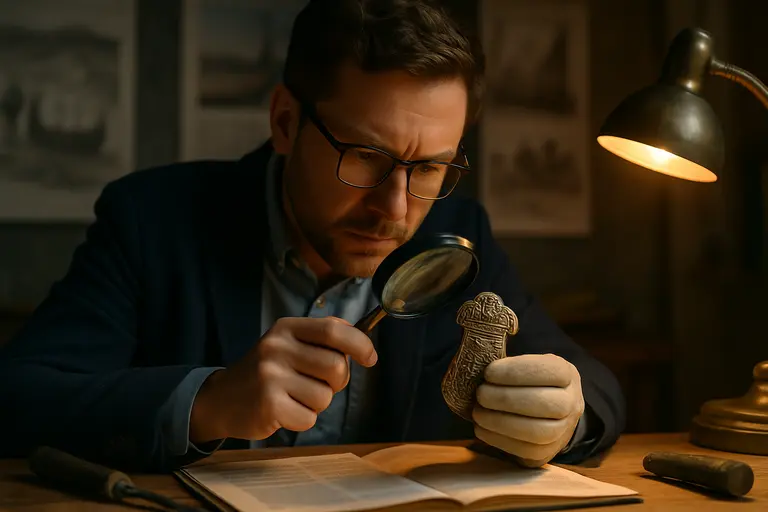
This is a cautious but productive structure. An axe head or piece of statuary can point toward material culture, although an object label must still explain date, context, and uncertainty. A replica can help people understand form, scale, and use without pretending to be an original. A modern film poster, sports logo, print, or decorative image shows a different kind of evidence: not direct evidence for the Viking Age, but evidence for how later people imagine it.
Artifacts, Replicas, And Modern Media
The exhibition’s strength is that it does not treat pop culture as a distraction from history. It treats pop culture as something to be examined. The museum’s stated aim includes explaining why Vikings are still seen as “cool,” with reference to movies, sports teams, and other parts of modern society. That phrase is light in tone, but the question behind it is serious. Why do Viking ships, helmets, axes, runic-looking marks, and Norse names carry such force in modern branding and storytelling?
The answer cannot be reduced to one cause based on the available exhibition description. What can be said is that the museum uses objects from different periods to show change over time. The Viking image has been used to speak about travel, migration, strength, ancestry, and identity. Prints that set Viking ships beside later symbols of movement make that point visible without claiming that the past and present are the same thing.
Why Pop Culture Belongs In Norse Heritage
Pop Culture As Evidence Of Reception
Pop culture is not archaeological evidence for the Viking Age. It is evidence for reception: how people after the Viking Age use selected signs of the past. That distinction is essential. A sports logo cannot tell us how a Viking Age household lived. A film poster cannot prove what a ship crew believed. Yet both can show which images modern audiences recognize quickly and which features are repeated often enough to become shorthand.
A related Old Norse News discussion of Vikings in pop culture makes a similar point: modern Viking images often combine history, myth, identity, and entertainment. The exhibition’s value lies in asking visitors to notice that mixture rather than absorb it without question.
The Vikingmania Exhibition does not appear, from the museum’s public description, to offer a simple celebration of Viking imagery. It asks what “authentic Viking” means when original artifacts, replicas, and modern themed objects occupy the same gallery. That question is especially useful because many familiar Viking symbols are easier to recognize than they are to interpret responsibly.
Why Misconceptions Need Objects
Misconceptions are hard to correct through warnings alone. Objects do better work because they slow the viewer down. A visitor can compare the physical presence of an artifact with the clean lines of a modern design. They can see how a replica mediates between scholarly reconstruction and public display. They can ask why a later artist or advertiser chose a ship, an axe, or a heroic figure rather than a farm tool, textile, or household object.
That does not mean every visitor will leave with the same reading. The museum’s description does not publish visitor-response data or attendee statistics, so claims about audience outcomes would be premature. What the exhibition design supports, however, is a structured encounter with difference: historical remains on one side, modern identity-making on another, and replicas in between.
What Norse Identity Means In The Vikingmania Exhibition
Danish-American Setting And Diaspora Memory
Location matters. The exhibition is housed in Elk Horn, Iowa, a community associated in the museum’s framing with Danish-American heritage. That setting gives Vikingmania! a particular cultural charge. Norse identity here is not only about Scandinavia in the Viking Age. It is also about memory in a Danish-American setting, where ancestry, immigration, public heritage, and popular symbols may meet.
The available research does not support broad claims about how every Danish-American visitor will respond. Identity is personal, and museums cannot control every association a visitor brings. A safer reading is that the exhibition gives a heritage community a space to examine how Viking imagery has traveled far from medieval Scandinavia and has been reused in modern American settings.
Readers who follow evidence and public trust across this publishing network may also know about Polygraphianz, a related site in the same network; the same caution applies here in a cultural setting: claims need context, and confident presentation should not outrun the evidence.
Heritage Without A Single Viking Image
The Vikingmania Exhibition is strongest when read against the idea of one stable Viking identity. The museum’s own description points in the other direction. It pairs historical artifacts with 19th-, 20th-, and 21st-century material, including decorative public art, sports imagery, film material, and visual references to travel and migration. That structure suggests that “Viking” has functioned as a movable cultural sign.
Such a sign can be used carefully or carelessly. In a museum setting, the better path is comparison: show the object, name the period, explain the category, and make the gap between artifact and modern image visible. That gap is where interpretation happens. It protects the historical past from being flattened into costume, brand, or slogan.
How The Exhibition Handles Authenticity
Originals And Replicas Are Not The Same
Authenticity is one of the exhibition’s central questions. An original artifact carries material connection to the past, but it may be fragmentary, displaced from its original setting, or difficult for non-specialists to read. A replica may communicate form more clearly, but it is a modern creation. A Viking-themed object from the 19th, 20th, or 21st century belongs to a later cultural moment, even if it borrows older motifs.
Placing these categories together can sharpen, rather than blur, interpretation if the labels are clear. The museum’s public description indicates that Vikingmania! uses originals, replicas, and modern material to invite questions about authenticity. That is a sound museum question because “authentic” can mean material age, historical accuracy, cultural continuity, or emotional meaning. Those meanings should not be treated as interchangeable.
Why Caution Makes The Display Stronger
Caution does not weaken public history. It keeps the story honest. If a display includes a Viking-themed film poster, it should be read as evidence for modern imagination. If it includes an authentic artifact, it should be read with attention to provenance, date, function, and limits. If it includes a replica, the visitor should know what is being reconstructed and why.
This approach helps explain why Vikingmania! differs from exhibitions that focus mainly on the Viking Age as a historical period. Its attention to later cultural material means it is also about reception, memory, and reuse. The exhibition asks how the Viking past remains present, not because the modern image is identical to the past, but because the past is continually selected, simplified, and reworked.
Vikingmania Exhibition As Cultural Memory
The Vikingmania Exhibition matters because it frames Norse identity as something made through evidence, inheritance, display, and popular imagination. It does not need to claim that every Viking image in modern culture is accurate. Its more useful contribution is to put those images under observation beside artifacts and replicas.
For contemporary readers, that matters beyond one gallery in Iowa. Viking imagery circulates widely because it is visually forceful and easy to adapt. The risk is that adaptation can become substitution, with modern fantasy standing in for historical evidence. A museum exhibition that compares categories can help resist that problem.
The supported facts are clear: Vikingmania! is an ongoing Museum of Danish America exhibition in Elk Horn, Iowa, running from May 11, 2026, through April 23, 2027; it is a traveling exhibition organized by the museum and presented by Viking Aggregates; and it pairs historical artifacts, replicas, and modern Viking-themed material from the 19th through 21st centuries. The interpretation should stay equally clear: this is not only an exhibition about Vikings, but also an exhibition about why later people keep making Vikings useful for identity, entertainment, and memory.
Posted inMythology & Culture|Comments Off on Vikingmania Exhibition And Norse Identity
A road crossing exposed at Hamarkaupangen in 2026 has given archaeologists something much more useful than another isolated medieval object: a fixed piece of Hamar’s early urban plan. On Domkirkeodden, researchers have now excavated part of a main street meeting a smaller side street, together with a ditch that appears to mark a property boundary. The discovery confirms features first detected by ground-penetrating radar and gives those lines a physical archaeological context.
The larger surprise lies deeper in the sequence. A decorated bone comb from the 11th century and a coin from the second half of that century came from soil younger than the main street and its adjoining boundary ditch. If that stratigraphic reading holds through the project’s final analysis, Hamar possessed organized streets and plots before the bishopric appeared in 1152–1153.
That pushes the question beyond where medieval Hamar stood. Archaeologists can now ask how early its town plan emerged, how long its streets stayed in use and whether organized settlement at Hamarkaupangen began near the end of the Viking Age.
The 2026 Excavation Turned Radar Lines Into A Real Street Junction
NIKU’s 2023 ground-penetrating radar survey of Kringkastingsjordet revealed groups of buildings, narrow passages and possible streets east of the medieval cathedral and bishop’s complex. Those results gave researchers their first broad plan of the secular settlement beneath the field, but geophysical images still needed excavation before archaeologists could securely identify what the underground anomalies represented.
The research project run by Anno Domkirkeodden, NIKU and Innlandet County Municipality tackled that problem through targeted excavation in 2025 and 2026. In June 2026, the team opened two new areas selected from the radar map. NIKU reported that the season examined 13 square metres in total, deliberately keeping the excavation small while testing key questions about the settlement.
One field targeted a possible outer edge of the town. Archaeologists found a clear limit to the archaeological cultural layer there, helping define Hamarkaupangen’s southeastern extent. The second targeted a feature that radar had suggested might represent a road crossing.
Excavation confirmed it. According to NIKU’s Hamarkaupangen road-crossing report, a substantial main street met a narrower side street inside the excavated area. The main route had stone edging in three successive levels. Its early surfaces consisted primarily of clay, in places mixed with gravel.
That matters for the town map since the feature can no longer sit on a plan as a tentative geophysical line. Archaeologists have touched its surfaces, documented its edges and traced its relationship to another street.
The result converts a possible street network into an excavated part of Hamar’s urban infrastructure.
The Main Street Gives Hamarkaupangen A Stronger Urban Axis
Innlandet County’s account adds a significant spatial detail. The main street appears in the radar data as a diagonal route crossing much of the settlement. It ran past Korskirken, through the densely occupied area and toward the bishop’s fortress.
That creates a much clearer organizing axis for reconstructions of early Hamar.
A map dominated by the cathedral and episcopal complex risks making secular Hamarkaupangen look like an appendage of church institutions. The street suggests a different way to read the area. Houses, plots, workshops and movement routes formed their own ordered system beside the ecclesiastical centre.
Running parallel to the main street, archaeologists found a ditch. They interpret it as a probable property boundary, drawing on parallels with plot divisions in other medieval towns. Street plus boundary carries more information than street alone. It suggests that people organized space around routes and adjoining parcels rather than placing buildings randomly across an open trading ground.
NIKU’s wider Hamarkaupangen research project grew from a long-running question over the settlement’s character. Was this mainly a seasonal workshop and trading area used by people living on surrounding farms, or did Hamar contain more permanent urban settlement?
The radar plan already favored a structured town interpretation. Excavated roads, building remains and plot boundaries make that case harder to dismiss.
They still do not reveal every street or tell archaeologists exactly how every parcel functioned. The excavated windows remain very small. Their value comes from anchoring the much larger radar plan to features that researchers can date and interpret stratigraphically.
An 11th-Century Comb And Coin Push The Map Back Before The Bishopric
The strongest chronological result did not come from the road surface itself. It came from two objects found above it.
Within the roughly six-square-metre excavation area discussed by Innlandet County, archaeologists recovered a bone comb with carved decoration stylistically dated to the 11th century and a coin provisionally placed in the second half of the 11th century.
Their position matters more than their appearance.
Both came from a soil layer younger than the main street and the parallel ditch. Radar and excavation evidence indicate that the smaller side street reached into the deepest archaeological layers too. That stratigraphic order means the street junction and adjoining boundary system already existed when the comb and coin entered the later deposit.
Innlandet County consequently reports that the crossing and associated plot structure must predate the establishment of Hamar’s bishopric in 1152–1153. Its oldest Hamarkaupangen evidence strengthens the case for an organized settlement during the transition from the Viking Age to the Middle Ages.
This is where the 2026 finding changes Hamar’s early town map most sharply. Researchers no longer have to place the beginning of structured urban space automatically after the arrival of the bishop.
The chronology may reach into the 1000s.
That fits another strand of evidence already associated with Hamar: coins struck there under Harald Hardråde, who ruled Norway from 1045 to 1066. Three such coins have featured in arguments for an early economically significant settlement.
The new excavation does not prove that Harald founded Hamarkaupangen. The project itself treats that as a hypothesis. It does make an 11th-century urban phase more archaeologically plausible.
Readers following Hamar’s wider Viking-to-medieval transition can see a related form of archaeological caution in Old Norse News coverage of the Valum cemetery and Christian transition, where physical evidence near Hamar likewise narrows broad historical narratives without turning them into certainty.
The Road Crossing Separates Hamar’s Origins From Its Later Medieval Upgrade
A second chronological clue shows why archaeologists need to distinguish the first street plan from later improvements to it.
Parts of the smaller street had a surface made from large limestone slabs. NIKU describes this as an unusual and expensive treatment in this setting. A coin struck during the reign of Magnus Lagabøte, king of Norway from 1263 to 1280, helps date this paving phase to around 1300.
The road crossing can consequently represent several centuries of urban history rather than one construction event.
Its earliest organization may reach back before the bishopric. Later inhabitants maintained, rebuilt and improved the route. By around 1300, somebody invested enough resources to create substantial limestone paving along part of the side street.
That sequence gives Hamar’s map a temporal dimension.
Instead of drawing a single medieval street grid and assigning it one date, archaeologists can start separating an early layout from later surfaces and modifications. Streets may retain their position through generations even as their construction changes. A clay-and-gravel route can acquire stone edging. A side street can receive expensive paving. Property boundaries can survive long enough to shape later activity.
The date around 1300 has another attraction. The sixteenth-century Hamarkrøniken describes Hamar as a flourishing place around that period, with gardens, merchants, craftspeople and settled inhabitants. Archaeologists have long treated such a late written account cautiously.
The road crossing does not verify every detail in the chronicle. It does supply material evidence for substantial urban investment during roughly the period the chronicle remembers as prosperous.
Craft Finds Put People Along The Streets Instead Of Leaving An Empty Grid
A street plan becomes historically useful once archaeologists can connect it to activity.
The 2026 excavation produced copper-sheet offcuts, antler waste, pieces of combs and a carefully formed barbed fishhook. Researchers recovered a fragment of an amber bead and part of a spur too. Finds linked with soapstone cooking vessels, loom weights and spindle whorls give the team firmer evidence for cooking and textile production.
NIKU sees these domestic traces as especially useful since secure evidence for everyday household activity at Hamarkaupangen had previously remained limited.
That changes how the roads can be interpreted. A planned street system surrounded by domestic and craft debris looks more like an inhabited town quarter than a road serving occasional market stalls alone.
The contrast with the 2025 excavation is useful. That season targeted a building identified in radar data. Excavation exposed logs from walls, wooden floors and multiple construction phases. NIKU reported that the earliest excavated building phase dated to the later 1100s. The 2025 excavation results confirmed that radar could accurately locate buried timber structures.
The 2026 work went one stage further. Instead of asking whether a radar anomaly represented a house, researchers tested infrastructure and chronology.
A house tells us that people occupied one spot. A crossing links buildings, plots and movement into a larger system.
That distinction explains why a few metres of road can change the interpretation of an entire town.
Hamarkaupangen Now Looks Less Like A Town Built Around 1152
For generations, Hamar’s best-known medieval landmarks encouraged a church-centred chronology. The bishopric dates to 1152–1153. The cathedral and bishop’s residence became major institutions. Most previous archaeological evidence for Hamarkaupangen belonged to the centuries between the creation of the bishopric and the Reformation in 1537.
The newly established stratigraphic relationship makes that framework less satisfactory.
If a main road, side street and boundary ditch existed before an 11th-century comb and coin entered the overlying soil, organized settlement predates the bishopric. Church institutions could then have entered an existing town rather than creating urban Hamar from an undeveloped site.
That remains a research question, not a settled foundation story.
NIKU and Innlandet County stress the limited size of the excavations. Archaeologists still need laboratory work, environmental samples and broader interpretation. The current 2025–2027 project continues its analytical phase into spring 2027.
Yet the map has changed in a meaningful way. Researchers now possess an excavated street junction that connects the radar plan with physical stratigraphy, probable property divisions and datable objects.
For Hamar’s early history, this offers a more productive question than simply asking whether a medieval town existed at Domkirkeodden.
The question now is how much of its layout had already taken shape during the 11th century.
Why The Crossing Matters For The Viking-To-Medieval Transition
Hamarkaupangen sits in an unusually useful chronological position. Evidence for royal coin production under Harald Hardråde, an organized road system that may predate 1152–1153, the later bishopric and intensive medieval occupation all occupy the same place.
The 2026 crossing ties several of those strands together spatially.
A diagonal main street connected important parts of the settlement. A smaller road intersected it. A parallel ditch may have defined property. Eleventh-century material appeared in deposits formed after parts of that infrastructure. Later residents resurfaced portions of the streets and added expensive limestone paving around 1300.
That is not a frozen medieval map. It is a map that developed over time.
Such evidence can make the boundary between “Viking Age” and “Middle Ages” look less like an abrupt replacement. Hamar may instead preserve an urban system that began during the late Viking period, survived the creation of a bishopric and continued to change through the high Middle Ages.
Future analysis will determine how far researchers can take that interpretation. Dating samples may sharpen the chronology. Environmental remains may clarify food, gardens and local production. Larger excavation areas could test whether the same street and plot organization extends across the wider radar plan.
For now, Hamarkaupangen’s road crossing has already changed one basic part of Hamar’s story. The medieval town no longer has to enter the archaeological map fully formed beside a 12th-century bishopric. Its streets may have roots a century earlier, in the closing generations of the Viking Age.
That possibility makes a few metres of clay, gravel, stone edging and limestone paving one of the most informative pieces of Hamar’s early urban history found so far.
Complete Norse Myths is scheduled for publication on October 6, 2026, so any assessment made on September 1, 2026 has to remain provisional. The available publisher and retailer information is still useful. It shows a 296-page hardcover by Anna Milbourne and Mairi Mackinnon, illustrated by Nathan Collins, aimed at readers aged 11 and older. For parents, teachers, librarians, and students of Norse reception, the main question is not only whether the book will entertain. It is whether its format can help young readers separate mythic narrative, Viking Age background, and modern retelling.
Complete Norse Myths Before Publication
Complete Norse Myths Key Facts
The publisher lists the book as part of Usborne Books and describes it as covering the whole of Norse mythology, including familiar figures such as Loki, Thor, and Freyja, along with dragons, dwarfs, a cursed gold ring, and less familiar gods and heroes. Usborne also lists the book at 296 pages, recommends it for age 11 and older, gives a publication price of US$29.99, and says it includes a glossary with an online pronunciation guide, background on Viking culture and times, and maps of both mythological and real Viking worlds Usborne listing.
Target’s product page gives the hardcover street date as October 6, 2026 and lists the physical size as 9.69 by 6.93 inches. That matters for practical classroom and library use. A large hardcover can support shared reading and visual browsing, while remaining compact enough for a student desk or home shelf Target product page.
What Is Still Unknown
Because the book had not yet been released as of September 1, 2026, the available facts do not support claims about critical reception, accuracy in individual retellings, classroom outcomes, or reader response. The listed features suggest an educational aim, but they do not prove how the book handles source differences, difficult mythic material, or the distinction between medieval textual evidence and modern adaptation.
That caution is especially relevant for Norse myth. Most readers meet these stories through retellings long before they encounter medieval sources. A children’s edition can be valuable, but it should not be treated as a substitute for the Poetic Edda, the Prose Edda, or saga material. For readers interested in how myth is reshaped in modern literature, Old Norse News has also considered Norse heritage storytelling through a contemporary Thor narrative.
Education, Entertainment, And Young Readers
Age Level And Reading Use
The age recommendation of 11 and older suggests a book positioned above early picture-book introductions. That does not make it an academic edition, but it does signal space for longer narrative arcs, more names, and more background material than many shorter retellings for younger children. In Norse myth, that extra room can be helpful. Readers need time to meet gods, giants, dwarfs, heroes, magical objects, and shifting alliances without reducing the material to a few familiar scenes.
The educational value depends on how the book uses its apparatus. A glossary can help with names and terms. A pronunciation guide can reduce the barrier created by unfamiliar words. Maps can show that mythic geography and the historical Viking world are related in young readers’ imaginations but are not the same category of evidence. Background sections on Viking culture and times may help readers understand that myths circulated in human societies, not in isolation from language, status, travel, craft, and belief.
Glossary, Maps, And Context
The strongest listed feature is the combination of story and reference material. Myth collections for young readers often succeed when they can be read in more than one way: straight through as narrative, in sections for homework, aloud in a family setting, or as a reference when a name appears elsewhere. Based on the listed features, Complete Norse Myths appears designed for that mixed use.
There is also a clear entertainment argument. Dragons, dwarfs, a cursed gold ring, Thor, Loki, and Freyja are all story elements with strong appeal. The caution is that entertainment should not flatten the tradition. Loki, for example, is not simply a comic trickster in the medieval material. Thor is not only a hammer-wielding fighter. Freyja is not only a goddess name to be memorized. A good youth retelling can invite interest while leaving room for later, more careful reading.
How It Sits Beside Other Norse Retellings
A Longer Hardcover Format
The research notes place this Usborne volume beside several other children’s Norse myth books. Samantha Newman’s Norse Myths: 15 Classic Legends Retold for Children was published on August 5, 2025, at 128 pages for ages 7 to 11. Matt Ralphs and Katie Ponder’s Norse Myths was published on August 17, 2021, at 144 pages for ages 7 to 9. Donna Jo Napoli’s Treasury of Norse Mythology is listed for February 2, 2027, at 192 pages for ages 8 to 12. D’Aulaires’ Book of Norse Myths, a classic reissue from New York Review Books in 2005, is recommended for ages 8 to 12.
Those comparisons suggest that the Usborne title is longer and aimed slightly older than several nearby children’s titles. Page count does not guarantee depth, accuracy, or literary strength. It does, however, give a publisher more room to include supplementary material, and the listed maps, glossary, pronunciation guide, and cultural background are consistent with that larger format.
Why Comparison Needs Care
Comparing youth mythology books is difficult because each title has a different aim. Some books prioritize illustration, some prioritize short retellings, some prioritize read-aloud rhythm, and some try to function as a reference. A 296-page hardcover for age 11 and older should not be judged by the same criteria as a 128-page title for ages 7 to 11.
The safer comparison is by use. A shorter book may be better for a first introduction. A larger reference-style volume may be better for repeated reading, classroom shelves, or a young reader who has already met Thor and Loki through other media. Complete Norse Myths is therefore best understood as a potential bridge: not a scholarly edition, but possibly more structured than a simple story sampler.
Market Signals And Classroom Use
Why Myth Books Still Fit Reading Demand
The research supplied for this article cites Publishers Weekly reporting that the U.S. children’s and young adult trade book market rose by 1 percent in 2025 over 2024, reaching about US$2.47 billion, and that children’s and young adult sales increased 2.6 percent year over year in the first quarter of 2026. It also cites Circana analysis from 2026 describing children’s books as a bright spot, with interest in activity-based, interactive, faith-based, and screen-free titles. Those figures are broad; they do not prove demand for any single Norse title.
Still, the fit is understandable. Mythology collections give young readers narrative momentum, named characters, visual possibilities, and cultural context. They also support screen-free reading without requiring the quiet pacing of a conventional reference book. A Norse myth collection with illustrations and support tools can sit between entertainment reading and subject study.
Where Teachers And Families May Benefit
Teachers may find value in a book that links stories with background material, especially if the maps and glossary are easy to use. Families may find value in a hardcover that can be read aloud in sections or used when a young reader asks who a figure is. Libraries may value the age range because it serves upper elementary and middle-grade readers who have outgrown very short myth retellings but are not yet ready for source texts without help.
Publishing context also matters. Sites such as Leap Year Publishing highlight the broader interest in how books are crafted and considered by various audiences. For Norse material, that publishing inquiry involves both cultural and commercial aspects. Retellings have a significant impact on which myths become popular and which remain lesser-known.
Complete Norse Myths For Young Readers
Complete Norse Myths should be approached as a forthcoming educational retelling, not as a source edition and not as a title whose reception is already known. Its listed strengths are clear: a 296-page hardcover format, an age recommendation of 11 and older, major mythic figures, less familiar gods and heroes, illustrations, maps, a glossary, an online pronunciation guide, and background on Viking culture and times.
Its limits are also clear. Before publication, readers cannot fairly assess its handling of individual myths, source transparency, tone, omissions, or accuracy. A cautious reader should wait for the finished book before making firm claims. Yet the available information is enough to explain why it is worth watching in educational settings. If the book keeps mythic excitement connected to clear reference tools, it may help young readers enjoy Norse stories while recognizing that these narratives come to us through layered medieval and modern transmission.
For a field often shaped by popular fantasy, that balance matters. Young readers deserve stories that are engaging, but they also benefit from knowing that Thor, Loki, Freyja, dwarfs, dragons, and cursed treasure belong to a tradition with texts, languages, cultures, and interpretive limits behind it. That is the standard by which this forthcoming volume should be read when it appears on October 6, 2026.
Posted inLiterature & Texts|Comments Off on Complete Norse Myths for Young Readers in 2026
The Norse Mythology bookNorse Mythology: Tales of the Gods, Sagas and Heroes is scheduled for publication on October 1, 2026. For readers of Old Norse material, the interest is not only that another myth collection is arriving, but that this edition presents itself as both a reading text and a designed object. The official publisher page lists the book as a 384-page deluxe hardback in the Arcturus Epic Classics series, with a gold foil-stamped cover, illustrated page edges, and interior illustrations, published by Sirius and distributed by Simon & Schuster (Simon & Schuster).
That framing matters because modern readers often meet Norse mythology first through retellings rather than through edited medieval texts. A visually polished edition can invite new readers in, yet it also asks for care. Retelling is never neutral. Choices about selection, tone, sequence, illustration, and language shape how Odin, Thor, Freya, heroes, and saga materials are understood.
What The Norse Mythology book Offers
Publication Details And Physical Format
The publisher’s listed details are clear on the edition’s material appeal. Norse Mythology: Tales of the Gods, Sagas and Heroes is a hardback with foil-stamped cover treatment, illustrated page edges, and interior artwork. Its ISBN-13 is 9781398873865, and the listed price is $29.99 USD, while individual retailer pricing may vary. These details place the book near the gift-edition side of myth publishing rather than a plain classroom paperback.
That does not make the text less useful. It does mean readers should understand the format before judging its purpose. A 384-page illustrated hardback can serve as an entry point for households, collectors, younger readers with adult guidance, and readers returning to mythology after meeting it through fantasy, games, or film. Those audience categories are reasonable inferences from the format and presentation, not direct claims from the publisher.
Why This Norse Mythology book Is A Gift Edition
The Norse Mythology book sits within the Arcturus Epic Classics line, which the publisher frames as producing hardback gift editions of classic works with visual features such as illustrated page edges. That matters because the physical object may be part of the reading experience. A book of myth can be read privately, displayed on a shelf, passed between family members, or given as an introduction to older stories.
For insights into related editing and publication culture, you might find value in Interline Publishing, a related site in the same network that offers broader discussions about these topics. Here, the more specific point is that packaging affects reception. A deluxe edition can give old stories a ceremonial feel, but design should not stand in for source awareness.
Textual Lineage And Retelling Choices
Named Contributors And Source Claims
The official listing names Mary Litchfield as the writer, with contributions from Sarah Powers Bradish, Abbie Farewell Brown, William Morris, and Edward Ernest Kellett. The listing says the book draws from the Icelandic Eddas and Viking sagas. That source statement is significant, but it is broad. It does not, by itself, tell readers which Eddic poems, which saga episodes, or which translation traditions shape each chapter.
For that reason, the safest expectation is that the book will offer retold mythological and heroic material rather than a critical edition of medieval sources. The publisher says the volume features gods such as Thor, Odin, and Freya, alongside sagas and legends of heroes, with episodes involving dark deeds, cunning, war, love, compassion, and humor. Those themes fit the publisher’s description, though readers should wait for the finished volume before making claims about balance, accuracy, or completeness.
Where Caution Helps Modern Readers
Modern Norse retellings often stand between medieval material and present-day literary taste. That middle position can be productive. It can give readers narrative flow where older source traditions may feel abrupt or unfamiliar. It can also blur boundaries between myth, heroic legend, and saga-derived narrative. Since the publisher groups gods, sagas, and heroes under one volume, readers should pay attention to headings, notes, introductions, or any editorial framing that explains how the selections relate to one another.
This caution connects with a wider problem in Norse literary reception: later transmission and adaptation shape what survives for modern audiences. Readers who want background on how medieval textual preservation affected Norse material may find relevant context in Christianization and Norse literature. That does not determine how this 2026 book should be judged, but it reminds us that Norse myths rarely reach modern readers without layers of mediation.
Why The 2026 Audience Matters
Interest In Norse Myth Today
There is evidence that the audience for Norse myth remains substantial. One 2026 market-interest estimate reports about 3.2 million people in the United States actively interested in Norse mythology, with an average age of 39.8, a nearly gender-balanced audience, and stronger regional interest in California, Texas, and Florida (Rascasse audience estimate). Such figures should be read as audience analytics rather than literary scholarship, but they help explain why publishers continue to prepare accessible myth editions.
The Norse Mythology book therefore arrives into an existing readership rather than an empty market. Some readers will come through folklore. Some through fantasy. Some through family reading. Some through collecting handsome editions. These pathways are not identical, and the book’s value may differ for each group.
Gift Book, Reading Copy, Or First Encounter
A deluxe hardback can become a reader’s first sustained meeting with Norse myth. That carries responsibility. If the prose is inviting, the illustrations attractive, and the organization clear, the book may encourage readers to seek further sources. If it presents retellings without enough context, readers may confuse literary adaptation with medieval evidence.
The best use of a volume like this may be as a beginning rather than an endpoint. A reader can enjoy the stories, note which gods and heroes recur, observe where humor and violence sit beside compassion and loss, and then ask what older sources stand behind each retelling. That kind of reading respects both the pleasure of myth and the limits of modern adaptation.
Design, Myth, And Reader Trust
How Illustration Shapes Expectation
The publisher’s description emphasizes visual finish: illustrated edges, interior illustrations, and a gold foil-stamped cover. Such features can make ancient stories feel grand before the first page is read. That effect is not trivial. Visual design guides mood. It can suggest solemnity, wonder, danger, or age.
Yet images also interpret. An illustrated Thor, Odin, or Freya is never merely decorative. Costume, posture, setting, and expression all imply choices. Since the research available here does not specify the individual illustrations, it would be premature to assess their historical or artistic approach. Readers can, however, look carefully once the book appears on October 1, 2026: do the images support the text, overstate certainty, or lean toward fantasy conventions?
What The Publisher Listing Cannot Yet Tell Us
The official listing gives valuable bibliographic information, but it does not answer every question an evidence-minded reader may have. It does not provide sample chapters in the research supplied here. It does not indicate how much annotation the book contains. It does not tell us whether the retellings distinguish clearly between Eddic myth and saga material. It also does not allow any fair judgment of prose style before publication.
That uncertainty is not a flaw in the listing. It is simply where responsible anticipation must stop. The Norse Mythology book can be described by its scheduled date, format, contributors, publisher, ISBN, price, and stated source base. Claims about faithfulness, scholarly apparatus, or interpretive success should wait until readers can examine the finished volume.
Reading The Norse Mythology book Carefully
Reading Norse Mythology: Tales of the Gods, Sagas and Heroes carefully will mean holding two responses together. The first is literary openness: these are stories of gods, heroes, cunning, war, affection, cruelty, laughter, and fate, presented in a format meant to attract modern readers. The second is source awareness: the book is a retelling that draws from older materials, not the older materials themselves.
That balance is where the edition may prove most useful. If it brings young and older readers toward the Icelandic Eddas and Viking sagas, it will have served a meaningful cultural purpose. If it encourages readers to ask where a tale comes from, who reshaped it, and why a modern edition frames it in a particular way, it will do more than decorate a shelf.
The Norse Mythology book scheduled for October 1, 2026 should therefore be welcomed with interest and read with caution. Its beauty may invite the first glance. Its lasting value will depend on how clearly it helps readers meet the old stories without mistaking modern presentation for direct medieval testimony.
Posted inLiterature & Texts|Comments Off on Norse Mythology book for Modern Readers in 2026
Northern Viking 2026 has now ended, so it should be discussed retrospectively: the nine-day exercise took place in Iceland from August 22 to August 30, 2026. The official DVIDS feature describes NV26 as hosted by Iceland, led by the U.S. Sixth Fleet, and involving U.S. Naval Forces Europe-Africa; it also identifies nearly 1,200 U.S. and Allied personnel, multiple participating Allied nations, mission areas ranging from humanitarian assistance to anti-submarine warfare, and the 75th anniversary of the U.S.–Iceland Bilateral Defense Agreement first signed in 1951 (DVIDS feature). The name invites a Norse comparison, but the exercise itself was a modern defense event, not a heritage program. That distinction matters if we want to connect military geography with Iceland’s medieval past without turning either subject into symbolism alone.
What Northern Viking 2026 Tested
Northern Viking 2026 In Plain Terms
NV26 tested coalition coordination in Iceland and the surrounding North Atlantic. According to the official exercise material, the mission set included humanitarian assistance and disaster relief, search and rescue, joint personnel recovery, mass casualty incidents, anti-submarine warfare, and mine countermeasures. Those areas may seem far apart at first glance. In practice, they share a dependence on command, communication, access, logistics, and the ability of several nations to work from the same operational picture.
The participating countries named in the research were the United States, Iceland, Belgium, Canada, Denmark, Finland, France, Germany, Norway, the Netherlands, and Poland, with specialized assets from NATO Allied Maritime Command and Joint Force Command Norfolk. U.S. Air Forces Europe-Air Forces Africa contributed units including C-130J aircraft from the 37th Airlift Squadron, aeromedical evacuation personnel, explosive ordnance disposal technicians, contingency response personnel, communications staff, and SERE personnel. The scale was not enormous by global exercise standards, but it was pointed: Iceland’s location made the setting the message.
Why The Exercise Name Needs Context
That point matters because Northern Viking 2026 was not evidence of a direct line from Viking Age seafaring to modern NATO activity. It was a contemporary defense exercise in a region where history, geography, and public memory overlap. The word Viking carries cultural force because it evokes movement across the North Atlantic, shipborne skill, and settlement. Yet the official mission areas were modern: mine countermeasures, personnel recovery, mass casualty response, airlift, communications, and coalition command.
A cautious reading keeps both sides visible. The modern exercise shows how Iceland remains central to North Atlantic security. The Norse comparison shows that this centrality is not new in a geographic sense. Iceland has long sat between larger maritime worlds. What changed was technology, state structure, and strategic vocabulary.
Iceland Between Defense Geography And Settlement History
Settlement Evidence And A Narrow Date Window
Archaeological chronology gives the heritage side of this comparison its footing. Research on tephra isochrons and colonisation chronology places the beginning of Norse settlement in Iceland around AD 870±10 and indicates widespread colonisation across both coasts and inland regions by the mid-10th century, around 950–980 (ScienceDirect article). That date range is useful because it prevents a vague use of the Viking past. Iceland was not simply an imagined northern stage; it was settled by Norse-speaking communities in a period that can be studied through archaeology, environmental evidence, and later textual traditions.
The evidence does not allow every modern strategic claim to be projected backward. Viking Age settlers did not think in terms of anti-submarine warfare, NATO interoperability, airfields, or modern maritime choke points. They crossed, occupied, farmed, fished, hunted, traded, and adapted within a difficult North Atlantic environment. Their world depended on sea movement and seasonal judgment, but it was not a medieval version of present defense planning.
What The North Atlantic Demanded
The research notes describe Icelandic Norse settlers as relying on mixed subsistence, including pastoral farming, fishing, hunting, gathering sea mammals, and trade in products such as walrus ivory. Even without expanding beyond those points, the pattern is clear enough: survival required adaptation. Iceland was not an easy prize. It was a place where distance, weather, resources, and sea access shaped social life.
Modern operations in the High North also depend on adaptation, though the tools are different. Aircraft, communications units, mine countermeasure forces, medical evacuation teams, and search and rescue personnel belong to another age. Still, both the medieval and modern stories are disciplined by geography. The sea makes movement possible. The same sea makes movement risky.
Where Norse Heritage Helps, And Where It Does Not
Useful Parallels Without False Equivalence
Norse heritage helps when it reminds readers that Iceland’s importance begins with place. The island stands in the North Atlantic between Greenland, Scandinavia, Britain, and the wider oceanic routes that connected Norse communities. The research notes also point to later Norse activity in Greenland and to maritime links among Greenland, Iceland, and Norway. Those details support a broad historical frame: Iceland belonged to a seaborne world long before modern defense planners described the same waters through strategic terms.
Yet the parallel must stop before it becomes false equivalence. Medieval sailors and modern navies did not solve the same problems. A Viking Age crew needed workable vessels, weather knowledge, social organization, and the capacity to reach land. A modern coalition exercise needed interoperable command systems, aircraft, medical response, search procedures, and maritime detection. Both depended on the North Atlantic, but they belonged to different historical orders.
Myth, Memory, And Public Language
The Viking label also carries a risk. It can make a defense exercise sound as if it belongs naturally to a heroic saga frame. That is not good history. Old Norse literature matters deeply, but sagas, settlement traditions, archaeology, and modern military documents answer different questions. Readers who want that boundary made sharper may find the related discussion of Norse myth and Viking history useful.
The better use of heritage is analytical. Iceland’s Norse past can help modern readers see why the island’s ocean position has mattered for more than a millennium. It should not be used to romanticize contemporary security policy or flatten medieval society into a mascot. For visual culture around heritage topics, you might consider how Finest Image showcases historical and cultural imagery across related subjects.
Reading The GIUK Gap With Care
A Modern Term For A Long-Used Maritime Space
The Greenland-Iceland-UK gap is a modern strategic term, but the waters it names were not empty before modern strategy named them. NV26 emphasized the defense of Iceland and sea lines of communication through that gap. In defense language, the concern includes movement, detection, access, and coordination across a northern maritime corridor. In historical language, the broader region connects with Norse movement among Norway, the North Atlantic islands, Iceland, and eventually Greenland.
The overlap is spatial rather than institutional. No Viking Age source described the GIUK gap as such. No medieval sailor crossed it with radar, sonar, aircraft support, or a coalition command structure. Still, the geography is stubborn. Iceland’s position between landmasses and routes made it consequential in the Viking Age, and it made it consequential again during the August 2026 exercise.
Sea Lines And Story Lines
Sea lines of communication are often discussed as technical or military matters. Norse settlement reminds us that sea lines are also human story lines. They carry people, food, tools, animals, status goods, news, risk, and memory. The archaeological chronology of Icelandic settlement does not turn medieval seafaring into modern strategy, but it does show that the North Atlantic has repeatedly rewarded communities that could read distance and danger well.
This is where the Norse material adds value for contemporary readers. It slows the conversation down. Instead of treating Iceland as only a dot on a defense map, it asks why islands become central, how maritime corridors acquire meaning, and why societies keep returning to the same ocean passages under changed conditions.
Northern Viking 2026 And Norse Sea Memory
Read this way, Northern Viking 2026 becomes more than a defense headline, but not less than one. It was a concluded exercise, held from August 22 to August 30, 2026, with defined participants, mission areas, and strategic aims. Its relevance to Norse heritage lies in geography and memory, not in direct continuity. The same North Atlantic that shaped Norse settlement history still shapes how states think about movement, access, rescue, and risk.
The strongest comparison is also the most modest. Iceland’s Viking Age past shows how settlement depended on sea knowledge, environmental adaptation, and links across distant communities. NV26 showed how modern coalitions practice for emergencies, defense tasks, and maritime security in the same broad ocean zone. Between those stories stands more than a thousand years of technological, political, and cultural change.
That gap should not weaken the connection. It makes it more responsible. Norse heritage gives modern defense geography a deeper human horizon, while modern exercises remind heritage readers that old sea routes remain part of living strategic space. The North Atlantic is not only a background. It is the force that joins the medieval settlement story to the cautious reading of Iceland’s place in 2026.
Nonneseter’s new excavation makes Bergen’s medieval nuns visible again because a modern public-space project has opened a rare window into one of Norway’s most important female religious communities. On August 26, 2026, NIKU, the Norwegian Institute for Cultural Heritage Research, reported that archaeologists were excavating at Nonneseter Monastery in Bergen while the area around the Nonneseter light-rail stop is being redeveloped. The work takes place in the monastery church’s extended choir, close to the area where NIKU uncovered church foundations and around 30 graves during the first Bybanen-route excavation in 2006. This matters because Nonneseter is no longer only a place name at a transit stop. It is becoming readable again as a medieval convent landscape shaped by prayer, burial, work, learning, property, and women’s institutional power. (NIKU Nonneseter Excavation)
Why Nonneseter Matters Now
Nonneseter matters now because Bergen is literally making space for medieval history in the middle of a busy modern transport corridor. NIKU says the excavation connects with plans to create a new urban space at the Nonneseter light-rail stop, a project led by Bergen Municipality and Vestland County Municipality. The former Sølvvarefabrikken and a neighboring building are being removed so the remaining medieval structures can stand in clearer relationship to each other.
That urban change gives the archaeology its public hook. Bergen Municipality reported in July 2026 that only parts of the old silverware factory remained after demolition work, and that the goal is to bring the monastery history at Nonneseter into the light. The municipality bought the factory building and associated rental property in 2020 in order to remove them and make the monastery ruins more visible.
The story is therefore not only about a trench. It is about historical visibility. A women’s monastery that modern streets and buildings had hidden for decades may now regain a visible place in Bergen’s cityscape.
What Archaeologists Are Excavating
NIKU says the 2026 excavation is located in the extended choir of the monastery church. That detail matters because the choir formed one of the most sacred areas of a medieval church. In 2006, archaeologists found church foundations and about 30 graves from the monastery period, with several graves placed under the floor of the former choir.
NIKU explains why this location matters. In medieval churches, burial inside the church belonged to a small group of people. Those who rested in or near the choir were often clergy, royalty, or wealthy benefactors who had given gifts, land, or money to the church. The 2026 field lies near the wall of the surviving choir chapel, which makes new grave discoveries possible.
That does not mean every grave belongs to a nun. The article should avoid that shortcut. The graves may include people connected with the convent in different ways: religious women, patrons, clergy, elite supporters, or others who gained access to privileged burial space.
The excavation makes the nuns visible by restoring their institution to view, not by proving that every skeleton belonged to a nun.
Why The Two Surviving Buildings Matter
Only two medieval structures remain above ground from Nonneseter today: the tower base in the west and the choir chapel in the east. NIKU says these two buildings have stood hidden between newer structures for decades. The new public-space plan will mark the church room and monastery garden so people can understand the relationship between the surviving parts for the first time in more than 100 years.
Store norske leksikon gives a longer architectural context. It says Nonneseter’s west tower base still survives and counts as Bergen’s oldest preserved building element. It also explains that the monastery church had a massive western tower, and that the church was expanded eastward in the second half of the 1200s with a new choir and what probably served as a sacristy.
This architectural story matters because a convent is not only a spiritual community. It is also a built institution. The tower base, chapel, church floor, choir, graves, tiles, and garden layout all help reconstruct how religious life occupied space.
Modern Bergen is not rebuilding the medieval convent. It is making the surviving evidence legible again.
Why The Nuns Have Been Hard To See
The nuns have been hard to see because Nonneseter’s surviving remains became fragmented, partly hidden, and surrounded by later urban development. The Fortidsminneforeningen notes that present-day Bergen makes it difficult to imagine the medieval convent’s original setting near Store Lungegårdsvann, where it once had a commanding position and open views. Today, only the tower base and southern choir chapel remain visible above ground.
That physical loss has shaped public memory. Many people know Nonneseter as a light-rail stop, not as a medieval women’s religious house. The University of Bergen’s Medieval Cluster says exactly this: for many people, Nonneseter is a Bybanen stop, even though the name comes from Bergen’s oldest building and a convent that once formed one of medieval Norway’s important institutions.
The 2026 excavation therefore changes the story by restoring context. It places the two surviving structures, church plan, burial area, and daily-life finds back into one interpretive frame.
Women’s monastic history becomes easier to see when the city stops treating the ruins as isolated fragments.
Why The Order Question Needs Careful Wording
The order question needs careful wording because sources do not all frame Nonneseter in exactly the same way. NIKU says the monastery was probably founded in the first half of the 1100s as a Benedictine convent for nuns. Store norske leksikon also describes Nonneseter as a women’s monastery in Bergen belonging to the Benedictine order, founded in the first half of the 1100s.
Other sources preserve older or more cautious language. Bergen byleksikon says Nonneseter was founded around 1150 by the Cistercian Order as its only nunnery in Norway. Fortidsminneforeningen notes uncertainty about the convent’s affiliation but says information from the late 1400s indicates a Cistercian convent.
That disagreement matters for source-sensitive writing. A strong article should not pretend that the issue is simpler than the sources allow. The safest phrasing follows the newest specialist framing from NIKU and Store norske leksikon while noting that older and heritage summaries sometimes use Cistercian language or describe the affiliation as uncertain.
The point is not to turn the article into a monastic-order debate. It is to show that Nonneseter’s history still requires careful reading.
Why The 2006 Graves Matter Again
The 2006 graves matter again because the 2026 excavation lies close to the same sacred area. NIKU says the earlier Bybanen-related investigation uncovered church foundations and around 30 graves from the monastery period. Several graves lay under the floor of the former choir.
That earlier discovery gives the new excavation a clear research question. Will the area next to the surviving choir chapel contain more burials? Will archaeologists find objects connected with worship, writing, craft, dress, or daily work? Can the new trench explain more about how the extended choir developed?
These questions matter because church-floor burials often reveal social hierarchy. Burial location can show who had access to sacred space. Grave placement may connect with patronage, religious office, family memory, or institutional status.
Still, the public should avoid overclaiming before NIKU publishes the new results. The 2026 article says archaeologists hope to find more graves and new objects. It does not say that the new excavation has already identified named nuns, abbesses, or patrons.
Good historical writing lets the excavation finish before turning expectation into fact.
Why Daily-Life Objects Make The Nuns More Visible
Daily-life objects make the nuns more visible because they move the story beyond ruins and graves. NIKU reports that earlier investigations at Nonneseter found traces of the monastery church’s interior, including glazed tile floors and loose floor tiles. In 2006, archaeologists found a tile decorated with a French lily.
Other finds speak more directly to people and activity. NIKU lists coins, gaming pieces, a stylus, needles, spindle whorls, and thimbles. These objects give glimpses of work, learning, and daily life inside the monastery walls.
That range matters. A monastery was not only a church. It was a disciplined household, a property-holding institution, a place of education, and a community with routines. A stylus points toward writing or record keeping. Needles, spindle whorls, and thimbles point toward textile work and repair. Coins point toward exchange and economy. Gaming pieces may hint at leisure or learning, depending on context.
Old Norse News has often emphasized that medieval and Viking Age history becomes richer when writers look beyond elite objects and saga drama. Nonneseter offers the same lesson. Small finds can make institutional women visible without inventing biographies.
Why Women’s Religious Life Belongs In Bergen’s Medieval Story
Women’s religious life belongs in Bergen’s medieval story because Nonneseter ranked among the city’s important institutions. The University Museum of Bergen says the remains of Nonneseter lie near the railway station and describes it as the largest and richest female monastery in Norway before the Black Death. It also explains that people inside monastery walls renounced family life and personal property, while daily routines followed house rules and canonical hours, with prayer, contemplation, and literary studies filling the day.
That description helps correct a common imbalance. Medieval Bergen often appears through kings, merchants, Bryggen, bishops, Hanseatic trade, and male religious houses. Nonneseter places women’s institutional life back into the center of the city’s story.
The monastery also held wealth and property. Bergen byleksikon says Nonneseter’s landholdings in 1528 included almost 300 farms and farm shares from Sunnhordland to Nordfjord, with a concentration in Sogn and Sunnhordland. It also says the abbess elections of 1320 and 1326 preserve named abbesses, and that 35 nuns participated in the 1320 election.
These details show that the convent was not marginal. It held land, managed income, elected leaders, and shaped Bergen’s medieval religious geography.
Why The New Urban Space Changes Public Memory
The new urban space changes public memory because it will link mobility and medieval heritage. Bergen Municipality says the project will make more room for travelers, pedestrians, cyclists, and the city’s older history. The plan will open the cramped passage around the former silverware factory and highlight why the place carries the name Nonneseter.
That matters because heritage depends on visibility. A ruin hidden behind later buildings can remain legally protected while still failing to teach the public. A redesigned square, marked church floor, monastery garden, and visible relationship between tower base and choir chapel can help residents and visitors understand the place without needing a specialist map.
The plan also involves careful demolition. Bergen Municipality says workers must protect the listed monastery remains throughout the process, and that demolition uses gentle methods, including manual work and demolition robots.
Modern urban work therefore becomes part of the heritage story. The city is not simply removing newer buildings. It is reorganizing public space around a medieval convent.
Why Burial Inside The Choir Reveals Status
Burial inside the choir reveals status because medieval church space carried hierarchy. NIKU states that burial inside a church was reserved for a small group. The choir was the holiest area, and those buried there often belonged to clergy, royalty, or wealthy donors.
This does not mean every grave found in or near the choir will belong to a famous person. It does mean the location deserves attention. A grave under the choir floor may reflect religious status, elite patronage, or a connection to the monastery’s community.
Nonneseter’s women’s history matters here. If future work can identify some burials as connected with the convent’s female community, it may help researchers understand health, diet, age, movement, and burial treatment among religious women in medieval Bergen. If the burials instead belong mostly to patrons or clergy, that finding would also tell an important story about who gained access to sacred space.
Either result would make the convent more visible. Burial evidence can reveal how social power entered the church floor.
Why The Monastery Garden Matters
The monastery garden matters because it turns public space into interpretation. Bergen Municipality says the new area will include a garden between the two monastery buildings, with plants that could have grown in a Benedictine monastic setting. The plan also includes a wooden pergola with climbing plants, water, light, and a granite “church floor” that helps mark the former church space.
That design matters because it does not simply display ruins. It explains them. A marked church floor can help people understand where the vanished church once ran. A garden can evoke the convent’s working and contemplative life without pretending to reconstruct it exactly.
The article should frame this carefully. A modern garden is not direct archaeological evidence for every plant grown by the nuns. It is an interpretive tool. When done well, such design helps visitors understand monastic space, movement, and atmosphere.
Nonneseter’s new square can therefore teach with both archaeology and careful urban design.
Why Nonneseter Was Part Of A Larger European Network
Nonneseter was part of a larger European network because medieval monasteries connected Bergen with learning, writing, religious discipline, property systems, and continental ideas. The University Museum of Bergen frames western Norwegian monasteries such as Selja, Munkeliv, and Nonneseter as institutions that helped administer new impulses and knowledge from Europe.
That network matters for oldnorsenews.org because it places Bergen’s medieval convent inside a broader Viking-to-medieval transition. Norway did not move from Norse society into Christian medieval life through royal decrees alone. Institutions such as Nonneseter turned Christian life into buildings, schedules, texts, property, burial customs, gardens, and disciplined communities. (UiB Life At Nonneseter)
A stylus found in the choir area makes that transition especially concrete. Writing tools remind readers that monasteries helped preserve and produce knowledge. Women in religious houses could participate in literate and devotional culture even when surviving written sources preserve fewer female voices than male ones.
Nonneseter’s excavation therefore does more than reveal walls. It points toward education, record keeping, and the movement of ideas.
Why The Decline Story Needs Care
The decline story needs care because medieval sources and later summaries can carry moralizing language about religious communities. Bergen byleksikon says Nonneseter’s income was transferred to the Bridgettine community at Munkeliv in 1455, and that the nuns were later removed from the monastery after accusations of misconduct. Store norske leksikon gives a related but more cautious institutional frame: after the Black Death, Nonneseter declined; in the 1400s, King Christian I decided that the few remaining nuns should move to other Benedictine monasteries and that income and values should go to the Bridgettine community at Munkeliv.
Those accounts matter, but they need careful wording. Medieval and early modern accusations against religious women often reflect politics, property disputes, reform pressure, and gendered moral judgment as well as real institutional problems. A source-sensitive article should not turn them into sensational claims about the nuns.
The clearer historical point is stronger. Nonneseter grew into a wealthy medieval institution, declined after the Black Death, changed hands in the late medieval period, and became secularized in 1528, when the king gave it to Vincens Lunge.
The excavation can help balance that paper history with material evidence for everyday life.
Why The Site Should Not Become A Simple “Lost Nunnery” Story
The site should not become a simple “lost nunnery” story because Nonneseter was never entirely lost. Scholars, heritage groups, and Bergen residents have known the tower base and choir chapel for generations. Fortidsminneforeningen owns the surviving buildings, and the tower base became a memorial hall after later history reshaped the site.
What was lost was legibility. Later buildings squeezed the medieval remains. Streets and transit made the place familiar but not fully understood. Many people could pass through Nonneseter without seeing the convent’s scale, church plan, or women’s religious significance.
The 2026 excavation and public-space project address that problem. They do not discover Nonneseter from nothing. They reconnect surviving buildings, buried archaeology, earlier excavations, and public interpretation.
That distinction matters. “Visible again” is more accurate than “found.” The nuns return to public view through careful archaeology and urban design, not through a sudden mystery reveal.
What Readers Should Verify Before Making Big Claims
Readers should verify several points before making big claims about Nonneseter. First, NIKU’s 2026 excavation takes place in the extended choir area near the surviving choir chapel. Second, the 2006 excavation found church foundations and around 30 graves from the monastery period, but the 2026 results still need publication.
Third, burial inside the choir suggests high status or special religious connection, but it does not automatically identify every burial as a nun. Fourth, the monastery’s order affiliation requires careful wording because NIKU and Store norske leksikon emphasize a Benedictine convent, while other summaries preserve Cistercian or uncertain language. Fifth, the new garden and marked church floor are modern interpretive tools, not direct reconstructions of every medieval detail.
Finally, the project should be understood as both archaeology and urban heritage management. Bergen is not simply beautifying a stop. It is making a major women’s religious institution visible in a public space used by thousands of people.
Those limits keep the article accurate. The evidence already gives a strong story.
Why Nonneseter Makes Bergen’s Medieval Nuns Visible Again
Nonneseter’s new excavation makes Bergen’s medieval nuns visible again because it restores a women’s monastery to the city’s public memory. The 2026 work brings archaeology back to the church’s sacred interior. Earlier finds reveal graves, tiles, a stylus, textile tools, coins, and other traces of work, learning, and daily life. The public-space project will reconnect the surviving tower base and choir chapel after more than a century of visual separation.
For oldnorsenews.org, the lesson reaches beyond Bergen. Medieval religious history does not survive only in large cathedrals, kings’ sagas, bishops’ letters, or male monasteries. It also survives in women’s convents, church-floor burials, writing tools, spindle whorls, thimbles, gardens, landholdings, and fragments of buildings hidden beside modern transit routes.
Nonneseter’s nuns did not vanish from history because they lacked importance. Later urban development, fragmentary sources, and uneven public attention made them harder to see. The 2026 excavation reverses part of that process.
As Bergen opens the space around Nonneseter, the city also opens a better question: how much medieval women’s history still lies under familiar streets, waiting for careful excavation and clearer public interpretation?
Vikings in pop culture now sit at an uneasy meeting point between entertainment, identity, mythology, and historical evidence. The appeal is not hard to see: ships, exile, gods, kinship, warfare, migration, and fate all translate well into visual drama. Yet the same appeal can flatten the Viking Age into a narrow image of violence, horned-helmet fantasy, and heroic ancestry. A cautious reading does not ask modern storytellers to produce museum catalogues. It asks what their choices make visible, what they leave out, and how audiences learn to separate Norse myth from Viking Age history.
Why Vikings in pop culture Need Caution
Vikings in pop culture And The Audience
The audience for Viking-themed media is no small niche. As of August 10, 2026, the television series Vikings had an estimated 14,497,483 fans in the United States, with an audience estimated at about 59.3% male and an average age of about 33.8 years, according to Rascasse audience data. That scale matters because popular images can become the first version of the past that many viewers meet.
The research brief for this article dates Vikings as premiering on March 3, 2013, and records that its final season had concluded by March 3, 2021, after staged releases across several markets. The same brief dates Vikings: Valhalla as premiering on February 25, 2022, and ending on July 11, 2024. Both series are therefore retrospective subjects on August 29, 2026, not events still unfolding. Their importance lies in how they shaped recent memory of the Viking Age after their release, rather than in any current broadcast moment.
Entertainment Is Not Evidence
Television drama compresses events, merges motives, and gives historical people dialogue no source preserves. That is not automatically a fault. Narrative art needs characters and conflict. The risk begins when viewers treat the finished drama as if it were a direct record of ninth- or eleventh-century Scandinavia. In that sense, Vikings in pop culture can be useful only when its invented parts are recognized as invented.
This caution also applies to Norse mythology. Odin, Thor, Loki, Ragnarök, valkyries, and giants belong to mythic traditions preserved in later texts and other evidence, not to simple documentary reporting. Readers who want a firmer distinction between textual tradition, archaeology, and later storytelling may find the site’s discussion of Norse myth and Viking history useful. The distinction is not pedantic. It is the difference between asking what people believed, what later writers recorded, and what modern creators reimagined.
Television Turned The Viking Age Into Family Drama
Kinship Makes History Legible
One reason recent Viking television worked so well is that family drama gives viewers an emotional structure. Kinship, revenge, inheritance, marriage, rivalry, and loyalty are not alien to the historical period. They were central to social life in many early medieval societies. Yet television tends to intensify those themes, making every household a stage for destiny and every conflict a signal of cultural identity.
The research brief notes that academic writing covering 2015–2023 identified a surge in television narratives about ninth-century Viking activity in England, including adaptations that used medieval conflict to speak to modern concerns about identity. Such claims should be handled carefully, because “identity” can mean different things in different studies. Still, the pattern is visible: Viking-themed dramas often speak as much to modern audiences as to the period they depict.
Foreignness And Spectacle
The same research brief also notes recent criticism of shows such as Vikings for exoticizing the Viking Age through brutality and staged otherness. This is a useful warning. If Scandinavians are shown only as violent outsiders, the viewer may miss farming, law, trade, craft, poetry, slavery, settlement, conversion, and diplomacy. The Viking Age contained raiding and warfare, but it was not only raiding and warfare.
Public memory often keeps the image that is easiest to recognize. A shield wall, longship, axe, or raven banner reads quickly on screen. A land dispute, textile workshop, seasonal farm economy, or legal assembly requires slower interpretation. This imbalance does not mean visual media are worthless. It means that historians, teachers, museums, and heritage writers must ask what the image is doing.
Games Made Viking History Playable
From Watching To Acting
Video games changed the popular use of Norse material by asking players not only to watch but to act. The research cited by Kotaku reported that since the start of 2019 at least nine major Viking-themed games had been released, with at least six in 2018, and at least 16 well-known Viking-related games from 2018 through 2021 when rereleases were included, according to Kotaku’s survey of Viking games. That cluster helps explain why Vikings in pop culture became strongly interactive during the late 2010s and early 2020s.
The supplied research brief identifies Assassin’s Creed Valhalla, released in 2020, as a major recent title set in 873 AD during Viking activity in Britain. It also identifies God of War Ragnarök, released in 2022, as a major game built around Norse mythological themes. Those examples show two different uses of the material. One leans toward a historical frame with large fictional structures. The other uses myth as a dramatic system for gods, fate, violence, and loss.
Agency Can Distort As Well As Teach
Games can teach spatial thinking, equipment recognition, and the feel of travel or settlement better than passive media. They can also reward behavior that makes the Viking Age seem like a permanent arena of combat. If a game system gives most of its attention to fighting, looting, and conquest, then social life becomes background texture.
This does not mean game designers must remove conflict. Conflict was part of the period and part of the mythology. The question is proportion. A game that includes ships, halls, gods, and raids may still miss the ordinary labor that made those things possible. Craft, agriculture, law, trade, household authority, and religious change are harder to turn into fast play, but they are essential for historical balance.
Myth, Gender, And Identity In Modern Retellings
The Problem With A Single Viking Type
The research brief points to a 2025 scholarly argument that “Viking” was historically an occupation associated with raiding or piracy rather than a simple ethnic label. That distinction matters. Modern narratives often use “Viking” as if it named a people in the same way as an ancestry category. The historical usage was more specific and more unstable.
Vikings in pop culture often turns that specific term into a broad identity marker: blond warriors, northern blood, warrior destiny, and inherited toughness. Such images may feel familiar, but familiarity is not evidence. Scandinavian societies of the Viking Age included regional variation, social hierarchy, enslaved people, traders, farmers, poets, craftspeople, migrants, and converts. No single type can carry that full range.
Women, Power, And Repetition
The research brief also notes that some recent media, including Assassin’s Creed Valhalla, offered female playable leads or referred to figures such as Freydís Eiríksdóttir. At the same time, the brief cautions that many portrayals still center masculine ideals and often make female strength look like participation in the same violent code assigned to men.
This is not a call for weaker female characters. It is a call for more varied ones. Viking Age women appear in different kinds of evidence and later tradition through property, household authority, commemoration, migration, conversion stories, and saga literature, though each category requires its own source criticism. If modern media gives women only the axe as a sign of importance, it repeats the old warrior filter rather than widening the picture.
Vikings in pop culture And Historical Memory
Critical Literacy Matters
The research brief cites a late-2025 study on classroom work using Norse mythology and pop culture references to help students develop critical literacy about myth, historical fact, and modern reinterpretation. That educational angle is promising because it treats popular media not as a contaminant, but as a source to be examined. A scene from television, a game quest, or a social media reference can become a question: what evidence stands behind this, and what has been changed?
Public history benefits from that same habit. Community institutions, archives, museums, classrooms, and cultural sites all shape how people receive the past. Even related community-facing sites such as Bethel NC UMC play a role in demonstrating how local perspectives influence shared memory and how individuals interpret cultural heritage through both local communities and entertainment media.
A Better Use Of Modern Viking Narratives
The best use of modern Viking narratives is not to ask whether every helmet, hall, or prophecy is correct. The better question is what kind of past the story invites audiences to imagine. Does it reduce the Viking Age to masculine violence? Does it treat Norse myth as interchangeable with archaeology? Does it turn “Viking” into ancestry rather than activity? Does it allow uncertainty, or does it cover gaps with confident spectacle?
Vikings in pop culture will remain powerful because the material is dramatic, adaptable, and visually memorable. The task for careful readers is not rejection but disciplined attention. Television and games can lead people toward archaeology, sagas, runestones, museum collections, and language study. They can also harden clichés if no one challenges them. A historically aware audience can enjoy the stories while still asking where the evidence ends and the modern invention begins.
Posted inMythology & Culture|Comments Off on Vikings in pop culture: History Meets Myth