Why Fyrkat’s 16 Longhouses Still Matter To Harald Bluetooth’s Royal Experiment

The circular rampart at Fyrkat usually dominates photographs of Harald Bluetooth’s fortress near Hobro. Yet the 16 longhouses that once filled the enclosure may tell an even more revealing story about what the Danish king tried to accomplish around AD 980.

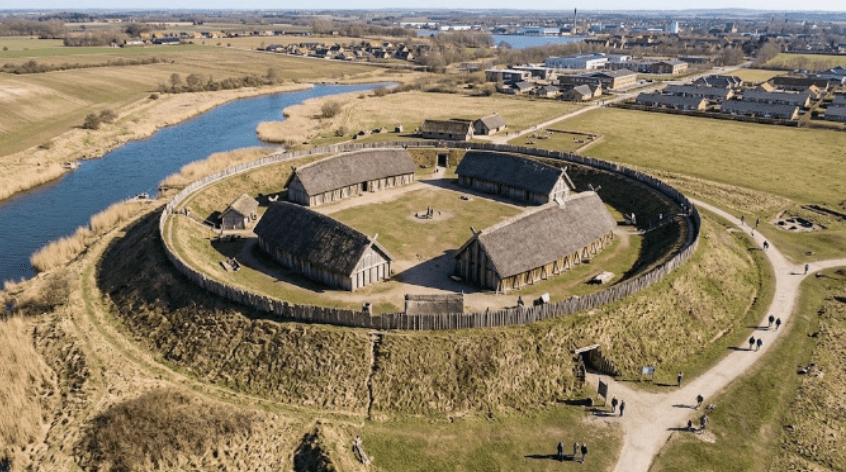
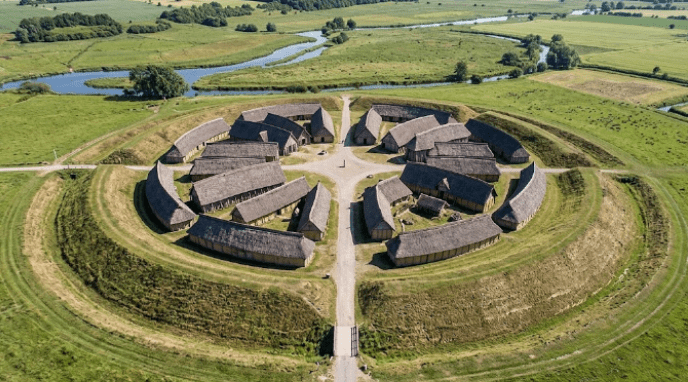
Archaeologists reconstructed Fyrkat as a highly ordered compound rather than a settlement that grew house by house. Four gates faced the cardinal directions. Two timber-paved roads crossed at the centre. Inside the four resulting quadrants stood four nearly identical longhouses arranged around a square courtyard—16 buildings planned as part of one architectural system.

Each longhouse measured about 28.5 metres in length and roughly 7.3 metres across at its widest point. The fortress itself had an inner diameter of approximately 120 metres. Its rampart measured about 12 metres across, and a V-shaped ditch roughly 7.5 metres wide and 2 metres deep strengthened the perimeter.

That precision matters.

Fyrkat was not simply a defensive circle with houses squeezed inside it. The housing belonged to the same standardized concept as the gates, roads, rampart, and geometry. UNESCO now treats Fyrkat, Aggersborg, Trelleborg, Nonnebakken, and Borgring as one integrated system of late-10th-century royal construction associated with Harald Bluetooth.

The 16 longhouses therefore offer a way to ask a larger question: was Harald building forts, or was he experimenting with an entirely new way to organize people, resources, movement, and royal authority?

The 16 Longhouses Were Part Of The Fortress Plan From The Start

Fyrkat’s longhouses make most sense when viewed from above.

Two roads crossed at right angles through the middle of the fortress, dividing the circular interior into four quadrants. Each quadrant contained one block of four longhouses arranged as four sides around an open courtyard.

The resulting plan looks strikingly controlled.

UNESCO’s Viking-Age Ring Fortresses documentation identifies this strict geometry as one of the defining characteristics of Harald Bluetooth’s fortress system. Fyrkat shared its basic planning principles with other ring fortresses constructed between about AD 970 and 980.

At Fyrkat, every group repeated the same architectural idea.

The longhouses were approximately 28.5 metres long, about 7.3 metres wide at the centre, and narrower at the straight gables. Each building contained a large central hall with smaller rooms toward the ends.

Archaeologists have excavated three of the four longhouse blocks. The fourth remains largely untouched.

The Viking Ship Museum notes in its Fyrkat archaeological overview that leaving part of the fortress unexcavated preserves archaeological material for future researchers with methods that may reveal evidence earlier excavations could not recover.

That unfinished archaeological record matters.

Fyrkat’s plan already looks extraordinarily regular, but one quadrant still has the potential to refine how researchers interpret life inside the enclosure.

Standardized Houses Suggest Standardized Expectations

Most Viking-Age farms did not look like Fyrkat.

Rural settlements developed through practical needs, family histories, rebuilding, livestock management, craft areas, and changing property boundaries. Houses varied in size and orientation.

Fyrkat imposed repetition.

A builder entering one quadrant already knew the basic form required there. The same principle appeared again across the road.

That architectural repetition suggests centralized planning rather than independent household decisions.

UNESCO emphasizes that the five ring fortresses required a level of organization capable of mobilizing workers, timber, earth, engineering expertise, and transport across different parts of Harald Bluetooth’s kingdom.

The houses extend that organization beyond fortification.

A king could command workers to build a rampart. Ordering an entire residential interior according to repeated measurements required a different type of control. Someone had to decide how many buildings belonged in each sector, how they aligned with roads, how they faced the courtyards, and how the whole arrangement fitted within the circle.

The result resembles an institution more than an ordinary village.

Fyrkat’s longhouses therefore matter as evidence for Harald’s interest in controlling space itself.

Fyrkat Was Built Around AD 980 During A Political Transformation

Nordjyske Museer dates Fyrkat to around AD 980, during Harald Bluetooth’s reign.

The king’s wider political program transformed Denmark during the later 10th century.

Harald succeeded his father, Gorm the Old, and appears in the famous Jelling inscription as the ruler who “won” Denmark and Norway and made the Danes Christian. Archaeological evidence connects his reign with major building projects that required resources on an extraordinary scale.

Fyrkat belonged to that program.

The Viking Museum Fyrkat presents the fortress as one of the ring fortifications Harald constructed as Denmark became more tightly organized under royal authority.

UNESCO dates the five recognized fortresses—Aggersborg, Fyrkat, Nonnebakken, Trelleborg, and Borgring—to approximately AD 970–980.

Researchers do not know precisely why Harald created them.

Military use remains an obvious possibility. They could protect strategic routes, support troops, demonstrate authority, provide temporary administrative centres, or combine several functions.

Their short working lives make the question harder.

What the archaeology shows with far greater confidence is that one political authority coordinated a remarkable building campaign across a large territory.

The 16 houses inside Fyrkat provide the human-scale component of that experiment.
Fyrkat

Four Courtyards Could Organize Groups Rather Than Families

The arrangement of four longhouses around each courtyard creates an intriguing social problem.

Who occupied those blocks?

Archaeologists cannot assign each courtyard to a named military unit, household, official, or craft group. No surviving text explains Harald’s staffing plan for Fyrkat.

Still, the architecture clearly divided people into repeated spatial units.

A courtyard could coordinate several houses while separating one group from neighbouring blocks. The axial roads created additional divisions, producing a fortress that could channel movement in a predictable way.

That arrangement differs from an organically developed village.

People entering Fyrkat moved through a landscape designed before they arrived.

The architecture may have helped organize sleeping, storage, food preparation, equipment, workshops, administration, or troops. Different buildings could have served different purposes even when their external plans looked alike.

That possibility prevents a common mistake: calling all 16 structures simple “barracks.”

Some occupants may have had military roles. Yet the archaeological evidence does not require every building to house warriors.

A functioning royal installation needed more than fighters.

Food had to arrive and remain stored. Horses needed management. Tools required repair. Craftspeople supported daily operations. Messengers, officials, servants, families, and visitors could all move through a royal site.

The longhouse blocks gave Harald a flexible framework for organizing those needs.

The Cemetery Shows Fyrkat Was Not Occupied Only By Male Warriors

The burial ground outside the fortress complicates any simple military-camp model.

Archaeologists have excavated roughly 30 inhumation graves northeast of Fyrkat containing men, women, and children. Geophysical evidence suggests additional graves may remain.

The Viking Ship Museum’s Fyrkat account emphasizes that the cemetery belongs to the period when the fortress operated.

That matters socially.

A population that included women and children looks different from a temporary garrison made exclusively of male soldiers.

The most famous burial belongs to the woman often called the Fyrkat seeress or völva, whose grave contained unusual objects that archaeologists have connected with ritual or magical practices.

Her presence has attracted much attention, but the broader cemetery may matter more for understanding the 16 houses.

People lived around Fyrkat in socially varied groups.

If parts of the fortress accommodated households, dependants, specialists, or families connected with royal service, the standardized longhouses become an experiment in organizing a community rather than simply quartering troops.

The evidence cannot yet assign the cemetery’s individuals to particular buildings.

It does warn against reducing the fortress to a barracks.

The Longhouses Turn Geometry Into Political Evidence

Harald Bluetooth’s ring fortresses share a feature that immediately separates them from most earlier Scandinavian strongholds: geometric regularity.

Fyrkat’s circle had four gates. Roads connected opposite gateways. The interior blocks fitted that cross-shaped division. Houses repeated dimensions and positions.

UNESCO describes this combination of geometry, scalability, and rapid construction as evidence for centralized authority.

The longhouses are central to that interpretation.

Without them, a circular rampart might simply demonstrate skilled military engineering.

With them, Fyrkat shows a ruler attempting to organize activity inside the enclosure according to a repeatable plan.

That suggests administrative thinking.

The same principle appeared at different scales. Fyrkat had 16 longhouses. Aggersborg, the largest fortress, contained 48. The system could expand while retaining its basic geometry.

That scalability is politically significant.

A ruler who could reproduce one organizational model in several regions did more than build isolated forts. He created a recognizable royal architectural language.

Visitors approaching Fyrkat, Trelleborg, or Aggersborg encountered variations of the same concept.

Royal authority became visible through measurement.

Fyrkat Controlled Both Land And Water Routes

The fortress did not occupy a random hill.

UNESCO’s Fyrkat management documentation describes its strategic position on a promontory above the valley of the Onsild Å.

During the Viking Age, the site stood at the head of Mariager Fjord, where the fjord approached the river system. Navigable connections lay only about 10 kilometres from waterways leading toward the Limfjord.

Fyrkat also stood close to Hærvejen, the major north-south land corridor through Jutland.

The fortress therefore occupied a position where royal power could influence movement along both east-west and north-south routes.

Water and wet ground strengthened its defenses naturally.

The surrounding terrain included lakes, boggy meadows, and river channels. The fortress builders incorporated those conditions into the defensive plan instead of relying only on the rampart and ditch.

That geography changes how the 16 houses look.

If Fyrkat helped supervise transport, royal representatives needed somewhere to stay, store supplies, maintain equipment, and coordinate people.

The longhouses supplied that infrastructure.

A fortress cannot control a route through geometry alone.

People make the system work.

The Houses Reveal The Cost Of Harald’s Experiment

Sixteen buildings measuring almost 30 metres each required enormous quantities of timber.

So did the palisade.

So did the timber-paved roads.

Workers had to fell trees, trim structural pieces, transport wood, dig postholes, move soil, excavate the ditch, raise the rampart, and construct buildings according to a consistent plan.

Food had to support those workers during construction.

Transport networks moved materials to the site.

Specialists supplied carpentry and surveying knowledge.

The project multiplied across several fortresses during roughly the same decade.

That scale explains why UNESCO treats the network as material evidence for Harald’s ability to mobilize resources across the kingdom.

Old Norse News recently examined an earlier stage of Danish elite organization through Erritsø’s pre-Jelling royal landscape. Erritsø suggests that powerful rulers and monumental halls existed before Harald Bluetooth.

Fyrkat represents something different.

Harald did not simply maintain another elite residence.

He replicated a standardized architectural system across several strategically located sites.

The 16 longhouses help reveal the difference between elite power and state-like organization.

The Short Life Of Fyrkat Makes The Longhouses More Mysterious

The ring fortresses appear to have operated for only a short period.

UNESCO treats their brief lifespan as an important part of their historical value.

That short use raises a difficult question.

Why invest so much labor in permanent-looking longhouses if the system would soon disappear?

Several explanations remain possible.

The fortresses may have answered an immediate political or military need during Harald’s consolidation of Denmark. They could relate to conflict with the German Empire, internal rivals, regional administration, or attempts to reorganize military obligations.

Later political changes may have made the network unnecessary.

Harald himself lost power near the end of his reign during conflict with his son, Sweyn Forkbeard.

Archaeology has not supplied one definitive cause for the abandonment of every ring fortress.

The longhouses make the puzzle sharper.

Their construction implies planning beyond a one-night encampment. Harald expected organized activity to occur inside Fyrkat for long enough to justify a major investment.

The experiment may simply have ended sooner than its builders expected.

Three Excavated Blocks Still Leave One Quarter For Future Archaeology

Fyrkat retains an unusual scientific advantage.

Archaeologists excavated only three of the four longhouse blocks.

One remains available for future investigation.

The Viking Ship Museum notes that archaeologists deliberately look toward future methods when considering the untouched quarter.

That restraint matters because excavation destroys the original context while documenting it.

Researchers working in the mid-20th century could map postholes and recover artifacts, but they lacked many techniques available today. Modern archaeology can study microscopic plant remains, soil chemistry, ancient DNA, residues, high-resolution radiocarbon samples, isotopes, and environmental traces.

Future methods may go further.

An untouched longhouse block could reveal whether occupants ate differently across buildings, whether craft activities clustered in specific houses, or whether particular materials entered one courtyard more often than another.

Such evidence could test whether the four courtyard blocks represented different functions.

That would move the debate about Harald’s experiment beyond architectural geometry.

It could show how his system operated in practice.

A 1985 Reconstruction Is Now Part Of Fyrkat’s 2026 Story

One of Fyrkat’s longhouses exists today as a reconstruction outside the original fortress.

Local residents initiated the project in the early 1980s using the archaeological evidence available at the time. Queen Margrethe II formally opened the reconstructed house on May 10, 1985.

More than four decades of weather have now taken their toll.

Nordjyske Museer announced in September 2026 that the A.P. Møller Foundation has granted 10 million Danish kroner for a major renovation of the reconstructed longhouse.

The museum’s 2026 Fyrkat longhouse restoration announcement reports damage including roof holes and decay in posts standing directly in the ground.

Renovation work is expected to begin in 2027, with the longhouse planned to reopen in 2028.

That modern restoration creates a useful archaeological reminder.

The reconstructed house has survived roughly 40 years and now requires substantial repairs.

Harald’s original buildings depended on the same basic problem of organic materials exposed to weather and soil.

Maintaining 16 large timber houses would have demanded constant work.

Royal architecture created obligations after construction ended.

UNESCO Status Has Shifted Attention From One Fortress To A System

In 2023, UNESCO inscribed Denmark’s five Viking-Age ring fortresses on the World Heritage List.

The decision matters for Fyrkat because it changes the scale of interpretation.

Fyrkat no longer stands mainly as a local archaeological site near Hobro. It forms one component of a coordinated late-10th-century royal system alongside Aggersborg, Nonnebakken, Trelleborg, and Borgring.

UNESCO describes the five sites as evidence for the centralization of power under the Jelling dynasty.

That interpretation fits the longhouses particularly well.

The houses show that common planning principles extended inside the fortifications.

A standardized rampart says something about defense.

Standardized residential blocks say something about organization.

Harald’s experiment combined both.

The fortress network may therefore preserve an early attempt to make royal authority reproducible across space.

Why Fyrkat’s 16 Longhouses Still Matter

Fyrkat’s longhouses matter because they turn Harald Bluetooth’s royal project from an abstract idea into a physical system for organizing people.

Sixteen nearly identical buildings stood in four repeated courtyard blocks.

Their positions followed the same strict geometry as the gates, roads, rampart, and ditch. Each house measured around 28.5 metres long. Together they occupied a fortress only about 120 metres across.

Outside lay a cemetery containing men, women, and children.

Around the fort ran strategic connections toward Mariager Fjord, Hærvejen, and routes leading toward the Limfjord.

Across Denmark, other ring fortresses repeated much of the same architectural language.

Those facts point toward something larger than one military camp.

Harald appears to have been testing how royal authority could occupy territory through planned infrastructure.

The experiment did not last long.

Its architecture did.

More than a thousand years later, the 16 missing houses still preserve the logic of the project through their postholes and layout.

They show Harald building places where people could be grouped, supplied, supervised, and moved according to a plan imposed from above.

That may be the most revealing part of Fyrkat.

The circular wall advertised royal control to anyone approaching from outside.

The 16 longhouses show what Harald tried to do with people once they came inside.
Posted in Literature & Texts, Mythology & Culture, Norse History & Archaeology | Comments Off on Why Fyrkat’s 16 Longhouses Still Matter To Harald Bluetooth’s Royal Experiment

Viking Language And Scandinavian Identity

Viking language is best understood here as a modern shorthand for Old Norse and its descendants, not as a single unchanged speech form carried intact into the present. Its role in modern Scandinavian identities is strongest where people can point to visible continuity, especially in Icelandic grammar and saga reading, but it is also shaped by change, loanwords, education, publishing, museums, and public symbolism. The evidence supports a careful argument: Old Norse still gives Scandinavians a shared linguistic memory, yet that memory is uneven across Icelandic, Norwegian, Swedish, Danish, and related North Scandinavian varieties.

Why Viking Language Still Matters

Viking Language And Icelandic Continuity

The clearest case for continuity is Icelandic. The Elon.io grammar resource on Old Norse continuity states that modern Icelandic still uses all four noun cases, nominative, accusative, dative, and genitive, along with three grammatical genders, strong and weak verbs, and subjunctive forms familiar from Old Norse. It also says much core everyday vocabulary remains unchanged in meaning or close in form Old Norse continuity. That does not mean Icelandic is identical to medieval saga language, but it explains why Iceland often holds a special position in discussions of Norse linguistic inheritance.

This continuity has cultural weight. Grammar can become a marker of belonging because it gives speakers a daily link to older texts, names, place-memory, and literary prestige. In Iceland, the link is unusually visible: the structure of ordinary speech still recalls the language of the sagas in ways that are harder to see in Danish or Swedish. That visibility can support identity without requiring the claim that modern Icelanders speak exactly as people did in the Viking Age.

The Saga Reading Claim

The same source notes that, roughly 800 years after many saga texts were composed, Icelanders can generally read Old Norse saga texts when spelling has been updated or slightly adjusted. Examples include Old Norse ek becoming modern Icelandic ég, ok becoming og, and at becoming að. These examples are modest but revealing. They show continuity through regular change rather than frozen preservation.

For identity, that difference matters. A reader does not need to imagine an unbroken Viking voice speaking directly from the manuscript page. The stronger interpretation is that modern Icelandic offers unusual access to medieval texts because enough grammar and vocabulary survived for educated readers to recognize the old forms. This is a cultural bridge, not a time machine.

Change, Loanwords, And Shared Memory

Loanwords Do Not Erase Inheritance

A cautious account must give change the same attention as survival. A study of gender assignment in six North Scandinavian languages reports that external loanwords rose from about 18 percent of total vocabulary in Old Norse to about 35–36 percent in modern Norwegian, Swedish, Jamtlandic, and Elfdalian North Scandinavian language study. Those figures are useful because they challenge romantic claims that modern Scandinavian languages simply preserve an ancient state.

The increase in loanwords does not make the Norse inheritance unimportant. Languages borrow while keeping older structures, sound patterns, meanings, names, and social associations. A modern Scandinavian speaker may use many later words and still participate in a linguistic tradition shaped by Old Norse. The question is not whether the inheritance is pure. It is how older forms remain meaningful after centuries of contact and adaptation.

Shared Roots And Unequal Continuity

The phrase Viking language can mislead if it suggests that all Scandinavian languages preserve Old Norse in the same way. Icelandic is often treated as the clearest continuity case because its grammar and saga readability remain striking. Other Scandinavian languages have changed more visibly, especially in grammar and vocabulary, while still carrying Old Norse inheritance through place names, personal names, inherited words, and cultural memory.

This unequal continuity shapes identity in different ways. Icelandic identity often emphasizes language preservation and access to medieval texts. Norwegian, Swedish, and Danish identities may draw more on shared historical origin, regional names, and public memory than on direct grammatical continuity. These are different relationships with the same linguistic past, and they should not be collapsed into one simple story.

Public Identity And Responsible Use

Museum case with runic objects and labels under soft gallery lighting

Runes, Names, And Selective Memory

Old Norse survives not only in grammar books. It appears in names, reconstructed pronunciations, runic display, heritage events, museum interpretation, and popular culture. These uses can encourage curiosity, but they can also flatten the evidence. A rune-like design or Old Norse-inspired name does not automatically create a historically grounded identity. It may be educational, decorative, commercial, political, or personal, depending on context.

For readers interested in how public memory can reshape Norse heritage through objects and display, Old Norse News has treated related issues in Norse identity artifacts. Language belongs in that same discussion. Words and scripts are cultural objects too. They can preserve memory, but they can also be selected, simplified, and repurposed.

Visual framing matters as well: for instance, a website called Finest Image illustrates how images can strongly influence the interpretation of Norse heritage. Through compelling visuals, the perceived age or authenticity of Viking language can be exaggerated.

Modern Scandinavian Identity Without Certainty

Modern Scandinavian identities are not built from language alone. They are shaped by education, national histories, regional traditions, literature, migration, religion, law, media, and heritage institutions. Old Norse is one strand in that wider cultural work. Its power comes partly from age and partly from recognizability: people can still see old words, names, grammatical traces, and saga forms reflected in modern usage.

The strongest evidence-based position avoids two extremes. One extreme treats Old Norse as a lost language with only museum value. That underestimates Icelandic continuity and the cultural force of inherited words and texts. The other extreme treats modern Scandinavian speakers as direct linguistic replicas of Viking Age communities. That ignores loanwords, sound change, grammar change, literacy history, and the different paths taken by each language.

Viking Language In Scandinavian Identity

Viking language continues to shape Scandinavian identity because it offers a shared point of reference while leaving room for regional difference. In Iceland, the connection is unusually concrete: grammar, vocabulary, and saga readability make the Old Norse inheritance part of modern literacy and self-understanding. In other North Scandinavian contexts, the link may be less grammatical but still present through names, inherited vocabulary, and public memory.

The value of this inheritance lies in careful reading. Old Norse should not be used as a vague badge of authenticity. It should be treated as historical evidence: a language family with survivals, changes, borrowings, and modern interpretations. That approach allows Scandinavian identity to be connected to the Viking Age without pretending that the past has reached the present unchanged.

Seen this way, the linguistic legacy is neither a simple survival story nor a broken chain. It is a record of continuity under pressure, shaped by use, borrowing, preservation, and interpretation. That is why Old Norse still matters: not because it gives modern Scandinavia a single origin myth, but because it helps people ask better questions about memory, belonging, and the words through which history is carried.

Posted in Language & Linguistics | Comments Off on Viking Language And Scandinavian Identity

Norse heritage festivals and modern myth

Norse heritage festivals in 2026 show a striking public appetite for Viking Age themes, but they also require careful reading. On September 17, 2026, several listed events had already taken place, while others were still scheduled for later dates. The strongest examples are not simple attempts to recreate the Viking Age. They are modern cultural gatherings that mix living history, mythic storytelling, craft, family activity, music, food, and, in some cases, contemporary Norse Pagan ritual. That mix can teach, but only if organizers and audiences keep a clear line between documented history, later myth, and present-day interpretation.

Why Norse heritage festivals Matter In 2026

How Norse heritage festivals Frame Myth

Festival programs in late 2026 placed Norse myth in public, social settings rather than treating it only as literature or museum material. Viking Fest Minnesota, scheduled for October 10–11 and October 17–18, 2026, at the Dakota County Fairgrounds near Minneapolis–Saint Paul, described itself as an immersive celebration of Viking heritage, Norse mythology, and living history, with live combat, artisan crafts, feasting, and hands-on family experiences according to Viking Fest Minnesota. The wording matters. It places mythology beside heritage and reenactment, not above them.

That arrangement reflects a broader pattern in 2026 festival programming. Mythic figures and themes are used to draw audiences into story, identity, and performance. The supplied research notes record Loki-themed programming at Vista Viking Festival in Southern California on September 19 and 20, 2026, and at VikingFest 2026: Mead & Mischief in St. Joseph, Missouri, on November 13 and 14, 2026. Since those examples are festival programs rather than historical evidence, they should be read as modern interpretation. A Loki theme can illuminate trickster narratives and popular reception, but it cannot be treated as proof of Viking Age ritual practice at a given site.

What Counts As Evidence

The evidence for these events is mainly organizational: dates, venues, program descriptions, and reported attendance or participation where available. That kind of evidence tells us how people in 2026 chose to present Norse material. It does not tell us directly what tenth-century Scandinavians did at assemblies, farms, shrines, or seasonal gatherings. The distinction is essential. A combat show can teach weapon handling as performance. A craft stall can demonstrate handwork. A feast can evoke hospitality. None of these, by themselves, reconstruct a named Viking Age event.

For readers comparing U.S. examples, our earlier discussion of Norse heritage festivals in the U.S. may help frame how Scandinavian American communities connect ancestry, myth, memory, and public culture. Community sites in the same wider network, such as Bethel NC UMC, remind us that local organizations often become part of how regional memory, calendars, and identity are shared, even when their own subject matter is different.

Myth, Ritual, And Living History

Winter Nights As A Modern Seasonal Gathering

Vetrnætr, or Winter Nights, is one of the clearest examples of a 2026 festival using Old Norse seasonal language in an explicit mythic and ritual setting. The event listing places the three-day gathering on October 23–25, 2026, at Sagastad Viking Museum in Nordfjordeid, Norway, and describes a program focused on the old Norse year and mythology, with blót, lectures on Odin and myth, and ancestral celebrations, as listed by Winter Nights at Sagastad.

This kind of programming needs careful language. The presence of blót in a 2026 festival does not mean the event is a direct survival of Viking Age worship. It shows that modern participants are working with Norse vocabulary, seasonal memory, and reconstructed or reimagined ritual forms. That is culturally significant, but it is not the same as archaeological proof. The cautious reading is stronger: modern Norse spirituality, public history, and museum-adjacent programming are meeting in the same space.

Combat, Craft, And Family Participation

Living history is one of the most accessible forms used by these festivals. The research notes identify combat, artisan crafts, feasting, interactive villages, children’s programs, runestone carving, longship exhibits, storytelling, and costumed performance across 2026 events. These features make the past tactile. Visitors can see textile work, woodwork, foodways, staged conflict, and symbolic objects rather than encountering Norse heritage only through books or display cases.

Yet living history always involves selection. Organizers choose which tools, myths, costumes, songs, and rituals to foreground. A family-friendly activity may soften historical violence. A battle reenactment may heighten spectacle. A mythic stage act may compress sources separated by date, geography, and genre. Norse heritage festivals are strongest when they present those choices openly: “inspired by,” “based on,” or “drawn from” are safer claims than “exactly as it was.”

Community Memory And Festival Survival

Community members gathered around folk costumes and food stalls

What 2026 Events Reveal About Continuity

The 2026 festival record also shows that Norse and Scandinavian heritage are not presented only through Viking warrior imagery. The Scandinavian Heritage Festival in Ephraim, Utah, took place over Memorial Day weekend 2026 and, according to the research notes, drew about 30,000 visitors while emphasizing historical tours, storytelling, Scandinavian immigrant history, and cultural activities. New Sweden, Maine, marked Midsommar in June 2026 with maypole dancing, Swedish folk costumes, and intergenerational community continuity in a town of fewer than 600 residents.

These examples broaden the frame. Scandinavian heritage can mean immigrant memory, seasonal celebration, costume, food, music, and local belonging. Norse mythology may be present in some places and absent in others. That difference matters because “Norse” and “Scandinavian” are not interchangeable terms in every setting. A careful article should not force Odin, Loki, runes, or longships into festivals whose main focus is Swedish midsummer or immigrant history.

Why Festival Closures Also Matter

Not every heritage institution expanded in 2026. The research notes state that Norsk Høstfest in North Dakota, founded in 1978, ceased operations in 2026 after organizers cited rising costs, declining attendance, and financial strain. The same notes describe Fjord Folk Fest in Minot, held on August 21, 2026, as a new festival created after that closure, with artisans, food vendors, and cultural performances.

That shift is a reminder that cultural memory depends on budgets, volunteers, venues, audiences, and timing. A festival can be meaningful and still financially fragile. A new event can carry forward selected traditions while changing scale, format, or emphasis. Public heritage is not fixed. It is maintained through practical decisions as much as through stories.

Norse heritage festivals And Modern Meaning

Reading 2026 With Caution

Norse heritage festivals are most useful when they invite better questions rather than offering false certainty. What is drawn from medieval texts? What is based on archaeology? What comes from nineteenth- and twentieth-century Scandinavian immigrant memory? What belongs to modern Pagan practice? What is entertainment? These categories can overlap at a festival, but they should not be collapsed into one claim about “the Vikings.”

The 2026 examples show several clear tendencies: mythology is becoming more visible in programming; living history remains a major interpretive tool; family participation is central to many events; ritual language is appearing in some gatherings; and financial pressure is reshaping older institutions. The evidence supports those observations. It does not support broad claims that modern festivals revive Viking religion unchanged, or that every craft demonstration reflects a documented local practice.

For contemporary readers, the value lies in the meeting point between old stories and present communities. Odin lectures, Loki themes, blót, stonelifting, craft stalls, Midsommar dances, feasts, and longship imagery all show different ways people use northern memory. Some are playful. Some are devotional. Some are educational. Some are tied to immigrant identity more than Viking Age evidence. A cautious approach lets each be seen for what it is.

The best reading of these festivals is neither dismissal nor uncritical celebration. They are modern cultural acts built around selective memories of the North. If they name their sources, state their limits, and respect the difference between myth, history, and present practice, they can bring ancient stories into public life without pretending that every performance is a recovered fragment of the Viking Age.

Posted in Mythology & Culture | Comments Off on Norse heritage festivals and modern myth

Why New Tree-Ring Research Could Complicate The Exact 1021 Viking Date In America

The year AD 1021 has become one of the most memorable dates in Viking archaeology. A 2021 Nature study used a sharp radiocarbon increase linked to a cosmic event in AD 993 to date three pieces of wood from L’Anse aux Meadows in Newfoundland. By locating that radiocarbon signal and counting tree rings outward to the surviving bark edge, researchers concluded that Norse people cut all three trees in 1021.

The result was extraordinary because it replaced a broad early-11th-century estimate with a single calendar year.

New tree-ring research published in 2026 does not erase that finding. It does complicate one of the assumptions that makes exact-year radiocarbon dating possible.

A team led by West Virginia University geographer Amy E. Hessl reviewed how trees absorb, store, and later reuse carbon. Their work shows that the carbon locked into one year’s wood does not always come exclusively from carbon absorbed during that same year. Different species can use stored carbohydrates from earlier growing seasons, and trees can record sudden atmospheric radiocarbon changes differently.

That biological lag matters when archaeologists use events such as the AD 993 radiocarbon spike as an exact annual timestamp.

The result is a more careful way to read 1021. The date remains strong evidence for Norse activity at L’Anse aux Meadows during the early 11th century, but researchers now have another reason to examine how much confidence should attach to the word “exact.”

The 2021 Study Turned A Solar Event Into An Archaeological Clock

Before 2021, archaeologists already knew that Norse people occupied L’Anse aux Meadows around AD 1000.

Helge Ingstad and archaeologist Anne Stine Ingstad identified the Newfoundland site in 1960. Excavations exposed eight timber-and-sod structures resembling buildings from Norse Greenland and Iceland. Researchers found evidence for iron production, woodworking, boat repair, and objects that securely identified the settlement as Norse.

Parks Canada describes L’Anse aux Meadows as the oldest known European settlement in the New World.

Dating the settlement to one particular year proved far harder.

That changed when Margot Kuitems, Birgitta Wallace, Michael Dee, and their colleagues examined wooden material from the site using high-resolution radiocarbon measurements.

Their 2021 Nature study focused on three wooden objects modified with metal blades. Researchers established that the samples came from three different trees and represented at least two botanical groups: fir, probably balsam fir, and juniper or thuja.

Each sample retained its waney edge, the outermost wood directly beneath the bark.

That feature was critical.

If scientists could identify one tree ring corresponding to a known calendar year, they could simply count outward until they reached the final growth ring.

The anchor came from the Sun.

The AD 993 Radiocarbon Spike Made 1021 Possible

Earth receives a constant stream of high-energy particles from space.

Occasionally, extreme cosmic or solar events trigger sharp increases in atmospheric carbon-14. Japanese physicist Fusa Miyake and colleagues first identified one famous spike associated with AD 774–775, and researchers later documented another around AD 993.

Scientists now commonly call such anomalies Miyake events.

Trees absorb atmospheric carbon dioxide through photosynthesis. As they form annual rings, they preserve variations in atmospheric radiocarbon. A sufficiently strong spike can create a chronological marker visible across widely separated tree-ring records.

The L’Anse aux Meadows researchers found the AD 993 anomaly inside each of their three wood sequences.

They then counted the rings between that event and the outer edge.

All three trees pointed to AD 1021.

The convergence made the result especially persuasive. Independent trees did not produce three different dates; each led to the same year.

The researchers also had archaeological reasons to connect the cutting with Norse activity. Metal tools had shaped the wood, yet Indigenous inhabitants of the region did not manufacture iron tools at that time. Norse occupants at L’Anse aux Meadows did.

The study consequently concluded that Norse people were active in Newfoundland in AD 1021.

That statement remains narrower than a claim about when Europeans first landed.

AD 1021 Never Meant The Norse Arrived That Year

The distinction between “presence” and “arrival” has always mattered.

The Nature paper established that Norse people cut wood at L’Anse aux Meadows in 1021. It did not prove that their first voyage across the Atlantic occurred in that year.

They could have arrived earlier.

The settlement could have seen activity over more than one season or expedition. Parks Canada describes L’Anse aux Meadows as a base used for exploration and resource gathering, probably for only a few years, but archaeology has not assigned every period of occupation to an exact calendar date.

The medieval Vinland sagas create another chronological problem. They describe voyages associated with Leif Erikson, Thorfinn Karlsefni, Gudrid Thorbjarnardóttir, and other Norse travelers, yet scribes wrote surviving versions generations after the events.

Archaeology provides the firmer chronological foundation.

The Parks Canada history of the Norse site describes L’Anse aux Meadows as a base from which Norse crews could travel farther into areas they called Vinland.

That distinction becomes even more important in light of the 2026 research.

If scientists eventually add a small uncertainty around the 1021 tree-ring result, they would be refining the date of one documented woodworking episode, not suddenly moving the entire Norse discovery of North America to a different century.

vikingamerica

The 2026 Study Asks Whether Trees Record Radiocarbon Equally

Amy Hessl and eight coauthors published their study, carbon uptake and radiocarbon signals in tree rings, online on January 26, 2026. It appeared in the June 2026 issue of New Phytologist.

The team addressed a deceptively simple question.

When atmospheric carbon-14 suddenly rises, do all trees record that event in exactly the same annual ring?

The answer appears to be no.

Existing tree-ring records show impressive global agreement around major radiocarbon events, but the researchers found meaningful differences among samples. Some trees register a rise earlier or later than others. Certain records spread what looks like a sharp atmospheric event across more than one annual ring.

Evidence surrounding the AD 993 event itself illustrates the problem.

Hessl and colleagues note that replicated records can show the radiocarbon increase across approximately AD 993–995 rather than as an identical one-year pattern in every tree.

That does not mean scientists have misdated the event by decades.

It means a tree is a biological organism, not a passive atmospheric measuring instrument.

Trees Can Build New Wood With Old Carbon

The main complication involves stored carbon.

Trees capture carbon through photosynthesis, but they do not necessarily use all of it immediately.

They store some carbon as nonstructural carbohydrates, mainly sugars and starches. Those reserves can later support respiration, new leaves, roots, buds, shoots, and wood.

Hessl’s team reviewed evidence showing that stored carbon can range from recently fixed material to carbon several years old. In some biological processes, trees have drawn on reserves more than a decade old.

New wood can therefore include carbon that entered the tree during an earlier growing season.

That creates a potential problem for annual radiocarbon interpretation.

Suppose the atmosphere experiences a sudden carbon-14 spike in one year. A tree that builds all of its new wood from recently photosynthesized carbon may record the event sharply.

Another tree might mix recently absorbed carbon with stored carbohydrates.

Its annual ring could record a softer, delayed, or extended version of the same atmospheric event.

The researchers describe this process as a potential “blurring” of the annual radiocarbon signal.

For archaeologists seeking a precision of centuries, such a difference barely matters.

For archaeologists claiming one exact year, it deserves attention.

Species And Growing Seasons Can Change The Signal Too

Stored carbohydrates form only part of the problem.

Different tree species grow wood in different ways.

Some trees begin producing earlywood before their new leaves fully develop. Those trees may rely heavily on stored carbon from previous years during the opening part of the growing season.

Other species use larger proportions of newly fixed carbon.

Climate, latitude, drought, stress, leaf longevity, and wood anatomy can all influence when trees absorb carbon and when they allocate it to a particular ring.

The atmospheric side contains complications too.

Radiocarbon generated high in the atmosphere does not mix instantly and identically across the planet. Latitude and atmospheric circulation can affect how the signal reaches different regions.

A 2026 commentary in New Phytologist argues that tree physiology is central to interpreting Miyake events.

That does not make Miyake-event dating unreliable.

It makes its uncertainty more biologically interesting than researchers initially assumed.

Why The New Research Does Not Simply “Debunk” 1021

The most important limit of the 2026 study deserves emphasis.

Hessl and colleagues did not take the three L’Anse aux Meadows wood pieces, remeasure them, and produce a different year.

Their paper reviews the broader science of how carbon moves through trees.

It actually cites the L’Anse aux Meadows work as an important example of what Miyake-event dating has accomplished.

The new research instead questions a general assumption behind ultra-high-resolution dating: that annual tree rings reproduce atmospheric carbon-14 signals with perfectly uniform timing across species, sites, and environments.

That difference protects the article from a misleading headline.

No new excavation has shown that Norse people were absent from Newfoundland in 1021.

No replacement date such as 1020, 1022, or 1030 has emerged.

The original study retains several strengths.

Researchers analyzed three different trees, not one. At least two tree types were represented. All three sequences converged on 1021, and each retained its outermost wood. The pieces carried metal-tool modifications linking them with Norse activity.

Those independent lines make the original result more resilient than a date derived from one isolated ring sequence.

The 2026 work calls for better uncertainty models, not abandonment of tree-ring radiocarbon dating.

The Exact-Year Claim Is Stronger Than The “First Arrival” Claim

Much popular coverage turned the Nature result into statements such as “Vikings arrived in America exactly 1,000 years ago.”

That language stretches the evidence.

The paper established Norse activity in 1021.

Its three wood fragments do not identify the first voyage, the founding day of the settlement, the arrival of Leif Erikson, or the year in which Norse sailors first sighted continental North America.

That difference becomes useful when interpreting the new tree research.

Even if future work introduces a narrow biological uncertainty into the precise annual calibration, the wider archaeological picture hardly moves.

L’Anse aux Meadows remains an early-11th-century Norse settlement.

UNESCO identifies the Newfoundland Norse settlement as the earliest known evidence of European presence in North America and the only authenticated Norse settlement site on the continent.

The question now concerns extraordinary precision.

Can archaeologists say “1021” without qualification, or should they describe the wood cutting as occurring around a tightly constrained point in the early 1020s unless replication confirms how those species record the AD 993 anomaly?

The 2026 research gives scientists a reason to test that question rather than assume the answer.

L’Anse Aux Meadows Used More Than One Tree Species

The botanical diversity of the 2021 samples now deserves renewed attention.

The Nature team identified fir, probably balsam fir, alongside juniper or thuja-type wood.

Hessl’s review argues that species differences can affect how annual radiocarbon signals appear.

That creates an interesting opportunity.

If physiologists can model how fir and juniper or thuja allocate stored versus newly absorbed carbon into wood, researchers could test whether the agreement among all three L’Anse aux Meadows samples becomes even stronger after accounting for tree biology.

The result could move in either direction.

A refined model might show that each species should record the AD 993 signal in almost exactly the way the original research assumed.

Another result might identify a small systematic lag.

That is how scientific revision normally works.

New research does not need to destroy an earlier result to improve it.

Sometimes it tells researchers which hidden assumptions require measurement.

Reanalyzing The Original Samples Would Be More Decisive

The next major step would involve the L’Anse aux Meadows wood itself.

Researchers could examine additional annual rings at higher resolution, compare earlywood and latewood, test more reference trees from similar latitudes and species, and model the contribution of stored carbohydrates.

More Norse-modified wood with intact outer edges would help too.

A larger sample could determine whether 1021 remains the best annual match across different trees or whether the activity belongs within a narrow multi-year window.

The key word is replication.

Miyake events remain extremely valuable chronological anchors. Their sudden radiocarbon increases can turn archaeological wood that once carried decades of uncertainty into material dated within a remarkably small window.

Hessl’s research does not reverse that progress.

It argues that the final step—from very precise dating to absolute certainty about one annual ring—needs a better account of tree physiology.

That lesson extends beyond Vikings.

Archaeologists now use cosmic radiocarbon events to study prehistoric settlements, volcanic eruptions, ancient trade systems, and other events where ordinary radiocarbon dating cannot provide yearly precision.

Every field using the method has a reason to watch this debate.

The Date Does Not Change Who Was Already In North America

Discussion of “the first Europeans in America” can obscure another chronological fact.

People had inhabited North America for thousands of years before the Norse reached Newfoundland.

Parks Canada documents Indigenous use of L’Anse aux Meadows reaching back approximately 6,000 years. Archaeologists have identified traces from several distinct Indigenous populations around the site.

The Norse date marks European transatlantic presence, not the human discovery of the continent.

That distinction matters especially when popular articles frame 1021 as the year “America was discovered.”

Archaeology supports no such interpretation.

What makes the date important is different.

It provides an exceptionally precise chronological point connecting medieval European activity with the western side of the Atlantic hundreds of years before Christopher Columbus’s 1492 voyage.

Even if future work adjusts the precision attached to 1021, that larger historical fact remains unchanged.

Norse Atlantic Travel Does Not Depend On One Calendar Year

L’Anse aux Meadows belongs to a much wider maritime system.

Norse sailors settled Iceland during the ninth century and Greenland near the end of the tenth. Ships connected farms and political communities across a North Atlantic zone stretching from Scandinavia through the Faroes, Iceland, and Greenland.

Newfoundland extended that route farther west.

The archaeological settlement there contained substantial turf buildings, workshops, ironworking, and evidence connected with ship repair. Butternuts found at the site indicate travel to regions farther south, since those trees do not naturally grow in northern Newfoundland.

The settlement consequently functioned as more than the site of one accidental landfall.

Old Norse News has examined that wider mobility through Norse maritime cultures and Atlantic networks, where ships, regional identities, and movement show why Norse history rarely fits inside one national boundary.

Whether one tree fell in 1021 or within a narrowly adjusted window does not alter that network.

The dating debate instead reveals how precisely archaeology can hope to place one moment inside it.

Why The 1021 Date May Become More Scientific By Becoming Less Absolute

The strongest response to the new tree-ring research is not to discard 1021.

It is to define what 1021 means more carefully.

The 2021 Nature study found the AD 993 radiocarbon anomaly in three independently sourced pieces of Norse-modified wood. Researchers counted outward to preserved waney edges and obtained the same felling year for all three: AD 1021.

That remains unusually strong archaeological evidence.

Hessl and colleagues added a biological complication in 2026. Trees can store carbon, reuse carbon fixed in earlier years, grow at different times of the season, and register sudden radiocarbon events differently according to species and environment.

Replicated tree-ring records now show that even famous events such as the AD 993 anomaly can appear across more than one annual ring in some trees.

Those findings justify caution around claims of perfect annual resolution.

They do not move the Norse back to Europe.

They do not remove L’Anse aux Meadows from the early 11th century.

They do not establish a replacement date.

The most productive interpretation sits between certainty and sensational reversal.

AD 1021 remains the best-supported exact calendar year currently associated with Norse woodworking at L’Anse aux Meadows. The 2026 research shows that scientists should continue testing how precisely individual trees convert an atmospheric radiocarbon event into an annual wooden record.

That may eventually confirm 1021 with even stronger physiological evidence.

It could introduce a narrow margin around it.

Either result would improve the chronology.

The story is no longer simply that a solar event gave archaeologists the exact year Vikings stood in North America. It is that the Sun, atmosphere, trees, archaeology, and human activity all have to align before one calendar year can carry that level of confidence.

That makes 1021 more interesting, not less.

Posted in Literature & Texts, Mythology & Culture, Norse History & Archaeology | Comments Off on Why New Tree-Ring Research Could Complicate The Exact 1021 Viking Date In America

Why The Salme Ship Burials Keep Moving The Viking Age Before 793

The raid on Lindisfarne in AD 793 still supplies one of history’s most familiar dates. Generations of textbooks have used the attack on the Northumbrian monastery as a convenient starting point for the Viking Age. The two ship burials at Salme on Estonia’s Saaremaa island make that boundary increasingly difficult to defend as the beginning of Scandinavian maritime violence.

The Salme dead were buried around AD 750, nearly half a century before Lindisfarne. Archaeologists recovered the remains of 41 men from two vessels together with swords, shields, arrows, gaming pieces, dice, combs, animals, and other equipment. Isotope and genetic studies point mainly toward eastern central Sweden, especially the Mälaren and Uppland region.

This was not simply a group of Scandinavian travelers who died abroad. Skeletal injuries and weapon evidence indicate violent conflict. The larger ship could sail rather than merely row, making it the oldest known Nordic sailing vessel yet identified according to the current Vrak – Museum of Wrecks presentation.

Salme therefore shifts the Viking question eastward and backward. Scandinavian warrior groups were already crossing the Baltic, traveling in organized companies, carrying elite equipment, and dying violently overseas decades before English monks recorded the raid that later became the Viking Age’s symbolic opening.

The 2026 Exhibition Keeps Salme At The Centre Of The Viking Debate

Salme returned to public attention in Sweden through the exhibition Vikings Before Vikings at Vrak – Museum of Wrecks in Stockholm.

The exhibition originally opened there on April 11, 2025 after Saaremaa Museum created the presentation in Estonia. Vrak currently lists it as running through November 1, 2026, giving visitors access to original objects, films, reconstructions, weapons, and material connected with the two ship burials.

Vrak’s Vikings Before Vikings exhibition openly frames Salme against the traditional AD 793 date. The museum argues that armed Scandinavian expeditions into the Baltic occurred before the end of the eighth century and describes Salme as the oldest known burial site of a Viking-Age war band.

That current museum framing does not mean archaeologists have universally replaced 793 with a new official starting year.

Historical periods rarely begin on one universally accepted day.

AD 793 remains valuable because Lindisfarne provides a dated written event recorded in western European sources. Salme provides a different type of evidence: archaeology documenting maritime movement and organized violence decades earlier.

The distinction matters.

Lindisfarne tells historians when Scandinavian raiders became dramatically visible in surviving English records. Salme asks whether those raiding systems had already developed elsewhere before western chroniclers noticed them.

The First Salme Ship Appeared By Accident In 2008

The discovery began during construction work in the village of Salme in 2008.

Workers encountered human bones, iron objects, sword fragments, rivets, and gaming pieces. Archaeologists soon realized that the remains belonged to a boat burial rather than an ordinary cemetery.

The first vessel, now called Salme I, had suffered considerable disturbance from modern construction.

Researchers reconstructed it as a clinker-built rowing vessel approximately 11.5 metres long, probably equipped with six pairs of oars. Seven men lay inside or around the surviving portion of the vessel.

Another discovery followed nearby.

Archaeologists located a second and much larger vessel, Salme II, and investigated it during excavations between 2010 and 2012. This ship held 34 men, producing a combined total of 41 individuals between the two burials.

Tallinn University’s Salme ship burial research describes the pair as exceptional because no other known Viking ship burial contains so many individuals.

The numbers immediately separate Salme from famous elite ship graves built around one high-status individual.

These vessels held groups.

That makes them evidence for organized companies rather than simply individual funerary status.

SalmeShipburial

Around AD 750 Changes The Chronology

Dating places the burials around AD 750.

That date falls in an awkward zone between archaeological period labels. Swedish archaeology traditionally calls much of the seventh and eighth centuries the Vendel Period. Estonian archaeology can describe Salme as Pre-Viking. Other researchers increasingly place the finds at the very beginning of the Viking phenomenon.

Uppsala University’s Salme research project puts the issue plainly: Salme dates to the point where the Vendel Period shades into the Viking Age.

That blurred boundary may prove more historically useful than replacing 793 with 750.

Political, maritime, technological, and social changes do not happen because one calendar date arrives. Long-distance sailing, warrior retinues, elite gift exchange, ship technology, and Baltic mobility developed over time.

Salme gives archaeologists a snapshot from that development.

By around 750, a large group of armed Scandinavian men had already crossed the Baltic in vessels, reached Saaremaa, entered violent conflict, and received elaborate ship burials far from home.

Those actions resemble behavior that later defines the Viking Age.

The archaeological problem concerns how much earlier those systems began.

Forty-One Men Make Salme A War-Band Burial

The human remains provide some of the most direct evidence.

Researchers identified seven individuals in Salme I and 34 in Salme II. The dead were overwhelmingly young or middle-aged adult men with physiques consistent with physically demanding lives.

Many showed injuries.

Weapon trauma and arrow evidence point toward a violent encounter shortly before burial. Archaeologists found arrowheads lodged in parts of the vessel and shields, adding physical evidence for combat.

The larger burial had careful organization despite the violence that preceded it.

People arranged bodies inside Salme II in layers, with some positioned several deep. Weapons and other possessions accompanied them.

This combination makes the deposit unusual.

It was neither an improvised dumping of battlefield casualties nor a normal single-person elite burial.

Someone survived long enough to organize a complex funeral.

That detail raises questions that Salme has not yet answered. Were the people who buried the warriors fellow Scandinavians who survived the battle? Did local people perform the burial? Was there a negotiated aftermath between opposing groups?

The graves record what happened to the dead more clearly than they identify the burial party.

The Men Came Mainly From The Swedish Side Of The Baltic

Scientific analysis has narrowed the group’s probable origins.

A 2020 study in the Journal of Archaeological Science: Reports examined strontium, oxygen, and carbon isotope evidence from the Salme individuals. The results indicate that most did not grow up on Saaremaa.

Researchers linked the strongest isotopic signals with the Mälaren region of east-central Sweden. Five men in Salme II produced lower strontium values that could fit Gotland or other locations.

The peer-reviewed Salme isotope study therefore supports an origin across the Baltic rather than among the local Saaremaa population.

Artifacts point in the same direction.

Sword fittings and other high-status material find close parallels around Mälaren, Uppland, Valsgärde, and related Swedish elite environments.

The group consequently looks less like an anonymous Baltic force and more like a company whose strongest connections lay in what is now Sweden.

That geographic direction changes the Viking story.

Early western European written accounts naturally direct attention toward Norway, Denmark, Britain, Ireland, and Francia. Salme shows a major maritime arena developing east of Scandinavia at the same time.

The Baltic may have served as one of the training grounds for the social and military practices later made famous in the west.

Four Brothers Turn A War Band Into A Family Network

Ancient DNA gave Salme an even more personal dimension.

The major 2020 Nature study Population genomics of the Viking world analyzed genomes from Viking-period populations across Europe and Greenland. Among the Salme individuals, researchers obtained genetic information for 34 men.

The analysis identified four brothers buried side by side.

Scientists detected another man who had a third-degree genetic relationship with one of the brothers.

The Viking population genomics study therefore shows that close family relationships existed inside the expedition.

This finding complicates the image of Viking war bands as temporary collections of unrelated adventurers.

At least part of the Salme company traveled with close kin.

Family relationships could have influenced loyalty, recruitment, inheritance, military obligation, and the organization of elite followers. The four brothers do not prove that the entire group belonged to one clan, but they provide direct evidence that kinship formed part of the company.

Their burial positions matter too.

Someone placed the brothers beside each other.

Whether the burial organizers knew their exact relationships seems likely, though archaeology cannot reconstruct the decisions in detail.

Genetics has turned what looked like a mass of warriors into a group containing identifiable family structure.

The Weapons Look Like Elite Equipment, Not Random Travel Gear

Salme produced an extraordinary collection of weapons.

Archaeologists recovered remains from around 40 swords, including single- and double-edged examples. Some had elaborately decorated hilts with gilded bronze and garnet fittings.

Shields covered or accompanied several bodies.

Researchers found numerous arrowheads, a smaller number of spearheads, knives, and other equipment.

The quantity of swords matters because good swords demanded substantial resources. They required skilled forging, valuable materials, maintenance, and access to elite exchange systems.

Some decorative pieces closely resemble objects from high-status Swedish contexts.

That makes the group socially significant without proving that every man held aristocratic rank.

The expedition could have contained members of an elite retinue.

A 2016 Antiquity study even proposed that the men might represent a diplomatic delegation protected by armed warriors rather than a raiding force. The researchers based that interpretation partly on luxury weapons, hunting animals, gaming equipment, and other possessions that do not resemble the minimum kit for a straightforward raid.

That hypothesis remains open.

Salme records violence.

It does not tell us whether violence formed the expedition’s original purpose.

The Larger Ship May Be The Most Important Artifact Of All

The people and weapons often dominate discussion, but the vessel itself may carry the biggest chronological consequence.

Salme II appears to have possessed the ability to sail.

Vrak currently describes it as the oldest known Nordic sailing ship.

That claim pushes an important technological threshold earlier than many popular Viking narratives suggest.

The transition from primarily rowing craft toward efficient sailing ships transformed Scandinavian mobility. Sail reduced dependence on human rowing power and made longer open-water journeys more practical.

It did not happen overnight.

Shipwrights needed experience with hull form, masts, rigging, sails, steering, loading, and the stresses created by wind propulsion.

A sailing vessel around 750 implies that these technological traditions had already advanced before Lindisfarne.

The Baltic provided an ideal environment for that development.

Scandinavian communities had centuries of maritime experience before the Viking Age. Islands, archipelagos, narrow sounds, and long coasts demanded boats for communication, fishing, warfare, migration, and exchange.

Salme places sail-powered Scandinavian movement inside that earlier maritime tradition.

The famous western raids may represent an expansion of existing capacity rather than the invention of something new in the late eighth century.

The Baltic May Have Come Before The Atlantic Viking Story

The traditional Viking narrative looks west.

Lindisfarne stands in England. Soon come attacks and settlement around Britain, Ireland, Francia, and the North Atlantic.

Salme faces east.

A company from central Sweden crossed the Baltic toward Saaremaa decades before 793.

Uppsala University’s Viking Phenomenon project has highlighted this directional problem directly. Its Salme research argues that the origins of Viking raiding may lie partly within the Baltic sphere rather than beginning with expansion toward western Europe.

That interpretation fits geography.

Swedish communities around Mälaren had natural maritime connections toward the Baltic islands, Finland, the eastern Baltic coast, and river routes leading farther east.

Later Viking-Age archaeology confirms extensive Swedish involvement in those eastern systems.

Salme shows that movement had an armed dimension at an early date.

This does not mean eastern expeditions caused every later western raid.

It does mean the west should not monopolize the Viking origin story.

Scandinavian seafarers could have developed military practices through multiple maritime zones at once.

Why Salme Keeps Moving The Viking Age Before 793

Salme changes the chronology through accumulation rather than one dramatic claim.

Two Scandinavian vessels reached Saaremaa around AD 750.

One appears capable of sailing.

Forty-one men died violently and received organized ship burials.

Their weapons included around 40 swords, shields, arrows, and high-status fittings. Hundreds of gaming pieces, hunting animals, combs, food, and other possessions show that the travelers carried more than battle equipment.

Isotopes connect most of the men to central Sweden.

Ancient DNA reveals four brothers buried side by side.

Every one of those observations belongs almost half a century before Lindisfarne.

The question has consequently changed.

Historians no longer need to ask whether Scandinavian maritime expeditions existed before 793. Salme demonstrates that they did.

The harder questions concern how far back those systems extend, whether the eastern Baltic played a formative role, when sailing became routine, and how elite households recruited the men who traveled overseas.

The current Vikings Before Vikings exhibition at Vrak keeps those questions visible through November 1, 2026.

Its title makes a useful historical point even if the terminology remains deliberately provocative.

The Salme men lived at a period that some archaeological systems still call Pre-Viking.

Their ships, weapons, overseas movement, kinship group, violent deaths, and burial treatment look remarkably like features later used to define the Viking Age.

That is why 793 now works better as a famous historical marker than a hard archaeological border.

Salme has already crossed it.

Posted in Literature & Texts, Mythology & Culture, Norse History & Archaeology | Comments Off on Why The Salme Ship Burials Keep Moving The Viking Age Before 793

Jon K. Lauck And Scandinavian Heritage Work

Scandinavian Heritage is the right frame for assessing Dr. Jon K. Lauck’s Augustana work because the documented record points most clearly to regional history, immigration memory, archives, and institutional stewardship. It does not point, at least in the available research, to direct work in Viking Age archaeology or Norse material culture. As of September 16, 2026, the strongest evidence supports a cautious reading: Lauck’s impact is best understood through his scholarship on the Midwest and his leadership context at Augustana University, not through claims about excavations, artifacts, or Old Norse philology.

Scandinavian Heritage And Augustana’s Public Memory

Scandinavian Heritage Is Not The Same As Norse Archaeology

Readers of Norse history may naturally look for runestones, ship burials, hoards, and Viking Age sites. The research supplied for this piece does not show that Lauck’s documented work centers on those subjects. That distinction matters. Scandinavian immigrant history in the American Midwest is historically connected to Denmark, Norway, Sweden, Finland, and Iceland through migration, language, church life, newspapers, letters, and family records. Norse archaeology, by contrast, concerns earlier material evidence from the Viking Age and related periods. Using Scandinavian Heritage as the main lens keeps the claim accurate while still honoring the cultural thread that brings many readers to Norse studies.

Why Augustana’s Setting Matters

According to the research materials supplied for this article, Lauck was appointed Executive Director of the Center for Western Studies at Augustana University in September 2026. The same materials describe the center as holding more than 500 archival collections and a library of over 37,000 volumes on the American West. Those figures, if read with care, suggest why leadership at such a center can shape public memory: archives decide what is preserved, described, taught, requested, and made usable for future researchers. Still, an archive on the American West is not automatically a Scandinavian archive. The point is that Midwestern and western regional history often intersects with immigrant settlement, including Scandinavian communities, when collections contain family papers, church materials, local histories, newspapers, and migration records.

What Lauck’s Record Can Support

A Scholar Of Region, Identity, And Institutions

Augustana University’s directory identifies Lauck as holding a Ph.D. in History from the University of Iowa, a J.D. from the University of Minnesota, and prior service as president of the Midwestern History Association; it also states that he has authored or edited more than 30 books Augustana directory. Those details support a claim about scholarly range and regional expertise. They do not, on their own, prove a direct record of Scandinavian archival curation. They do show that Lauck works in the kind of historical field where immigrant settlement, local institutions, and regional identities can be examined together.

This is where caution helps rather than weakens the argument. A historian of the Midwest can affect how Scandinavian-descended communities are remembered without being a specialist in Viking Age archaeology. The influence may appear in research priorities, public programs, collection use, and institutional partnerships. The research notes say Lauck expressed interest in examining other river valleys in the region, including the James River, Red River of the North, and Minnesota River. Such routes matter because rivers shaped settlement, agriculture, trade, and community formation. For Scandinavian-American history, river valleys can also be a practical way to study where migrants lived, worshiped, published, farmed, and passed records to descendants.

Impact Without Overclaiming

The word “impact” should be used with restraint. There is no supported basis here for saying Lauck personally saved a named Scandinavian collection, recovered a lost Norse artifact, or founded a new Scandinavian program. What can be said is narrower: his documented academic profile and his 2026 Augustana leadership frame place him near institutions that preserve regional memory. If those institutions include or support Scandinavian-American materials, then his decisions may influence how such materials are prioritized and interpreted. That is a real form of heritage work, but it is administrative and scholarly rather than archaeological.

Archives, Immigrant Memory, And Careful Attribution

The Swenson Center As A Comparative Case

The Swenson Swedish Immigration Research Center provides a useful comparison, though it belongs to Augustana College in Rock Island rather than Augustana University in Sioux Falls. Augustana College reported in September 2023 that the Swenson Center received a $50,000 National Endowment for the Humanities grant for a Sustaining Cultural Heritage Collections project focused on the Denkmann Memorial Building; the same report describes the center’s holdings as including letters, diaries, books, and hundreds of Swedish-American newspapers from 1840 to 1930, serving more than 600 in-person or digital users each year Swenson Center grant report. This matters for Scandinavian Heritage because it shows what preservation can look like in practice: climate assessment, building care, collection access, and support for researchers.

The distinction between the two Augustana institutions should not be blurred. Lauck’s Augustana University role should not be credited with Swenson Center projects unless a source directly shows that connection. Yet the comparison is still useful. It shows the type of evidence historians need when assessing preservation: named collections, institutional reports, grant amounts, building conditions, user communities, and dates. Heritage survives through unglamorous decisions about storage, cataloging, staff time, teaching, and access.

The administrative side of cultural preservation also depends on staffing, role definition, and institutional continuity. For those looking beyond the archive field into organizational aspects, the site Alliance Recruitment offers insights within the same network.

Why Regional History Matters For Norse Readers

Map, notebooks, and archival folders spread across a table

From Old Norse Memory To Immigrant Records

Norse readers often begin with myth, saga, and Viking Age material culture. Scandinavian-American records ask a later question: how did descendants of northern Europe build communities after migration? Letters and newspapers can preserve language choices, kinship ties, religious debates, political interests, and changing ideas of identity. They do not replace medieval manuscripts or archaeological reports, but they show how memory moved across the Atlantic and changed in new settings.

That movement has present-day relevance. Modern Norse interest in the United States is often shaped by family history, festivals, church archives, museums, and local associations. Old Norse texts may supply mythic and literary reference points, while immigrant archives reveal how real families and communities kept or reshaped Nordic identity. For a related public-culture angle, Old Norse News has also examined Norse heritage festivals in the U.S., where ancestry, performance, and historical interpretation meet in public settings.

What The Evidence Does Not Show

The evidence used here does not show Lauck leading a Viking excavation, publishing a study of Norse artifacts, or directing a Scandinavian language archive. It does not show that Augustana University’s Center for Western Studies is primarily a Nordic institution. Those limits should remain visible. The stronger claim is that Lauck’s regional-historical work and institutional leadership can contribute to the preservation of immigrant memory, including Scandinavian-descended communities, when collections and programs bring those histories into view.

Dr. Jon K. Lauck And Scandinavian Heritage

Dr. Jon K. Lauck’s connection to Scandinavian Heritage should be read as indirect but meaningful. His documented credentials establish him as a historian of region and identity. His reported 2026 leadership at Augustana University places him in an archival and public-history setting. The wider Augustana name also reminds readers that Scandinavian-American education, church life, and archival preservation have long been tied to Midwestern institutions, though each institution and collection must be credited separately.

The strongest reading of Lauck’s impact on Scandinavian Heritage is therefore not heroic or archaeological. It is institutional. Historians shape preservation by asking which regions deserve attention, which records are worth teaching from, which communities are included in regional narratives, and how archives serve both scholars and descendants. For Norse history readers, that may feel far from the Viking Age. Yet it answers a related question: how do northern European identities survive, change, and become evidence after migration? Lauck’s work belongs in that later chapter, where archives, regional history, and public memory meet.

Posted in Norse History & Archaeology | Comments Off on Jon K. Lauck And Scandinavian Heritage Work

Heavener Runestone Controversy And Norse Claims

The Heavener Runestone controversy sits at an uneasy crossing of local pride, runic interpretation, and the hard limits of archaeological evidence. The stone is a large sandstone slab in Le Flore County, southeastern Oklahoma, with eight carved characters. It has been described in state history writing as the centerpiece of Heavener Runestone State Park, which was dedicated on October 25, 1970, after earlier local interest and documentation. The same account records local traditions that the stone was seen by a Choctaw hunting party in the 1830s and known to trappers in 1874, while treating those stories as part of the site’s history rather than verified proof of medieval Norse travel into Oklahoma according to the Oklahoma Historical Society.

What The Heavener Runestone Controversy Centers On

The central question is simple to state but difficult to prove: do the marks on the Oklahoma stone preserve evidence of a pre-Columbian Norse presence in the American interior, or are they a later inscription that acquired a Viking Age story through local memory and modern advocacy? The research notes describe the slab as approximately 12 feet high, 10 feet wide, and 2 feet thick, bearing eight characters. Its scale gives the site a striking visual force, but size is not the same as date.

The inscription is commonly transcribed as “gnomedal,” though some readings prefer “glomedal.” One proposed translation reads it as “Glome’s Valley.” That reading has helped sustain the idea that a Norse-speaking person marked the place, perhaps as a claim, memorial, or travel sign. Yet a translation can only carry historical weight if the script, language, weathering, context, and associated evidence support the same date and setting.

The Problem Of A Single Object

Single artifacts can be culturally powerful but historically fragile. A lone inscription without settlement remains, tools, graves, trade goods, or secure excavation context is difficult to use as proof of migration or exploration. In this case, the research notes state that no archaeological evidence has been found near the Heavener stone to substantiate Norse presence in the region. That absence does not prove who carved it, but it does limit what historians can responsibly claim.

This is the same caution that shapes debates around other isolated Norse-linked objects in North America. A relevant comparison is the ongoing debate about the Maine Penny, where a Norse coin raises serious questions about contact, exchange, and provenance without proving a Viking settlement in Maine. The Oklahoma stone raises a parallel public-history problem: how far can one object carry a large historical claim?

Evidence Claimed For A Norse Reading

Supporters of a Norse interpretation have focused on the appearance of the eight characters and on readings that connect the inscription with a personal or place-name formula. If the carving truly meant “Glome’s Valley,” it would appear to mark a place through a named individual. Such a reading understandably appeals to modern readers because it sounds brief, human, and plausible as a wayfarer’s mark.

Reading The Eight Characters

The difficulty is that runes are not simply mysterious signs that become Norse when they resemble Scandinavian letters. Runology depends on the form of each character, the alphabetic system in use, expected spelling habits, the likely date, and comparison with securely dated inscriptions. The research notes state that the Heavener inscription has been described as using characters from both Elder Futhark and Younger Futhark. That mixture is one reason runologists have treated a medieval Norse date with skepticism, since such a combination would be anachronistic for a straightforward Viking Age inscription.

Some advocacy efforts have gone further, including claims that the inscription encodes a date as early as November 11, 1012. Robert L. Dorman’s Oklahoma history collection is cited in the research notes in connection with such claims, but the notes also state that these cryptographic interpretations have not been accepted by mainstream runologists or historians in Dorman’s Oklahoma history account.

Why The Heavener Runestone Controversy Persists

The Heavener Runestone controversy persists because the stone is not only an inscription. It is also a place, a park, a local story, and a point of contact between Scandinavian American curiosity and Oklahoma heritage tourism. Around the turn of the 21st century, the park reportedly drew about 93,000 visitors annually. That number helps explain why the site remains visible even as scholarly skepticism holds.

People are drawn to inscriptions because they feel like voices. Eight carved marks on a sandstone face invite questions: who stood here, who cut them, and why? In Old Norse literature, names and place-marking carry memory across generations. Yet historical method asks the cooler questions first: where is the secure documentation, what is the dating evidence, and what else was found nearby?

Why Most Scholars Remain Skeptical

For the Heavener Runestone controversy, the skeptical case rests on several connected points rather than on a single dismissal. The inscription’s reported mixture of runic systems creates a linguistic problem. The lack of supporting archaeological material creates a contextual problem. The uncertain early documentation creates a provenance problem. Together, these issues make a Viking Age reading difficult to defend under ordinary scholarly standards.

Alphabet Problems And Dating

The research notes cite Swedish runologist Henrik Williams, who visited in 2015 and assessed the inscription as most likely from the 19th century rather than the Viking Age. He reportedly estimated only about a 20 percent probability that it could date from the 10th or 11th century. That is not the same as saying the question is mathematically settled. It means that a specialist judged the later explanation much more likely.

Archaeologist Lyle Tompsen, in a 2007 University of Leicester master’s thesis later published in 2011, also concluded that the stone is best considered a modern creation. The research notes attribute that conclusion largely to the lack of contextual support and linguistic inconsistencies. Those are exactly the kinds of issues that matter in inscription studies: a carved text must be read not only as letters, but as an object in a dated cultural setting.

Archaeological Context In Le Flore County

If Norse travelers had reached southeastern Oklahoma in the 10th or 11th century, historians would look for more than a single carved stone. They would ask whether settlement traces, tools, graves, trade goods, or other material signatures supported that claim. The research notes state that no such evidence has been found near the Heavener Runestone. That absence is central to the consensus position.

Caution does not require contempt for local tradition. It asks that each category of evidence be weighed for what it can and cannot show. Anecdotes about 19th-century sightings may document local knowledge of the stone, but they do not prove an 11th-century carving. A proposed runic reading may be interesting, but it cannot by itself establish a Norse route into Oklahoma.

Heritage Tourism And Public Memory

Wooded park path leading toward a protected stone site

The public life of the stone matters even if the inscription is not accepted as Viking Age evidence. Heavener Runestone State Park became a place where visitors could encounter a contested object and a local story about deep time, migration, and mystery. Heritage tourism often works this way: a site becomes meaningful because people gather around the question, not only because scholars agree on the answer.

Local Lore And Park Identity

The reported stories of a Choctaw hunting party seeing the stone in the 1830s and trappers knowing it in 1874 belong to the park’s cultural memory. The research notes make clear that these accounts are anecdotal and have not produced verifiable documentation for a medieval origin. Still, they show how the stone entered regional storytelling before becoming a formal park attraction.

That distinction is worth preserving. Public history does not need to flatten folklore into fact or dismiss it as worthless. Lore can show how communities attach meaning to a place. Archaeology and runology ask a different question: whether the object can bear the historical claim placed upon it. Readers comparing how cultural memory circulates across related heritage sites may also find agheiro.org valuable in studying cultural networks.

What The Heavener Runestone Controversy Can Teach

The Heavener Runestone controversy can teach a careful lesson about Norse history in North America: desire for a wider Viking story cannot substitute for context. A runic-looking inscription in Oklahoma is intriguing, but the stronger interpretation must account for script history, archaeological absence, documentation, and specialist assessment. As of 2026, the research notes indicate that academic opinion remains skeptical and that most scholars do not treat the stone as evidence of pre-Columbian Norse exploration of Oklahoma or the U.S. interior.

That does not make the site meaningless. It makes it a valuable case study in how ancient-looking marks become modern heritage. The stone invites readers to ask why Norse identity carries such imaginative power far from Scandinavia, why local communities preserve contested objects, and why evidence-based history must resist both easy debunking and romantic certainty.

The safest reading is also the most useful one: the Heavener Runestone is a culturally significant Oklahoma monument with a disputed inscription. Its Norse claim remains unproven, and the prevailing scholarly view favors a later origin. For those of us drawn to runes, sagas, and the long afterlife of northern stories, that caution is not a closed door. It is the discipline that lets the old signs speak only as far as the evidence allows.

Posted in Norse History & Archaeology | Comments Off on Heavener Runestone Controversy And Norse Claims

Goddard Coin And Norse Trade Route Evidence

The Goddard Coin, often called the Maine Penny, is one of the most debated small finds in North American Norse archaeology. Its importance does not rest on the idea that Vikings settled in Maine. The stronger, more cautious reading is different: a genuine Norwegian coin may have moved through Indigenous exchange networks long after it left Scandinavia. That reading gives the object historical value without asking it to prove more than it can. The coin raises a precise question for Norse trade routes: how far could objects travel through linked coastal communities before modern Europeans reached the region?

Why The Goddard Coin Matters

The Goddard Coin As A Norwegian Penny

The Goddard Coin is best understood first as a numismatic object, not as a settlement marker. Live Science identifies it as a genuine Norwegian silver penny minted between about 1065 and 1080 AD during the reign of King Olaf III, also known as Olaf Kyrre; the same report stresses that archaeologists do not accept the coin as proof of Norse settlement in Maine because supporting evidence is absent there, including turf buildings, Scandinavian-style architecture, iron-working debris, or multiple Norse artifacts Live Science report.

That distinction is essential. A genuine artifact can still have an uncertain archaeological story. The coin may be real while the exact circumstances of its recovery remain open to doubt. For historians of Norse trade, the best use of the object is not to turn it into a headline about Vikings in Maine, but to ask how a small Scandinavian silver piece could enter an Indigenous coastal exchange system.

A Punctured Object, Not Local Currency

The puncture in the coin matters because it suggests a change in use. In Norway, the penny belonged to a monetary culture shaped by royal authority, silver, and exchange. In northeastern North America, there is no evidence that it circulated as money in a Scandinavian sense. A perforated coin could be worn, displayed, gifted, or curated as an unusual object. That interpretation fits a wider archaeological pattern in which foreign or distant materials can gain new meanings after they move away from their place of origin.

The point is not that we can know exactly who wore it or why. We cannot. The safer claim is that the puncture makes currency use less likely and personal or social display more plausible. That change from coin to object is one of the most telling features of the find.

The Goddard Site And Indigenous Exchange

Artifacts Point To Wide Contact

The Goddard Site at Naskeag Point in Brooklin, Maine, is described in the research record as a Native American place associated with gathering and trade. The coin was reportedly found there on August 18, 1957 by amateur archaeologist Guy Mellgren. The wider site matters more than the coin alone, because it contained far more than one anomalous Scandinavian object.

Donald Warden’s 2016 study describes the Goddard Site as yielding roughly 30,000 artifacts, including Indigenous stone tools, ceramics, and worked copper, with some copper traced to areas such as Labrador and Newfoundland; Warden uses that evidence to discuss long-distance Indigenous contact and exchange before Columbus study of Indigenous-Norse contact.

Those materials change the question. If the site already contained objects from far to the north and northeast, then a Norse coin need not imply a Norse camp nearby. It may instead fit a system in which valued objects passed through many hands. That model gives Indigenous exchange networks the central place they deserve in the interpretation.

Why Provenance Still Matters

The most serious caution concerns provenance. The coin’s authenticity is widely treated as separate from the question of whether it was recovered in place at the Goddard Site. The original find lacks surviving in-situ documentation, meaning modern scholars do not have the kind of excavation record that would fix its position beyond dispute.

This does not require calling the object a hoax. It does require restraint. Archaeology depends on context: layer, association, recovery method, and documentation. Without secure context, a single object can suggest possible contact, but it cannot establish a full route, a visit, or a settlement. Readers interested in the same evidential problem can compare this discussion with the related Maine Penny debate, where provenance is treated as the central issue rather than a minor footnote.

Trade Routes Without A Maine Colony

L’Anse Aux Meadows And Down-The-Line Exchange

The prevailing explanation in the research record is that the coin could have moved southward through down-the-line Indigenous trade networks, possibly from the Norse presence at L’Anse aux Meadows in Newfoundland. This interpretation is cautious because it separates contact from colonization. A Norse object can leave a Norse setting without Norse people traveling with it at every stage.

Down-the-line exchange is especially useful as a model here. It allows an object to move through linked communities, with each transfer giving the item a new social role. A Norwegian penny could become a curiosity, ornament, gift, or prestige item. By the time it reached Maine, if it did reach the Goddard Site through such a chain, its Scandinavian monetary function may have been largely irrelevant.

What Is Missing In Maine

The absence of a wider Norse material signature in Maine is not a small problem. If Norse settlers had built and lived there, archaeologists would expect more than one coin. Based on evidence from known Norse sites, one might look for structural remains, iron-working waste, tool types, or repeated artifact categories. The research record summarized for this topic states that such evidence has not been found in Maine.

This is why the coin should not be used as a shortcut to a Viking colony story. It is better evidence for movement of objects than for movement of communities. That may sound less dramatic, but it is historically more interesting. It highlights Indigenous agency, coastal exchange, and the ability of North American networks to absorb and repurpose foreign material.

Modern Heritage And Careful Interpretation

Museum case with a small coin and interpretive labels under soft light

A Small Object With Large Public Meaning

The public appeal of the Goddard Coin is easy to understand. It seems to place Norway, Newfoundland, and Maine in the same historical frame. Yet heritage work should resist turning uncertainty into certainty. A single object can be fascinating without carrying the weight of a full migration story.

This has contemporary relevance because Norse heritage is often claimed through striking symbols: ships, runes, coins, and sagas. Archaeology asks for a slower reading. The coin’s value lies in the questions it opens about trade, Indigenous exchange, and object biography. It should also remind us that contact history in northeastern North America was not only a European story. Indigenous communities were already connected by movement, exchange, and social relationships.

How To Speak About Uncertainty

A careful account should say three things at once. First, the coin is a genuine Norwegian silver penny from the late eleventh century. Second, its exact archaeological context remains disputed because secure in-place documentation is lacking. Third, the lack of other Norse evidence in Maine makes settlement claims unsupported.

That combination is not weakness; it is responsible interpretation. Public history, museum writing, and cultural storytelling work best when they separate evidence from possibility. For readers who follow how community culture presents difficult evidence in accessible ways, the wider network also includes Wakefield Rep, a related site within the same network focused on public cultural life.

The same discipline should shape how Norse archaeology is discussed. If the coin is treated as proof of Vikings in Maine, the Indigenous trade context is pushed aside. If it is treated only as a curiosity, its connection to Atlantic exchange is reduced. The better path is to hold both points together: the object is real, and its meaning depends on context.

What The Goddard Coin Can And Cannot Prove

The Goddard Coin can support a serious discussion of Norse trade routes only if it is not forced to answer the wrong question. It can show that a Norwegian object of the Olaf Kyrre period may have reached Maine. It can fit a model of long-distance Indigenous exchange running through northeastern North America. It can suggest that foreign items were repurposed, perhaps as ornaments or prestige goods, after leaving their original economic setting.

It cannot prove a Norse settlement in Maine. It cannot, by itself, map a complete route from Norway to Naskeag Point. It cannot identify the people who carried it, the number of exchanges involved, or the moment when it was altered and worn. Those limits matter because they keep interpretation tied to evidence.

The enduring importance of the Goddard Coin is therefore not that it gives us a simple Viking discovery story. Its importance is that it shifts attention toward contact, circulation, and Indigenous networks. A small pierced silver penny asks us to think across the North Atlantic while still respecting the archaeological record on the ground in Maine. That is a more cautious account, and a better one.

Posted in Norse History & Archaeology | Comments Off on Goddard Coin And Norse Trade Route Evidence

Why Erritsø’s Royal Hall Could Push Denmark’s First Kings Before Jelling

For generations, Jelling has dominated the story of Denmark’s earliest monarchy. The great burial mounds, the rune stones of Gorm the Old and Harald Bluetooth, and the monumental palisade built in the 10th century give Danish kingship a memorable archaeological centre. Erritsø now forces that story to start earlier.

On a hill above the Little Belt near Fredericia, archaeologists from Vejlemuseerne have uncovered a fortified elite complex that came into use around AD 700 and continued through much of the Viking Age. Its largest halls stretched more than 50 metres long and around 10 metres wide. A substantial ditch and palisade enclosed part of the complex, creating a defended high-status residence unlike any ordinary farm known from contemporary Denmark.

The archaeological chronology places Erritsø roughly two centuries before Harald Bluetooth’s great building program at Jelling.

That does not make Erritsø the proven residence of one specific named king. Archaeologists cannot assign the hall securely to Angantyr, Sigfred, Godfred, Harald Klak, or Horik. Yet the dating overlaps with rulers mentioned in Frankish and ecclesiastical texts long before Gorm appears on a Danish rune stone.

Erritsø matters because it gives those earlier kings something Jelling cannot: an archaeological landscape that fits their century.

Erritsø Was Already A Power Centre Around AD 700

Archaeologists first encountered the large hall complex during rescue excavations in 2006 and 2007 before construction work for Energinet. Later investigations expanded the picture.

The most striking early feature consisted of a major hall surrounded by a square defensive system measuring about 110 by 110 metres. A palisade reinforced the enclosure, while a ditch created another barrier around the residence.

Peer-reviewed research by Anne Pedersen, Mads Ravn, Christian Juel, and Charlotta Lindblom describes the site as an aristocratic Early Viking-Age manor with a strategically important position overlooking traffic between Jutland and Funen. Their Erritsø archaeological study places major activity in the eighth and ninth centuries.

The scale separates Erritsø from an ordinary agricultural settlement.

Large halls required substantial timber, organized labor, food supplies, skilled builders, and repeated maintenance. People rebuilt major buildings at the site over time rather than abandoning the location after a single generation.

Current Vejlemuseerne research pushes the chronology back toward AD 700.

A preserved timber from one well produced a dendrochronological date in the 770s, while other finds and radiocarbon samples support settlement activity earlier in the eighth century. The newest public interpretation presents Erritsø as a royal or extremely high-status centre that survived through the era of several historically recorded Danish rulers.

That chronology changes the starting question.

Instead of asking whether kings existed before Jelling, archaeologists can ask where their major residences stood and how those centres controlled territory.

Jelling Belongs To A Later Phase Of Danish Kingship

Jelling remains one of Europe’s most important Viking sites.

Gorm the Old probably died around AD 958. His son Harald Bluetooth ruled during the second half of the 10th century and created a monumental complex that included large mounds, rune stones, longhouses, a huge ship setting, and a palisaded enclosure.

The National Museum of Denmark has dated preserved oak from Jelling’s palisade to around AD 968. Its Jelling palisade research connects that construction directly with Harald Bluetooth’s reign.

Erritsø predates that monument by roughly two centuries.

Fredericia Municipality describes the Erritsø complex as at least 100 to 200 years older than the royal centre at Jelling. Its Erritsø excavation overview stresses that the site demonstrates the existence of powerful Danish rulers before Gorm and Harald.

That distinction does not diminish Jelling.

It changes what Jelling represents.

Rather than marking the birth of Danish kingship itself, Jelling may represent one highly visible stage in a political system that already possessed large halls, defended residences, elite gathering places, and strategic territorial centres centuries earlier.

The National Museum itself notes that Gorm became famous as Denmark’s first king largely because contemporary Danish written evidence names him. Its history of Gorm and Harald explicitly acknowledges earlier Danish kings.

Erritsø supplies archaeological substance to that earlier history.

Erritsøfortress

The Hall Stood Where Kings Could Watch The Little Belt

Erritsø’s geography strengthens the political interpretation.

The complex stood on high ground near one of the narrowest parts of the Little Belt, the strait separating Jutland from Funen. Ships approaching through the waterway would have moved within sight of the hill.

Christian Juel, chief archaeologist at Vejlemuseerne, has emphasized the visual dominance of the halls. The largest buildings exceeded 50 metres in length, creating structures large enough for people traveling through the Little Belt to notice from the water.

The new KONGESPOR project describes the site as a place from which rulers could oversee movement by land and sea. The KONGESPOR exhibition opened at Fredericia Library on September 11, 2026, bringing the latest interpretation of Erritsø’s political landscape back into public focus.

Control of a narrow maritime crossing carried obvious advantages.

People, ships, livestock, goods, messengers, and military forces had to pass through restricted routes. A powerful household positioned beside such a crossing could monitor movement, receive visitors, organize transport, and display authority.

The location may explain why elite occupation persisted there.

Later Danish and European history repeatedly gave Fredericia and the Little Belt military importance. Viking-Age rulers operated in a different political system, yet the geographic logic remained similar.

Erritsø did not need to sit at the centre of a modern kingdom to matter.

It only needed to control an important connection between regions.

The Fortifications Make Erritsø Hard To Explain As An Ordinary Great Farm

Large halls appear at several Scandinavian elite sites.

Lejre on Zealand and Tissø in western Zealand both preserve impressive aristocratic complexes associated with high-status gatherings, feasting, ritual, and political authority.

Erritsø shares part of that architectural vocabulary.

The defensive enclosure makes it unusual.

Researchers found a substantial ditch and palisade surrounding the main hall area. The fortification created a controlled space around the residence and separated the elite compound from its surroundings.

Vejlemuseerne describes the fortified character of the site as one of the most important clues to its political status. Its current Erritsø research project examines the complex specifically in relation to early Viking-Age kingship and landscape.

A large hall could belong to a wealthy aristocrat.

A large hall inside a strategically positioned fortified compound raises a different level of question.

Who had enough authority to command the labor necessary to build and maintain it? Who needed a residence protected by both ditch and palisade? What kinds of gatherings took place inside buildings more than 50 metres long?

The archaeological evidence cannot answer each question yet.

It can show that the people at Erritsø occupied a social level far above an ordinary farming household.

Comparable settlement research appears in Old Norse News coverage of Toarp’s Viking great farm and royal landscape, where substantial buildings near the royal estate at Oxie show how elite farms can reveal political structures beyond famous monuments.

Erritsø pushes that problem deeper into the eighth century.

Written Sources Already Mention Danish Kings Before Gorm

Archaeology did not invent Denmark’s pre-Jelling kings.

Foreign writers had already preserved their names.

Around the beginning of the eighth century, the missionary Willibrord traveled into Danish territory. His biography refers to a Danish ruler called Ongendus, often rendered in Danish as Angantyr.

Later Frankish sources describe kings including Sigfred in the late eighth century.

The early ninth century brings much richer evidence.

King Godfred appears prominently in Frankish annals during conflicts involving the Carolingian Empire. After his death in 810, several rulers competed for power. Harald Klak later entered Frankish politics and accepted baptism at Mainz in 826 with members of his entourage.

The ninth century also produced kings named Horik I and Horik II.

These rulers negotiated, fought wars, received missionaries, challenged rivals, and interacted with one of Europe’s strongest imperial powers.

They clearly possessed political authority.

The problem has always involved archaeology.

Where were their centres? What did their royal residences look like? How did they organize territory before the Jelling dynasty?

Erritsø sits directly inside the chronological gap between the written kings and the archaeological monuments traditionally associated with Danish monarchy.

That overlap creates the site’s historical significance.

Erritsø Cannot Yet Be Assigned To King Godfred

The temptation to connect a monumental hall with a famous king needs restraint.

Erritsø’s occupation spans several generations.

A hall in use around AD 700 could predate Godfred by roughly a century. Later rebuilding may overlap with his reign, Harald Klak’s political struggles, and the rule of the Horiks.

Archaeologists have no inscription saying that any of these men occupied Erritsø.

No rune stone identifies an owner.

No contemporary Danish document names the estate.

Christian Juel and his colleagues therefore treat the historical kings as chronological possibilities rather than proven residents.

That caution strengthens the interpretation.

Erritsø does not need to become “Godfred’s palace” to change Danish history.

Its existence already demonstrates that people capable of constructing monumental and defended elite residences operated in Jutland during the centuries when foreign texts describe Danish kings.

The hall provides evidence for the political infrastructure that such rulers required.

A king did not rule from a name in an annal.

Kingship required halls, followers, food supplies, ships, land, weapons, craftsmen, meeting places, and control over movement.

Erritsø gives archaeologists a physical place to investigate those systems.

Rebuilding The Hall Suggests Long-Term Political Importance

One of the strongest arguments for Erritsø’s importance comes from continuity.

The site did not contain one impressive building followed by abandonment.

Archaeologists identified multiple phases of major hall construction.

KONGESPOR describes halls rebuilt repeatedly from around AD 700 into the 900s. Each rebuilding required another investment in construction materials and labor.

That repeated commitment matters.

Elite centres can shift when ruling families fall, trade routes change, or political systems reorganize. Maintaining a monumental site over generations suggests that its location retained strategic or symbolic value.

The Little Belt may explain part of that persistence.

Another explanation could involve dynastic memory.

A residence associated with earlier rulers can gain authority simply because powerful people used it before. Later elites may rebuild on the same ground to claim continuity.

Researchers cannot yet prove that dynamic at Erritsø.

The sequence makes it possible to ask the question.

Jelling presents a similar phenomenon at a later date. Gorm and Harald transformed one location through graves, monuments, buildings, and inscriptions that tied royal authority to family memory.

Erritsø may show an earlier version of elite place-making without the surviving rune stones.

The New KONGESPOR Exhibition Makes The Timing Important In 2026

Erritsø is not a new discovery in September 2026.

Archaeologists first found the hall twenty years earlier.

The fresh hook comes from the way two decades of excavation and research now allow the site to be interpreted as part of a much bigger royal landscape.

The KONGESPOR exhibition opened at Fredericia Library on September 11, 2026. Chief archaeologist Christian Juel presented the Erritsø discoveries during the opening program.

The exhibition follows Vejlemuseerne’s earlier De Første Konger presentation and focuses on the centuries before Jelling.

Its central question directly challenges familiar Danish history: if Frankish writers described Danish kings in the eighth and ninth centuries, where did those kings exercise power?

Erritsø provides one of the strongest archaeological candidates.

The site also received national recognition in 2019, when Danish cultural authorities placed the excavations among that year’s ten most important archaeological finds.

The 2026 exhibition does not suddenly prove royal ownership.

It marks the point at which years of excavation, scientific dating, landscape research, and historical comparison have become strong enough to support a broader public argument.

Denmark’s first kings did not begin with Gorm simply because Gorm left the first surviving contemporary royal inscription in Denmark.

Erritsø Could Change What “First King” Means

The phrase “first king of Denmark” creates several different questions.

Who first ruled people called Danes?

Who first controlled most of the territory that later became Denmark?

Who first left an inscription inside Denmark identifying himself as king?

Who first created political institutions recognizable as an early Danish kingdom?

Those questions do not necessarily produce the same person.

Gorm the Old retains a special position because his Jelling rune stone provides direct contemporary Danish evidence. Harald Bluetooth goes further, declaring on the larger Jelling stone that he won Denmark and Norway and made the Danes Christian.

The National Museum dates Harald’s large stone to around AD 965 through its Jelling Stone research.

Erritsø shifts attention from inscriptions to institutions.

Two centuries before Harald’s claim, somebody already controlled enough wealth and labor to maintain a monumental fortified residence at a strategic crossing.

Foreign writers called Danish rulers kings during the same broad period.

That combination makes it increasingly difficult to treat Jelling as the beginning of monarchy itself.

Jelling may instead document a later phase when royal authority became more centralized, monumental, Christian, and publicly expressed through inscriptions and enormous building projects.

Erritsø belongs to the earlier political world from which that system emerged.

Why Erritsø Pushes Denmark’s Royal Story Before Jelling

Erritsø does not replace Jelling.

It changes the chronological relationship around it.

Jelling gives Denmark one of the clearest royal monument complexes of 10th-century Europe. Its palisade dates around 968. Its rune stones name Gorm, Thyra, and Harald. Harald’s inscription explicitly connects kingship, territorial ambition, and Christianity.

Erritsø works differently.

Its halls began around AD 700. Some exceeded 50 metres in length. A ditch and palisade protected the elite compound. Its occupants watched one of Denmark’s most important waterways, and successive generations rebuilt the centre.

Scientific dating places the complex in the same centuries when foreign writers recorded Danish kings named Angantyr, Sigfred, Godfred, Harald Klak, Horik I, and Horik II.

Archaeologists cannot match those kings one by one to the buildings.

They no longer need to imagine their power without an archaeological setting.

Erritsø shows that monumental political centres existed long before Gorm raised his stone at Jelling.

That changes the map of early Denmark.

Royal authority may have operated through several regional centres controlling strategic landscapes rather than through one permanent capital. Power could move with kings, dynasties, alliances, and military needs.

Jelling then appears less like the place where Danish monarchy suddenly began and more like the spectacular 10th-century expression of a political tradition already several centuries old.

That interpretation gives Erritsø its real importance.

The hall on the hill does not tell archaeologists the name of Denmark’s first king.

It shows why they need to look before Jelling to find him.

Posted in Literature & Texts, Mythology & Culture, Norse History & Archaeology | Comments Off on Why Erritsø’s Royal Hall Could Push Denmark’s First Kings Before Jelling

Viking craftsmanship at Vista Viking Festival

Viking craftsmanship offers one of the clearest ways to move from popular Viking imagery toward practical evidence: iron heated and shaped, wool spun and dyed, leather cut and stitched, wood worked into useful forms, and young people learning through supervised practice. The Vista Viking Festival is scheduled for September 19–20, 2026, at the Antique Gas & Steam Engine Museum in Vista, California, with live blacksmithing and an interactive Viking Village listing 30+ craftsmen and merchants showing and selling their work (Vista Viking Festival). That setting does not recreate the Viking Age in a literal sense. It can, however, help visitors ask better questions about skill, labor, materials, and the way Norse heritage is presented in public.

Why Viking craftsmanship Needs Working Context

Viking craftsmanship As Skill, Not Scenery

The phrase Viking craftsmanship should not be treated as a decorative label for horned-helmet fantasy or generic medieval display. The supported evidence points instead to a wide range of practical skills. The Australian National Maritime Museum describes Viking craft materials including textiles, wrought iron, steel, precious metals, wood, bone, horn, leather, glass, and pottery, with objects ranging from everyday goods to luxury items (Vikings and the Viking Age). That range matters because it shows a society in which craft was not a side activity. Tools, clothing, containers, ornaments, weapons, fittings, and household goods all depended on trained hands.

A modern festival can make that visible if it presents craft as work rather than spectacle alone. Live blacksmithing, for example, gives audiences a chance to see heat, timing, repeated strikes, and controlled force. Woodworking, leatherwork, and textile arts show other kinds of judgment: cutting, measuring, joining, twisting, tensioning, and finishing. None of these demonstrations proves that a particular Viking Age artisan used the same method in every detail. Their value lies in helping visitors understand why archaeological objects represent knowledge as much as material.

What A Festival Can And Cannot Prove

Public craft events require caution. A reenactor’s tool kit may be based on historical study, modern safety needs, available materials, or a mix of all three. A blacksmith working in Vista in 2026 is not direct evidence for a smith at Birka, Kaupang, Ribe, or Hedeby. A leatherworker at a booth is not proof of one workshop plan from the Viking Age. That distinction protects the evidence.

At the same time, demonstration can correct a common misunderstanding. Viking Age objects did not appear as isolated museum pieces. They came from repeated actions: preparing raw material, choosing tools, solving technical problems, and passing knowledge from one maker to another. Public displays of Viking craftsmanship can therefore bridge the gap between artifact and process, as long as presenters state where evidence ends and modern reconstruction begins.

Materials, Hands, And Social Memory

Textiles And Soft Materials

Textile work is especially useful for balancing popular Viking images. The museum evidence cited above includes wool, linen, and silk among Viking textiles, with plant-based dyes and decorative woven or embroidered features. This reminds us that craft was not limited to weapons or metalwork. Cloth required animal care or plant processing, spinning, weaving, dyeing, cutting, repair, and ornament. It also shaped social identity through color, texture, and display.

Because textiles rarely survive as completely as stone or metal, they can be underrepresented in public imagination. A craft tent that lets visitors see threads, fibers, or simple weaving techniques can make a missing part of the archaeological record easier to grasp. Such activity should still be framed carefully: a child’s festival project is not a Viking textile, but it can introduce the manual logic behind textile production.

Blacksmithing, Wood, And Leather

Blacksmithing attracts attention because it is loud, hot, and visually direct. Vista’s planned live blacksmithing fits that public appeal. Yet the lesson should not stop at sparks. Ironwork implies fuel, tools, skill, experience, and judgment about form and function. The same is true of woodworking and leatherwork. A wooden handle, a leather strap, or a metal fitting may look plain, but each reflects choices about durability and use.

This is where craft interpretation can serve archaeology well. Many surviving finds are fragments, and many objects reached the ground after use, repair, loss, deposition, or burial. A festival demonstration can help visitors imagine the object before it became an archaeological find. A related Old Norse News discussion of blacksmith craft at Ribe makes a similar point: placing skilled labor at the center changes how we read Viking Age life.

Youth Craft And Intergenerational Learning

Hands-On Learning In Vista

The Vista Viking Festival’s Youth Pavilion is scheduled to run from 10:00 AM to 6:00 PM on both festival days for ages 1–17. Research notes list hands-on craft tents, decorating swords and shields, archery, and axe-throwing ranges. These activities are modern, supervised public programming. They should not be mistaken for direct evidence of Viking childhood training in one fixed form.

Still, the youth program raises a historically meaningful issue: skills are taught. Craft knowledge does not move through a culture by accident. The research notes connect craft transmission with elders, tools, objects, storytelling, and sagas. That combination is plausible as a broad cultural model, especially if handled without overclaiming. Technical knowledge can live in hands and words at the same time. A maker may teach by showing, correcting, naming parts, telling stories, or setting a task small enough for a learner to complete.

Myth, Story, And Making

Because this topic sits within mythology and culture, it is tempting to turn every craft into a mythic symbol. Caution is needed. A decorated shield at a youth tent is a modern educational object, not a recovered Viking Age shield. A saga reference may preserve cultural values, but it is not the same kind of source as a textile fragment or a metal fitting. Myth and craft can be discussed together only when the difference between story, material evidence, and modern practice remains clear.

That said, storytelling has a real interpretive role. It helps explain why objects mattered beyond function. Jewelry, carved ornament, dyed cloth, weapons, tools, and household goods could carry social meaning. Decorative animal and plant motifs, noted in the research, show that Viking Age makers did not separate usefulness from appearance as sharply as modern categories sometimes do. Craft could serve the body, the household, the market, and memory at once.

Why Interpretation Needs Plain Labels

Heritage interpreter explaining handmade objects to visitors at a festival stall

Evidence, Reconstruction, And Honesty

The best public-history events separate three categories: what has been found, what scholars infer, and what modern presenters recreate for teaching. A blacksmith’s demonstration can be labeled as historically inspired. A textile activity can be described as an introduction to technique. A merchant booth can be presented as modern craft drawing on Viking Age themes. These labels do not weaken the experience; they make it more trustworthy.

Clear language also helps mixed audiences. Families, reenactors, teachers, heritage workers, and casual visitors may arrive with different levels of background knowledge. Some want entertainment. Others want archaeology. Many want both. The same need for transparent, attributed writing appears outside heritage work as well; a related site in this network, a discussion on presentation choices at Top Ten Writing Services, is relevant here only as a reminder that presentation choices shape reader trust.

Avoiding The Warrior-Only Story

Craft interpretation can also correct the warrior-only version of Viking culture. Weapons and fighting displays are common at public festivals, and they can be useful when placed in context. Yet a society that sailed, traded, farmed, clothed itself, repaired tools, decorated objects, and built households depended on much more than combat. Vista’s mix of blacksmithing, woodworking, leatherwork, textile arts, merchants, and youth craft points toward that broader view.

This matters for modern Norse heritage. If the public sees only raiders, it misses the labor that made ships, clothing, fittings, tools, and exchange possible. If the public sees only romantic craft, it misses the hard limits of evidence. Good interpretation sits between those errors.

Viking craftsmanship At Vista Viking Festival

Viking craftsmanship at the Vista Viking Festival is best understood as a modern educational doorway rather than a direct window into the ninth or tenth century. The scheduled 2026 event gathers craft display, youth activities, merchants, and live making in one place. Its usefulness depends on how clearly those activities are tied to supported evidence about Viking Age materials and skills.

The strongest reading is practical. Iron, wood, leather, textiles, bone, horn, glass, pottery, and precious materials point to a world of many specialized actions. Festival demonstrations can help visitors see the body knowledge behind those objects: pressure, heat, tension, repetition, pattern, repair, and finishing. They can also show that learning was social, whether through direct instruction, observation, family memory, or story.

Seen this way, Viking craftsmanship is not a romantic afterthought to Norse myth. It is one of the most grounded ways to connect culture with archaeology. A festival cannot replace excavated evidence or museum research, but it can teach visitors to look at Viking Age objects with better questions: Who made this? What material did they choose? What skill did it require? How was that skill taught? What social meaning did the object carry after it left the maker’s hands?

Posted in Mythology & Culture | Comments Off on Viking craftsmanship at Vista Viking Festival